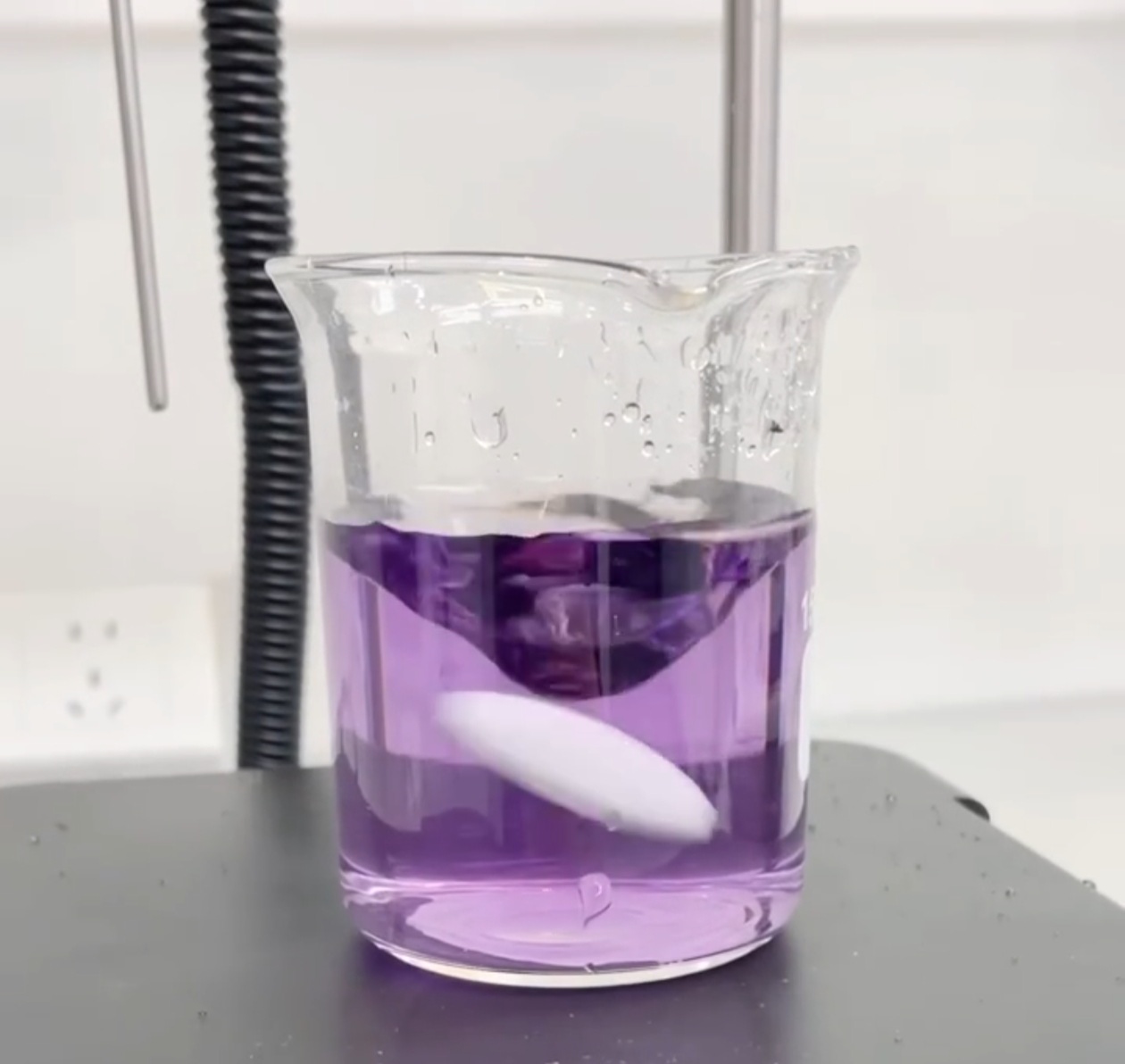
If a stir bar starts bouncing, rattling, or suddenly loses lock, the problem is not always the stir plate itself. In many cases, the real issue is a combination of speed, viscosity, bar choice, centering, and how well the vessel bottom supports stable rotation.
If your stir bar keeps decoupling, check the simple things first: speed, centering, stir bar choice, and whether the liquid has become harder to move. If the same stir bar and stir plate behave badly in one flask but not another, the vessel bottom may be part of the problem.
At the bench, stir bar decoupling usually appears as a practical problem before it becomes a dramatic one. The bar may start ticking against the glass, spinning unevenly, or drifting off-center as soon as the speed increases. Sometimes the setup works at first and then fails later, especially once the liquid thickens or the load on the bar increases.
Most of the time, this is not mysterious. A magnetic stirrer has a limited range in which it can keep the bar stably locked to the rotating magnet below. Once the setup moves beyond that range, the system becomes noisy, unstable, and harder to control.
What stir bar decoupling usually looks like
A stir bar rarely goes from perfect to useless in a single instant. More often, the change is gradual. The bar may begin to chatter, wobble, or trace an uneven path instead of rotating smoothly in place. The vortex may collapse when the speed rises, or the bar may briefly recover and then lose lock again.
These details matter because they often point toward the kind of problem you are dealing with. A setup that fails immediately at higher speed is different from one that becomes unstable only after the solution thickens. A setup that behaves badly in one vessel but not another is different again.
The most common reasons a stir bar decouples
It helps to think about magnetic stirring as a balance between what the system can do and what the setup is asking it to do. If that balance becomes unfavorable, the bar becomes unstable.
| What you notice | Likely cause | What to try first |
|---|---|---|
| The bar loses lock as soon as speed increases | The speed was ramped too quickly, or the setup is already close to the limit of stable coupling | Start lower, ramp more gradually, and make sure the vessel is centered |
| The bar chatters, rattles, or spins off-center | Poor contact at the vessel bottom, off-center placement, or a poorly matched stir bar | Re-center the setup, test another stir bar, and compare with a second flask |
| The setup worked at first but fails later in the run | The liquid has become more viscous or otherwise harder to stir | Reduce speed and ask whether magnetic stirring is still the right method |
| One flask behaves badly, but another works normally | The vessel bottom may be less stable or less forgiving for magnetic stirring | Use the better-behaved vessel for stirring and set the problematic one aside for other work |
| The bar struggles in thicker-bottomed or more insulated setups | The magnetic gap is too large for the available coupling strength | Reduce distance where possible and avoid trying to fix the problem with more RPM alone |
Why the flask may be part of the problem
It is easy to blame the stir plate first, but the vessel matters more than people sometimes expect. The stir bar is only as stable as the surface it is trying to follow. If the vessel bottom is slightly convex, the bar may sit on a less stable contact point and wobble more easily. If the bottom is slightly concave, the ends of the bar may drag instead of rotating cleanly.
None of this has to be dramatic to matter. A flask can look fine in ordinary use and still be a poor choice for stable magnetic stirring. This does not mean the flask is always the main problem. It does mean that the vessel should stay on the troubleshooting list, especially when everything else seems reasonable but one particular flask still refuses to stir well.
Bench note: If the same stir bar and stir plate behave differently in two similar flasks, do not ignore that result. In practice, that comparison often tells you more than arguing about whether the stirrer is “strong enough.”
A practical way to test it
Use the same stir plate, the same stir bar, and the same liquid in a second vessel of similar size. Start low, increase the speed gradually, and watch what changes. If one flask behaves normally and the other repeatedly chatters or throws the bar off-center under the same conditions, the vessel is giving you useful information.
Can you inspect the flask bottom directly?
Yes, but it is better treated as a rough bench check than as a formal test. One simple approach is to place the empty flask on a light surface and shine a narrow light source through the neck. In some cases, the shadow pattern makes obvious distortion easier to notice.
That said, it is still better to treat the light check as a clue rather than a verdict. A direct comparison between vessels usually tells you more.
The magnetic gap problem
Magnetic stirring depends on the rotating magnet in the plate staying strongly coupled to the stir bar inside the vessel. The more distance there is between them, the less forgiving the setup becomes. This is one reason some vessels stir more easily than others, and why thicker-bottomed or more insulated setups can become unstable even when the stir bar seems reasonable.
If the setup already feels marginal, adding more speed usually does not solve the real problem. It often makes the instability appear faster.
What to change first
1. Start lower and ramp more slowly
A stir bar that is already near the limit of stable coupling is easy to throw out of sync. If you jump straight to a high setting, the bar may never settle into stable rotation at all.
2. Re-center the vessel
Even a slightly off-center setup can become noisy and unstable much earlier than expected.
3. Reconsider the stir bar
Bigger is not always better. A poorly matched bar may wobble more easily, strike the curved transition near the wall, or lose alignment when speed increases.
4. Ask whether the liquid has changed
If the mixture becomes thicker during the run, the drag on the stir bar rises with it. A setup that worked well at the beginning may no longer be a good fit later on.
5. Swap the vessel before replacing the instrument
If the same plate and stir bar behave differently in another flask, that is worth taking seriously. It is often the quickest way to separate a vessel problem from a stirrer problem.
Simple rule: When a stir bar keeps decoupling, do not assume that more speed is the answer. In many cases, more speed is simply what makes the instability visible.
When it is time to switch to overhead stirring
Sometimes the real issue is not that anything is wrong with the stir plate. The job has simply outgrown magnetic stirring. If the liquid becomes obviously more viscous, if the setup only works at a weak and barely useful stir rate, or if the bar keeps decoupling even after you have corrected the basic variables, it usually makes more sense to stop forcing the system and switch to overhead stirring.
That is not a failure. It is just a better match between the mixing method and the load.
A simple troubleshooting sequence
- Start at low speed.
- Center the vessel carefully.
- Increase the speed gradually instead of jumping to the target RPM.
- If the bar becomes noisy or unstable, stop and test another stir bar or another flask.
- If the mixture has thickened, ask whether magnetic stirring is still the right tool.
- If the system repeatedly loses lock under real working conditions, switch to overhead stirring instead of forcing the plate harder.
Final takeaway
A decoupled stir bar usually means the setup has crossed the limit of stable magnetic coupling. Sometimes the cause is obvious: too much speed, too much viscosity, or a poor match between the stir bar and the vessel. Sometimes the overlooked detail is the flask itself, especially when the bottom does not give the bar the stable contact it needs.
The useful question is not only whether the stir plate is strong enough, but which part of the whole setup is making stable stirring harder than it should be.
FAQ
Why does my stir bar keep decoupling?
Usually because the setup is asking too much from the magnetic coupling. Common causes include too much speed, poor centering, a poorly matched stir bar, increasing viscosity, or a vessel bottom that is less stable than it looks.
Why does a stir bar bounce or rattle instead of spinning smoothly?
That usually means the bar is no longer staying in stable sync with the rotating magnet below. It may be close to the practical limit for the setup, or the vessel may not be helping the bar stay centered and stable.
Can flask shape affect magnetic stirring?
Yes. A vessel that looks acceptable in ordinary use may still be less forgiving on a stir plate if the bottom shape makes the bar wobble, drag, or lose alignment more easily.
Why does stirring fail when the solution gets thicker?
Because thicker liquids create more drag. A setup that works well at low viscosity may become unstable once the load on the stir bar increases.
When should I switch to overhead stirring?
When the liquid becomes too viscous, the bar keeps decoupling under realistic working conditions, or the only stable setting left is too weak to be useful.