A surprising number of lab mistakes begin with the wrong container. Something may hold a liquid perfectly well for a few minutes, yet still be a poor choice for storage, sample protection, or later analysis.
That is why bottles, flasks, vials, and tubes should not be treated as interchangeable. They may all hold material, but they do not all serve the same purpose.
This page breaks storage and sample handling into clearer practical categories, so you can judge which type of container makes sense for the task in front of you—and where common mix-ups begin.
How to Think About This Topic
Before comparing individual bottles, flasks, vials, and tubes, it helps to step back and ask what job the container is actually doing. In the lab, a vessel may be used for storage, temporary holding, sample collection, transfer, or protection under specific conditions. Two containers may both hold the same liquid, but that does not make them equally suitable for the same task.
A good first distinction is whether the container is meant for long-term storage or short-term working use. A reagent bottle, a sample vial, and a cryovial are all designed with storage in mind. A beaker, an Erlenmeyer flask, or a round-bottom flask may hold material during a procedure, but that does not automatically make it the best choice for keeping that material afterward.
The next question is whether the sample needs protection. Some materials are mainly limited by convenience and volume, while others are sensitive to light, air, moisture, pressure, or temperature. In those cases, the container body is only part of the decision. The closure, liner, septum, stopper, or joint may matter just as much as the vessel itself.
It also helps to distinguish between a storage container, a working container, and a receiving container. A storage container is chosen to keep a material stable and identifiable over time. A working container is chosen because it is convenient during handling or reaction. A receiving container is chosen because it fits a collection step, fraction, aliquot, or transfer. Confusing these roles is one of the most common reasons people choose the wrong vessel.
As you read this section, keep four questions in mind:
- Is this container for storage, temporary holding, or receiving?
- Does the material need protection from light, air, moisture, pressure, or low temperature?
- Does the closure matter as much as the vessel body?
- Is this container suitable for the job itself, or merely able to hold the material for a moment?
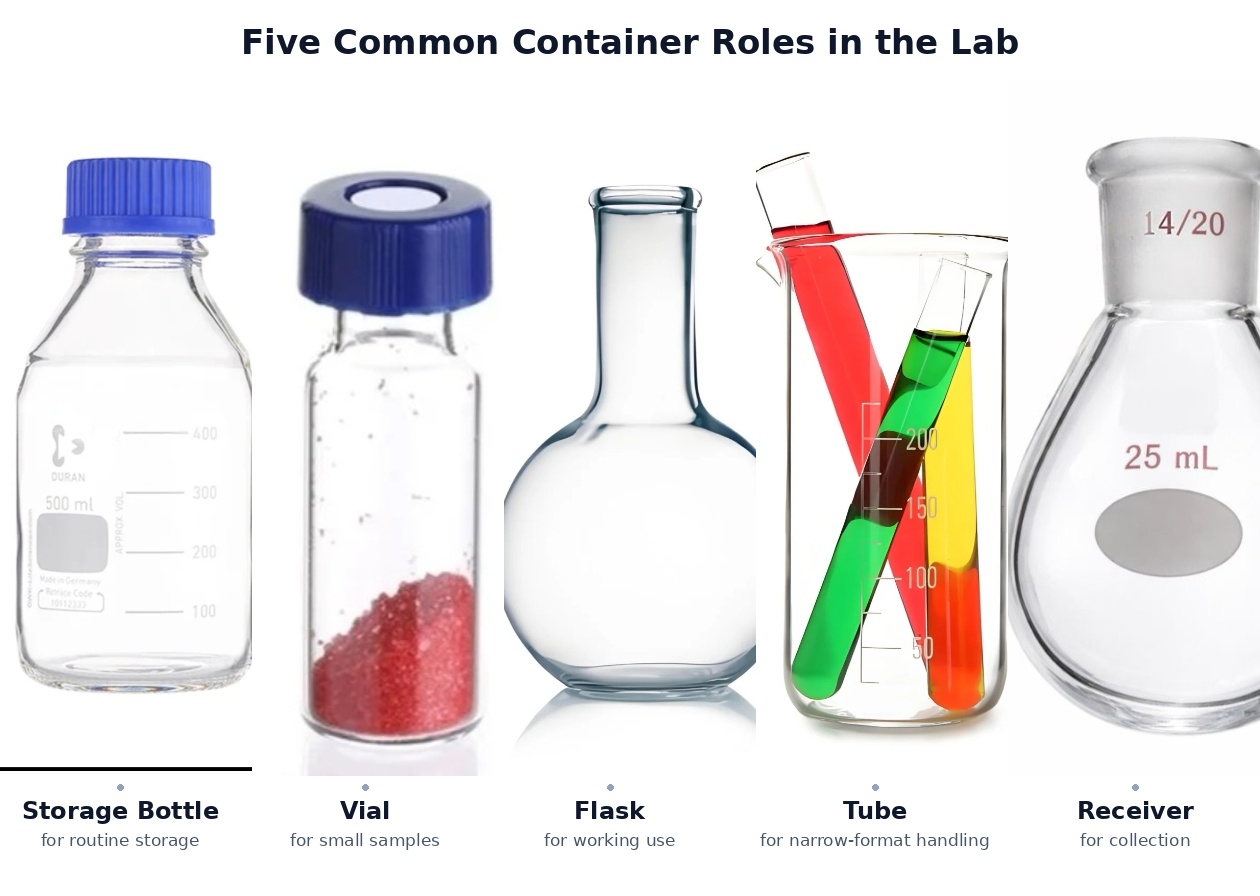
Before comparing individual vessels in detail, it helps to distinguish the five most common container roles in the lab.
| Container Type | Main Question It Answers | Typical Use | Common Mistake |
|---|---|---|---|
| Storage Bottle | Where should this material stay? | Reagent and sample storage | Using a working flask as a storage bottle |
| Vial | How should I keep a small sample? | Aliquots, retained samples, instrument submission | Using an undersized or poorly sealed vial for sensitive material |
| Flask | What should I use during the procedure itself? | Reaction, mixing, heating, short-term holding | Treating a reaction flask as a default storage vessel |
| Tube | How should I handle a small amount in a narrow format? | Microscale work, centrifugation, analysis | Confusing an analysis tube with a storage container |
| Receiver | What should collect material at the end of a step? | Distillation receiving, fraction collection, sample collection | Leaving collected material in the receiver instead of transferring it |
Primary Storage Bottles and Containers
Primary storage bottles and containers are the vessels most often used to keep reagents, solvents, retained samples, and routine laboratory materials in a stable and identifiable form. Their differences are not only about shape. In practice, they are distinguished by access, closure, light protection, material compatibility, and the kind of use they support over time.
Reagent Bottles
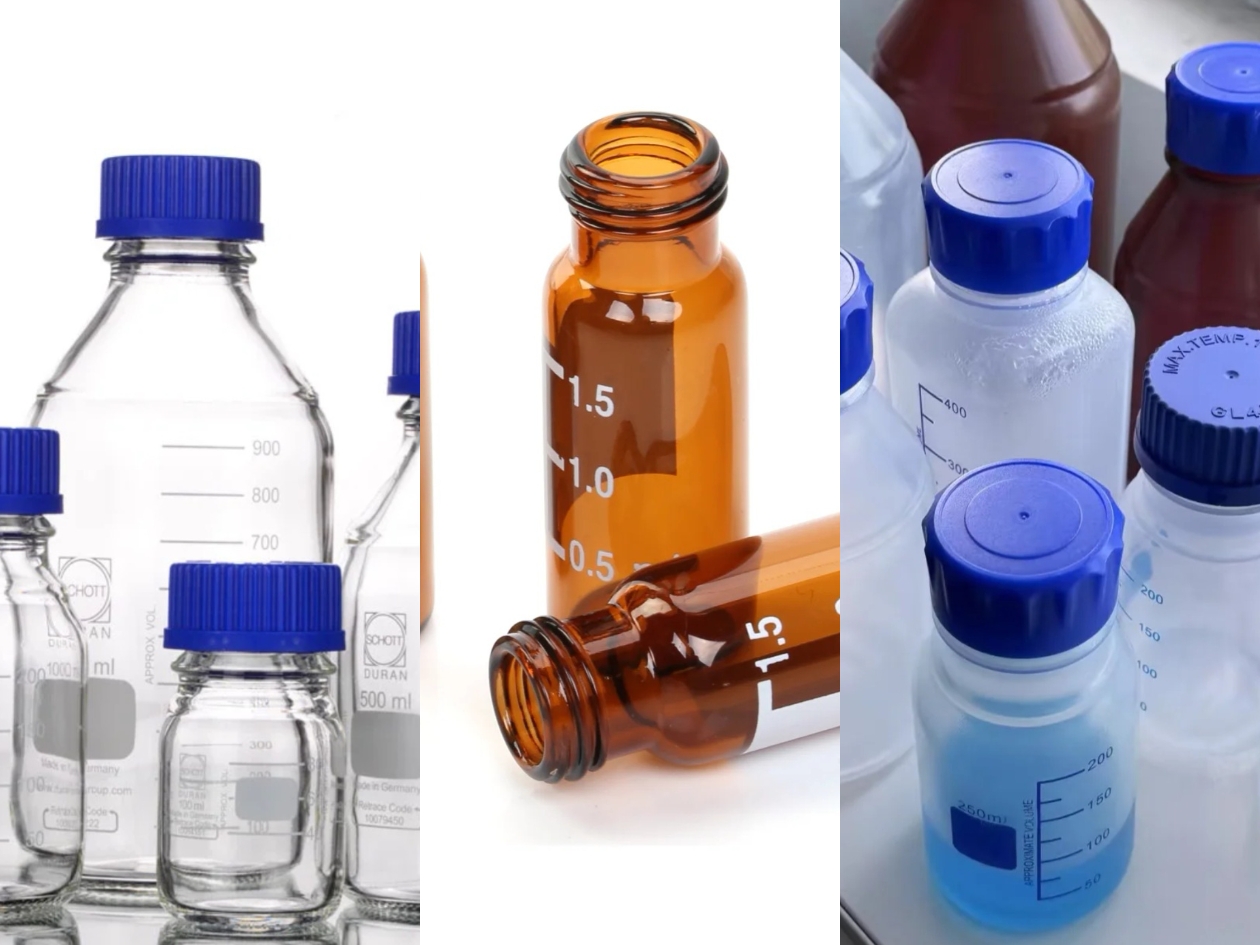
Reagent bottles are among the most common storage containers in the organic lab, but they are not all meant for the same kind of material or the same style of use. The most useful differences are usually practical ones: whether the bottle is easier to open for solids, easier to pour from, better for light-sensitive materials, or better suited to routine sealed storage.
When comparing reagent bottles, ask three questions first:
- Is the material mainly a solid or a liquid?
- Does it need protection from light?
- Does the bottle need to support frequent access, pouring, or safer routine handling?
-
Wide-Mouth Reagent Bottles — Best for solids, powders, and materials that need easier access. Their wider opening makes loading and retrieval easier, but they are not automatically the best choice for volatile liquids.
-
Narrow-Mouth Reagent Bottles — Better suited to routine liquid storage and controlled pouring. They are often more convenient for liquids than wide-mouth bottles, but less convenient for repeated solid access.
-
Amber Reagent Bottles — Used when light protection matters. They reduce light exposure, but they do not replace the need for a suitable closure or compatible bottle material.
-
Dropper Bottles — Useful for dispensing small amounts of liquid reagent. They are convenient for repeated small-volume use, but they are not a universal storage solution for all sensitive materials.
-
Screw-Cap Storage Bottles — Common for general sealed storage when a threaded closure is preferred. Their usefulness depends not only on the bottle body, but also on the cap and liner.
-
Media / Solvent Storage Bottles — Often used for routine solvent holding and general laboratory storage. Their format may be convenient for handling and pouring, but they still need to be matched to the chemical and the closure.
-
Plastic-Coated Safety Bottles — Used where additional breakage protection is desirable. The coating improves handling safety, but it does not change the chemical compatibility limits of the bottle itself.
For detailed differences in closures, compatibility, and use boundaries, see the related pages
Sample Vials and Small Storage Containers
Sample vials and other small storage containers are used when the material volume is limited, when aliquots need to be separated, or when a sample must be retained for transport, later analysis, or comparison. In practice, their differences are shaped less by size alone than by closure type, sample sensitivity, intended handling, and whether the vial is meant for routine storage, instrument submission, or controlled sampling.
When comparing small sample containers, ask three questions first:
- Is the sample only being kept, or will it also be injected, transferred, or repeatedly reopened?
- Does the sample need a simple cap, a crimped seal, or a septum-compatible closure?
- Is the container meant for routine storage, analytical submission, low-temperature holding, or microscale handling?
-
Sample Vials — General small-volume containers for retained samples, short-term storage, and routine handling. Their usefulness depends strongly on the closure style and the sensitivity of the material.
-
Screw-Cap Vials — Common for routine sample storage because they are easy to open, reseal, and label. Their performance depends not only on the vial body, but also on the cap and liner combination.
-
Crimp-Top Vials — Used when a more secure closure is needed, especially for analytical work or samples that benefit from a tighter seal. They are less convenient when frequent reopening is required.
-
Snap-Cap Vials — Convenient for quick closure in routine analytical or short-term handling settings. They are useful for speed and simplicity, but not always the best choice for more demanding storage conditions.
-
Septum Vials — Useful when a sample must be accessed by syringe without fully opening the container. They are especially relevant when repeated sampling or partial atmospheric protection matters.
-
Autosampler Vials — Designed for instrument submission and automated analytical workflows. They may resemble ordinary small vials, but their dimensions and closure requirements are tied to instrument use.
-
Conical-Bottom Vials — Useful when small sample recovery matters and material should collect into a narrow lower point. They are especially practical for high-value or low-volume samples.
-
Cryovials — Used when samples must be held under low-temperature conditions. Their format is tied to cold storage needs, not simply to small-volume convenience.
-
NMR Tubes — Narrow analytical sample containers designed for spectroscopic submission. They are handling and analysis vessels first, not general-purpose storage tubes.
-
Storage Tubes — Used for small retained materials when a tube format is more practical than a vial. Their suitability depends on whether the closure and geometry match the intended use.
-
Small Graduated Sample Tubes — Useful when a narrow-format sample must also be observed or handled with approximate volume markings. They are practical in some microscale settings, but they should not be confused with precision measuring ware.
For more specific differences in closure type, sample sensitivity, and analytical handling, see the related pages below.
Plastic Storage Containers
Plastic storage containers are widely used for routine sample handling, temporary storage, transport, and situations where impact resistance or reduced breakage risk matters. Their usefulness, however, depends heavily on chemical compatibility, temperature limits, permeability, and closure design. A plastic bottle may be practical for one material and a poor choice for another, even when the size and shape look similar.
When comparing plastic storage containers, ask three questions first:
- Is the material chemically compatible with the plastic body and the cap liner?
- Is breakage resistance more important than optical clarity or heat tolerance?
- Is the container being used for storage, transport, or short-term sample handling?
-
HDPE Sample Bottles — Common for general sample storage and transport when toughness and routine chemical resistance are useful. They are practical in many settings, but they should not be treated as universally compatible with all organic materials.
-
PP Sample Bottles — Often used where a lightweight, durable container is needed for routine handling or sample retention. Their suitability still depends on the material being stored and the temperatures involved.
-
PTFE Bottles — Used when broad chemical resistance is especially important. They are valuable in demanding situations, but their role is usually defined by compatibility needs rather than by convenience alone.
-
Centrifuge Tubes as Sample Containers — Frequently used for short-term sample handling, aliquots, and small retained portions when a capped tube format is convenient. They are useful as handling containers, but they should not automatically be treated as long-term storage vessels for every sample.
Temporary Holding and Working Containers
Not every vessel in the lab is chosen for storage. Many containers are selected because they are practical during active work: mixing, heating, dissolving, transferring, observing, or holding material for a short part of a procedure. These vessels often appear in everyday laboratory use, but their convenience during a task should not be confused with suitability for longer-term storage.
Open Working Containers
Open working containers are especially common when the material needs to be accessed easily, mixed, observed, or handled without a fully sealed closure. Their value is usually defined by convenience during use rather than by storage performance. In practice, they are most useful when the material is still being worked on, not when it needs to be protected, retained, or kept stable over time.
When comparing open working containers, ask three questions first:
- Does the task require easy access, stirring, pouring, or visual observation?
- Is the material only being held briefly during a procedure?
- Would the sample be better protected if transferred later into a more suitable storage container?
-
Beakers — Among the most familiar working containers in the lab, beakers are useful for mixing, dissolving, heating, and short-term holding when easy access matters. Their open form makes them convenient during a procedure, but not ideal when a sample needs protection or longer storage.
-
Erlenmeyer Flasks — Widely used when swirling, mixing, or temporary liquid handling is needed in a narrower profile than a beaker. They are practical for active bench work, but they should not automatically be treated as default storage vessels.
-
Test Tubes — Useful for small-scale handling, observation, and simple bench operations when only a modest amount of material is involved. Their format is convenient for temporary use, but not necessarily for stable storage or controlled sealing.
-
Reaction Tubes — Narrow working vessels used for small reactions, trial procedures, and compact sample handling. They are chosen for scale and convenience during use, not because they replace more deliberate storage containers.
-
Crystallizing Dishes — Best understood as open handling vessels for evaporation, crystallization, and shallow material holding. Their geometry supports observation and surface exposure, which also means they are poorly suited to ordinary storage.
Closed or Semi-Closed Working Containers
Closed or semi-closed working containers are used when the material still needs to be handled as part of an active procedure, but greater control is needed than an open vessel can provide. They are common in mixing, heating, receiving, short-term holding, and reaction work where joints, narrower openings, or more controlled transfer conditions are useful. Even so, their role is still defined by process use first, not by routine storage.
When comparing closed or semi-closed working containers, ask three questions first:
- Does the task involve heating, receiving, controlled transfer, or connection to another piece of apparatus?
- Is a narrower opening, jointed neck, or more protected format useful during the procedure?
- Will the material still need to be transferred later into a more appropriate storage container?
-
Round-Bottom Flasks — Central working vessels for reaction, heating, reflux, and distillation setups. They are defined by how they perform during an operation, not by convenience as everyday storage bottles.
-
Pear-Shaped Flasks — Useful when working volumes are relatively small and more compact liquid collection is helpful. Their shape supports certain handling situations well, but they are still best understood as working vessels rather than general storage containers.
-
Flat-Bottom Flasks — Chosen when a flask format is desired but a self-standing base is useful during handling or setup. They may be convenient on the bench, but they do not automatically replace more suitable storage vessels.
-
Reaction Vials — Small-format vessels used for microscale reactions, short handling steps, and compact experimental work. They often bridge the space between tubes and flasks, but their role remains procedural rather than long-term storage-focused.
-
Receiver Flasks — Used to collect material coming from another step, such as distillation or transfer. They are selected because they fit a receiving role, which is not the same thing as being the best vessel for later storage.
Dry Storage and Protected Storage Systems
Some materials are not difficult to store because of their volume or routine handling, but because they must be protected from ambient conditions. Dry storage and protected storage systems are used when moisture uptake, exposure to air, or uncontrolled contact with the bench environment would compromise the sample. In these cases, the container is doing more than simply holding material: it is helping preserve the condition of that material.
This group includes vessels and storage systems chosen for environmental protection rather than ordinary access or convenience. They are most useful when a sample must remain dry, shielded, or physically separated from uncontrolled lab air. Their value depends not only on the vessel itself, but also on whether the protective condition can actually be maintained during use.
When comparing dry or protected storage systems, ask three questions first:
- Is the main concern moisture, air exposure, contamination, or physical protection?
- Does the sample need a container, or does it need a protected storage environment around that container?
- Will the material still be protected once the vessel is opened, transferred, or weighed?
-
Desiccators — Used to keep moisture-sensitive materials in a dry enclosed environment, usually with a drying agent present. A desiccator is not simply another container on the bench; it is a controlled storage space intended to protect what is placed inside it.
-
Vacuum Desiccators — Used when reduced pressure is part of the protection or drying strategy. They extend the logic of ordinary desiccators, but they also introduce sealing and pressure considerations that must be treated as part of the system.
-
Weighing Bottles — Useful when a solid sample must be contained during weighing, transport, or short protected holding. They are especially practical when minimizing exposure during transfer matters as much as the weighing step itself.
-
Weighing Tubes — Narrow protected containers used when a small amount of solid must be handled, transferred, or weighed with reduced exposure. They are chosen for controlled handling rather than for ordinary bench storage.
-
Drying Dishes — Shallow vessels used when material needs to be dried, exposed, or held in a form that supports evaporation or controlled preparation. Their function is procedural and protective in context, not equivalent to closed storage.
Air-Sensitive and Moisture-Sensitive Storage Vessels
Some materials are not difficult to store because they are fragile or hard to handle, but because they degrade as soon as they meet air, moisture, or uncontrolled exposure. In these cases, the storage vessel is part of a broader containment strategy. The container body, the closure, and the way the vessel is accessed all matter together. A vessel that is perfectly acceptable for routine storage may be completely unsuitable once inert handling or protected transfer becomes necessary.
This category includes vessels used when a sample must be stored, transferred, or retained under conditions that limit contact with atmospheric moisture or oxygen. Their differences are not only structural. They also reflect how the sample will be loaded, sealed, reopened, sampled, or moved under controlled conditions.
When comparing air-sensitive storage vessels, ask three questions first:
- Does the sample need simple protection, or must it be handled repeatedly under inert conditions?
- Is the closure meant to be pierced, opened, or operated without exposing the material fully to air?
- Is the vessel being used for storage only, or also for transfer, sampling, or reaction-related handling?
-
Schlenk Flasks — Used when air-sensitive materials must be stored or handled in a vessel that can be connected to vacuum or inert gas. They are defined as much by their stopcock and line compatibility as by the flask body itself.
-
Septum-Sealed Flasks — Useful when a sample or solution must be accessed by syringe while minimizing direct exposure to air. Their practicality depends on how well the septum and flask format fit the intended handling pattern.
-
Storage Flasks with Stopcocks — Chosen when controlled sealing and more deliberate opening matter during storage or transfer. They are not just flasks with closures attached; the closure mechanism is part of their function.
-
Ampoules — Used when a sample must be sealed into a more permanent enclosed format, often after preparation under controlled conditions. They are valuable when the goal is sealed retention rather than repeated access.
-
Young Tubes / Young Flasks — Specialized vessels used when small-scale air-sensitive samples need secure sealing and controlled access. They are especially relevant when both compact scale and inert handling matter.
-
Inert-Atmosphere Sample Vials — Small-format containers intended for samples that must remain protected during storage or transport under inert conditions. Their usefulness depends on closure integrity and how the vial will actually be accessed later.
-
Glovebox-Compatible Sample Containers — Used when storage and handling must fit glovebox workflows rather than ordinary bench access. Their format matters not only for containment, but also for manipulation, transfer, and space efficiency inside controlled environments.
Pressure and Sealed Containers
Some containers are selected not because the sample is unusually difficult to store, but because the working conditions are more demanding than ordinary bench handling. Sealed and pressure-capable vessels are used when a material must be enclosed more deliberately, or when the procedure involves elevated temperature, confined volume, or conditions that go beyond routine open or loosely closed storage. In this category, the key distinction is not simply whether a vessel can be closed, but whether it is actually suited to the conditions involved.
These vessels are relevant when a sample or reaction mixture must be enclosed in a format that provides more control than an ordinary capped bottle or working flask. Some are meant for sealed retention, while others are designed to tolerate more demanding reaction conditions. That difference matters. A container that happens to close tightly is not automatically a pressure vessel, and a sealed vessel is not automatically appropriate for heat, pressure, or repeated reuse under demanding conditions.
When comparing sealed or pressure-capable containers, ask three questions first:
- Is the goal simple enclosure, or actual use under elevated temperature or pressure?
- Does the vessel need to be opened again, or is it intended for sealed retention?
- Is the container designed for these conditions, or merely capable of holding the material temporarily?
-
Sealed Tubes — Used when a material must be enclosed in a compact tube format for sealed handling or reaction. Their main value lies in controlled enclosure, not in serving as ordinary sample containers on the bench.
-
Heavy-Wall Pressure Bottles — Chosen when reaction or storage conditions demand a more robust vessel than routine glassware can provide. They should be understood in terms of wall strength, intended use, and condition limits rather than simple appearance.
-
Thick-Wall Reaction Vessels — Used when the procedure itself calls for a vessel built around more demanding sealed conditions. They are best understood as specialized process vessels, not as a stronger version of ordinary storage glassware.
Collection and Receiving Containers
Some containers are chosen not because they are the best place to keep a material indefinitely, but because they are the right place to collect it at the end of a step. Receiving and collection containers are common in distillation, fraction collection, aliquot handling, and sample transfer. Their main job is to capture material cleanly and conveniently at the moment it is produced, separated, or withdrawn.
What makes this group distinct is role rather than shape alone. A receiving vessel is selected because it fits a collection event, a transfer step, or a separated portion of material. Sometimes that same vessel may also serve for short-term holding, but just as often the material should be moved afterward into a more suitable storage container.
When comparing collection and receiving containers, ask three questions first:
- Is the container meant to collect, to hold briefly, or to become the final storage vessel?
- Does the collected material need immediate transfer into a better-protected format?
- Does the shape or opening help the collection step itself more than it helps later storage?
-
Receiver Flasks — Used to collect material directly from another apparatus step, especially in distillation or connected transfer work. They are chosen because they match the receiving task, not because they are always the best final storage vessel.
-
Fraction Collection Tubes — Used when separated portions must be collected in sequence and kept distinct. Their format supports orderly collection, but longer-term storage may call for transfer into a different container.
-
Fraction Collection Bottles — Useful when collected portions are large enough that a bottle format is more practical than a tube. They are defined by collection workflow first and storage convenience second.
-
Collection Vials — Small receiving containers used when only a limited amount of material is being captured. They are especially convenient for sample portions, small fractions, and analytical handoff.
-
Aliquot Tubes — Used when a larger sample must be divided into smaller retained portions for comparison, transport, or later use. Their role is shaped by subdivision and handling rather than by bulk storage.
-
Short-Term Sample Holding Containers — Used when a sample only needs to be retained briefly before the next decision, transfer, or analysis step. They are best understood as interim containers rather than default storage solutions.
Closures, Interfaces, and Protective Components
A container is never defined by its body alone. In practice, storage performance depends just as much on how the vessel is closed, sealed, or connected. A good bottle with the wrong cap liner can still be a poor storage choice. A suitable vial with the wrong septum may fail during sampling. For that reason, closures and interfaces are not minor accessories. They are part of the container system itself.
This group matters whenever the question is not only what should hold the material, but how that material should be protected, accessed, or connected during use. Some closures are chosen for routine sealing, some for repeated opening, some for syringe access, and some for compatibility with ground-glass systems. The right closure is therefore tied to the task, not just to the vessel size.
When comparing closures and interfaces, ask three questions first:
- Does the material need routine closure, tighter sealing, or controlled access during handling?
- Is the vessel opened directly, pierced by syringe, or connected through a jointed system?
- Is compatibility determined by the vessel body only, or also by the stopper, cap, liner, or septum?
-
Ground-Glass Stoppers — Used when a vessel closes through a matched glass surface rather than a threaded cap. They are common in traditional glass storage systems, but their usefulness depends on fit, cleanliness, and the actual storage conditions involved.
-
Ground-Glass Joint Closures — Relevant when a vessel is part of a jointed apparatus system rather than an isolated bottle-and-cap format. Their function is tied to apparatus compatibility as much as to closure itself.
-
Screw-Thread Closures — Used when the seal depends on a threaded neck and matching cap. They are especially common in modern storage bottles and vials, but their performance depends heavily on cap design and liner material.
-
Screw Caps — Common closure components for bottles, vials, and small sample containers. They may look simple, but their suitability depends on how often they are opened, how well they reseal, and what material sits beneath the cap.
-
PTFE-Lined Caps — Used when liner compatibility matters as much as the bottle body. They are especially important in situations where chemical resistance, reduced interaction, or improved sealing at the cap interface is needed.
-
Septa — Used when a vessel must be accessed by syringe without fully removing the closure. Their role becomes especially important in sample handling patterns that require repeated puncture or partial atmospheric protection.
-
Silicone / PTFE Septa — Composite septa used when puncturability and chemical resistance both matter. They are not interchangeable with every ordinary septum, because the layer facing the sample can change the practical performance of the closure.
-
Rubber Stoppers — Used for temporary closure, fitted sealing, or connection through bored openings. Their usefulness depends on the task, but they should not be assumed to behave like chemically inert long-term storage closures.
-
Parafilm as a Temporary Sealing Aid — Useful as a temporary external sealing aid when additional short-term protection is helpful. It is not a substitute for a properly chosen closure, and it should not be mistaken for true long-term sealing.
Materials and Compatibility
A container may look appropriate in size, shape, and closure style, yet still be the wrong choice if the material itself is unsuitable. In practice, compatibility is not a secondary detail. It is often the deciding factor. Glass, PTFE, HDPE, PP, and metal components do not behave the same way when exposed to solvents, reactive materials, low temperatures, or repeated storage conditions. A container is only as reliable as the materials that come into contact with the sample.
This section is not about materials in the abstract. It is about how material choice affects actual storage and sample handling decisions. In many cases, the container body is only part of the story. The liner, septum, stopper, cap insert, or threaded closure may introduce a second compatibility question even when the main vessel seems acceptable.
When thinking about compatibility, ask three questions first:
- Is the main concern chemical attack, permeability, temperature limits, or surface interaction with the sample?
- Does compatibility depend only on the vessel body, or also on the liner, septum, or closure material?
- Is the container being used briefly during handling, or for more extended storage where small compatibility problems become more important?
-
Borosilicate Glass — One of the most widely used materials for laboratory containers because it combines broad utility with good visibility and common apparatus compatibility. Even so, it should be judged by actual chemical conditions rather than treated as universally suitable for every sample.
-
PTFE — Used when chemical resistance is a defining requirement rather than a convenience. It often appears in bottles, liners, stopcocks, and contact surfaces where broad compatibility matters more than transparency or ordinary handling feel.
-
HDPE — Common in practical sample storage because it is durable, lightweight, and resistant to breakage. Its usefulness depends on the actual material being stored, especially in organic work where not every solvent or sample behaves benignly toward plastic.
-
PP — Often used where a practical, lightweight plastic format is needed for sample handling and routine storage. Like HDPE, it should be judged by the working conditions and chemical contact involved rather than by convenience alone.
-
Stainless Steel in Sample Handling — Relevant when sample handling involves metal contact surfaces, pressure-rated components, or more durable fittings than glass or plastic can provide. Its suitability depends not only on mechanical strength, but also on how the sample behaves toward the alloy and the specific use conditions.
-
When Material Choice Matters Most — A comparison-oriented guide to situations where compatibility is the first question rather than an afterthought, including aggressive solvents, sensitive samples, long contact times, and closure-related interactions.
How to Choose the Right Container
Choosing the right container is rarely about shape alone. In practice, the better choice usually depends on the job, the sensitivity of the material, the closure, and the conditions the container must tolerate. A vessel that works well in one situation may be a poor fit in another, even when it appears similar in size or format.
The fastest way to make sense of the options is to begin with the task itself. Start by asking what the material needs from the container: long-term stability, short-term convenience, protection from light or air, tolerance of pressure or low temperature, or a format that makes collection and later transfer easier.
| Task | Start by Considering | Check This First | Common Mistake |
|---|---|---|---|
| Long-term storage | Reagent bottles, storage bottles, suitable vials | Closure integrity, compatibility, headspace, labeling | Leaving material in a working flask |
| Short-term holding | Beakers, Erlenmeyer flasks, working vials, tubes | Whether the material still needs protection | Treating temporary holding as storage |
| Light-sensitive materials | Amber bottles, protected vials | Whether light protection is actually needed, and whether closure still matches the task | Assuming amber glass solves every stability problem |
| Air- or moisture-sensitive materials | Schlenk flasks, septum-sealed vessels, inert-atmosphere vials | How the sample will be accessed later | Choosing an ordinary capped bottle for an air-sensitive sample |
| Pressure or sealed reactions | Sealed tubes, heavy-wall pressure bottles, thick-wall vessels | Whether the vessel is actually designed for sealed or pressure use | Confusing “closed” with “pressure-rated” |
| Low-temperature storage | Cryovials, compatible sealed vials, selected storage tubes | Temperature tolerance of both body and closure | Using an ordinary vial without checking low-temperature suitability |
| Small-volume samples | Vials, conical-bottom vials, tubes, NMR tubes | Recovery, closure, and intended later handling | Choosing by size alone |
| Collection and receiving | Receiver flasks, collection vials, aliquot tubes, fraction containers | Whether the material should remain there or be transferred afterward | Treating a receiving vessel as the final storage vessel |
For Long-Term Storage
For long-term storage, the main question is not whether the material fits inside the container, but whether the container can keep that material stable, identifiable, and protected over time. In most cases, a purpose-chosen bottle or vial is a better starting point than a working flask or open bench vessel.
Check this first:
- Does the closure seal reliably for the expected storage period?
- Is the material compatible with both the container body and the closure liner?
- Is the headspace larger than it needs to be?
Common mistake: Leaving material in the same vessel used during the procedure instead of transferring it into a more suitable storage container.
For Short-Term Holding
Short-term holding is about convenience during active work, not about preserving a sample for later. A beaker, Erlenmeyer flask, reaction vial, or tube may be perfectly reasonable during a step of a procedure, even when the same vessel would be a poor choice for routine storage.
Check this first:
- Is the material only being held briefly?
- Will it be exposed to air, moisture, or contamination while in this vessel?
- Is there already a better storage container waiting for the next step?
Common mistake: Treating a vessel that is convenient during handling as though it were also appropriate for later storage.
For Light-Sensitive Materials
Light-sensitive materials call for more than a container that merely closes. Amber bottles and protected vials reduce light exposure, but they do not replace the need for a suitable closure, a compatible material, or good storage practice overall.
Check this first:
- Does the material truly require light protection?
- Is the closure still appropriate for the solvent or sample type?
- Will the sample spend most of its time exposed during use anyway?
Common mistake: Assuming that amber glass alone is enough, even when the main problem is actually air exposure, closure failure, or chemical incompatibility.
For Air- or Moisture-Sensitive Materials
When air or moisture sensitivity matters, the access method is often as important as the vessel itself. A suitable container must not only hold the sample, but also allow it to be sealed, reopened, sampled, or transferred without unnecessary exposure.
Check this first:
- Will the sample need syringe access, inert transfer, or repeated reopening?
- Is the closure part of the protection strategy?
- Is this really a storage vessel, or is it also part of the handling workflow?
Common mistake: Choosing an ordinary capped bottle for a sample that actually requires inert-atmosphere handling.
For Pressure or Sealed Reactions
Not every sealed vessel is a pressure vessel. In this category, the first question is whether the container is actually intended for enclosed reaction conditions, rather than simply being capable of being closed.
Check this first:
- Is the vessel designed for the intended thermal or pressure conditions?
- Is the closure part of a rated system, or merely a way to close the vessel?
- Does the procedure require repeated opening, or sealed retention only?
Common mistake: Assuming that a tightly closed ordinary container is suitable for pressure work.
For Low-Temperature Storage
Low-temperature storage introduces a second layer of judgment: the sample must remain stable, and the container must remain functional. The body, cap, and liner all need to tolerate the storage temperature without creating handling problems later.
Check this first:
- Is the container body intended for the temperature range involved?
- Will the closure still work after cooling?
- Does the sample need space for safe handling after cold storage?
Common mistake: Focusing on sample size alone while ignoring how the container behaves at low temperature.
For Small-Volume Samples
Small-volume work is often less forgiving than large-volume work. Recovery, dead volume, closure quality, and the intended next step matter more when the sample is limited or high-value.
Check this first:
- Is the container too large for the sample volume?
- Will the geometry help or hinder recovery?
- Is the sample being stored, submitted for analysis, or handled repeatedly?
Common mistake: Choosing a container by capacity only, without considering sample recovery or closure suitability.
For Collection and Receiving
A receiving container is chosen because it matches a collection step, not because it is automatically the best place to keep the material afterward. In many workflows, receiving is only the first stage, and transfer to a better storage format should follow.
Check this first:
- Is the vessel meant only to collect material, or also to store it afterward?
- Does the collected material need to be subdivided, labeled, or sealed more carefully?
- Is the container shape helping the collection step more than the later storage step?
Common mistake: Leaving the collected material in the receiver simply because it is already there.
Common Selection Errors
Most container mistakes in the lab do not come from not knowing the name of a vessel. They come from using a familiar container for the wrong job, or from paying attention to the vessel body while ignoring the closure, the material, or the working conditions. These errors are common because many containers can seem “good enough” in the moment. The problem is that short-term convenience and actual suitability are not the same thing.
Using a Working Flask as a Storage Bottle
This is common because the material is already in the flask, and moving it feels unnecessary. But a flask that works well during reaction, heating, or transfer is not automatically a good storage vessel. The neck may be inconvenient, the closure may be temporary, and the format may encourage poor labeling or excessive headspace.
Better habit: Once the working step is over, ask whether the material should remain there or be transferred into a bottle or vial chosen for storage rather than procedure.
Confusing Closure with True Sealing
A vessel may look closed and still fail as a storage system. This mistake is common when people assume that a cap, stopper, or wrapping layer automatically means the sample is protected. In reality, sealing depends on fit, liner material, closure condition, and how the vessel will actually be handled later.
Better habit: Judge the container and the closure together. Ask what is actually making the seal, and whether that seal is suitable for the sample, the solvent, and the storage period involved.
Ignoring Headspace and Volatility
This usually happens when the only selection criterion is “Will it fit?” A container that is much larger than necessary may leave too much headspace, which can matter for volatile samples, air-sensitive materials, or solutions that should not be repeatedly exposed to a large internal atmosphere.
Better habit: Choose a container that fits the actual sample volume and the storage task. Size is not only about capacity; it also affects exposure, handling, and sample stability.
Using the Wrong Plastic for Organic Solvents
Plastic bottles are convenient, light, and resistant to breakage, so it is easy to overgeneralize and treat them as interchangeable. The mistake is assuming that if one plastic container worked for one sample, another plastic container will work for any organic liquid. In reality, compatibility depends on the polymer, the closure, the contact time, and the specific solvent or sample.
Better habit: Check compatibility before using plastic as a default option. In organic work, “plastic” is not a complete answer.
Overlooking Light, Moisture, and Air Sensitivity
This is a classic mistake because the container may seem acceptable during the first few minutes of use. The failure only becomes obvious later, when the sample degrades, darkens, absorbs moisture, or no longer behaves as expected. The error is often not choosing the wrong shape, but failing to match the vessel and closure to the sensitivity of the material.
Better habit: Ask what the sample is sensitive to before deciding what to store it in. Light protection, inert handling, and moisture control are separate questions and should not be treated as interchangeable.
Using Collection Containers as General Storage Vessels
This mistake happens because collection is often the last visible step, so it is tempting to leave the material where it lands. But receiver flasks, fraction tubes, and collection vials are chosen because they suit a receiving step. They are not automatically ideal for later storage, labeling, transport, or sample protection.
Better habit: Treat collection as one stage and storage as a separate decision. Ask whether the material should remain in the receiving vessel or be transferred immediately afterward.
Using Standard Containers for Pressure Work
This is one of the more serious errors because it often begins with a misleadingly simple thought: “It closes, so it should be fine.” A standard bottle or flask may hold the material, but that is not the same as being suitable for sealed or pressure-related conditions. The consequences here are not just poor storage. They can be safety-critical.
Better habit: Separate the idea of “closed” from the idea of “pressure-capable.” Use vessels that are actually intended for the conditions involved.
Using the Wrong Closure Standard for the Task
This is common because closures are easy to treat as secondary details. A threaded cap, a ground-glass stopper, a septum, and a PTFE-lined closure may all “close” a vessel, but they do not all support the same kind of storage or access. The mistake is choosing by familiarity rather than by what the task actually requires.
Better habit: Ask how the vessel will be opened, sampled, resealed, or connected later. The best closure is the one that matches the real handling pattern, not the one that merely fits the opening.
One Final Decision Rule
In practice, the right container is rarely defined by shape alone. A bottle, vial, flask, tube, or receiver becomes the right choice only when it matches the real task, the sensitivity of the material, the closure system, and the conditions the sample must tolerate.
That is why storage and sample handling are easy to oversimplify. Many vessels can hold a material for a moment. Fewer can hold it well. Fewer still can protect it, preserve it, and fit the next step without creating new problems.
A better container choice usually comes from asking a better question first: What does this sample actually need right now—storage, temporary holding, protection, collection, or controlled access? Once that question is clear, the vessel is usually easier to choose well.
Continue Exploring
If you want to go deeper, the pages below expand the equipment logic behind storage, handling, sealing, and related bench decisions.