PPE group hub: Personal Protective Equipment
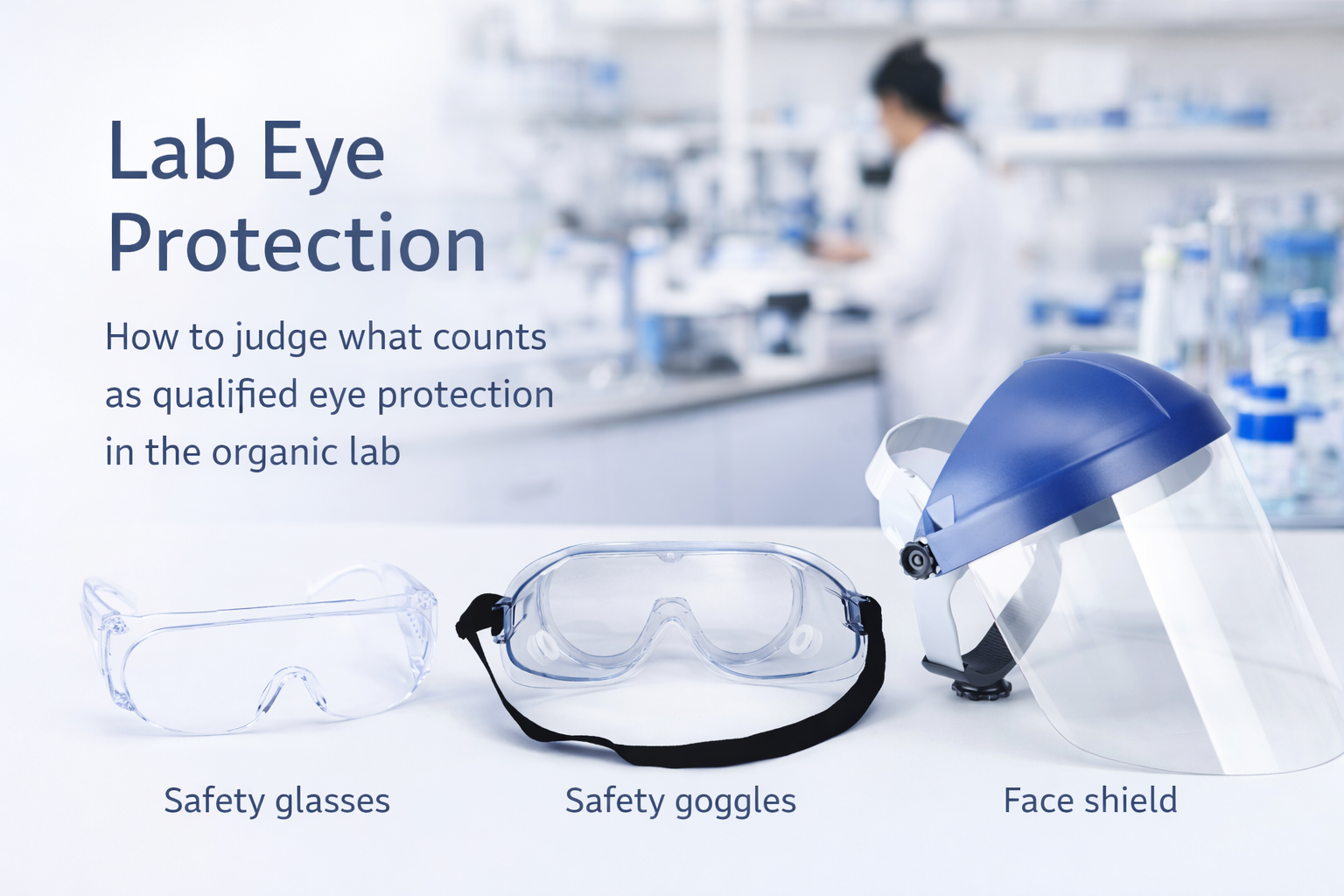
Eye protection in the organic lab is not a single item. It is a judgment problem: when are safety glasses enough, when do you need sealed goggles, and when does a face shield become necessary as an added outer layer?
Fast answer
- This page covers three levels: safety glasses, safety goggles, and face shields.
- Main rule: choose protection by hazard, not by habit.
- Most common beginner miss: treating ordinary glasses or routine-looking work as if they are enough.
- Upgrade idea: once splash, corrosives, dust, side-entry exposure, pressure, or violent failure becomes plausible, basic glasses may no longer be the right ceiling.
- Non-negotiable rule: a face shield adds protection, but it does not replace proper eye protection underneath.
Where this connects in ChemNorth
Eye protection is not only a PPE topic. It also connects to how beginners learn safety judgment, how setup risk rises during real operations, and how TAs help students inspect readiness before work begins.
- Learning Paths: for beginner safety habits and protection judgment — see Safety & Protection
- Troubleshooting: for setup failures and splash-risk situations that often drive eye exposure — see Troubleshooting
- Downloadables: for printable bench checks and TA handouts — see Downloadables
Why eye protection matters at the bench
Eye injuries do not only come from dramatic accidents. They also come from ordinary bench actions done quickly, too close to the face, or without enough thought about where liquid or fragments can actually go.
- transfers and rinses
- unexpected splashes during routine handling
- glass failure during assembly or disassembly
- bumping a setup or knocking a funnel
- leaning into a wet, hot, or pressurized operation
- solids, fragments, or dust released during handling
- nearby mistakes from someone else’s work
What beginners often underestimate
Many eye exposures happen during short, familiar steps that do not feel “dangerous enough” to justify upgrading protection. That is exactly why eye protection has to be chosen before the step starts, not after something splashes.
If you are new to lab work, it helps to learn eye protection as part of a broader safety workflow rather than as an isolated PPE rule. See Safety & Protection for the beginner-training side of this topic.
How to judge whether eye protection is actually qualified
- it provides the right kind of barrier for the actual hazard: impact, splash, dust, or broader face exposure
- it is built from real safety materials, not thin unidentified plastic or ordinary eyewear materials
- it carries a recognizable safety marking rather than only looking industrial
- it fits well enough to stay in place during normal bench movement
- it remains usable enough to keep on: clear visibility, manageable fogging, and no severe distortion
Before trusting any eye protection, ask:
- What hazard am I actually guarding against: front impact, side-entry splash, dust, or violent full-face splash?
- Does this item have the right structure for that hazard, or is it only giving partial front coverage?
- Can I identify a real safety marking on it?
- Is it clear, stable, and in good enough condition to wear for the full task?
- Has the task already moved beyond glasses and into sealed goggles or goggles-plus-face-shield territory?
The main beginner mistake is not forgetting PPE exists. It is treating a partially protective item as if it were fully qualified for the task in front of them.
The three protection levels
Safety glasses
Safety glasses are the baseline layer for routine lab work, but only when they are real safety eyewear. The important distinction is not “glasses versus no glasses.” It is “qualified safety glasses versus ordinary eyewear that only looks somewhat protective.”
Minimum protective performance
- They should protect against front and side impact, not only straight-ahead contact.
- They should reduce direct liquid splash to the front of the eyes during routine work.
- They should remain clear enough that the wearer does not keep lifting or removing them.
Materials and construction
- Lens material: preferably polycarbonate or another certified impact-resistant safety material, not ordinary glass or casual plastic.
- Side protection: real side shields or a built-in side-protective design. Front-only coverage is not enough for lab use.
- Frame stability: the arms should hold the glasses securely enough that they do not slide easily during bending, turning, or quick bench movement.
- Ventilation: the design should help reduce fogging, but not by leaving large open paths for splash to reach the eye.
Marking and certification
- The eyewear should carry a real safety standard marking, not just product branding.
- Examples of recognized markings include ANSI Z87.1 or EN 166.
- If there is no identifiable safety marking, do not treat it as qualified lab eye protection.
Fit, compatibility, and use
- They should fit comfortably over prescription eyewear or be provided as prescription safety glasses.
- The lenses should be clear, low-distortion, and not deeply scratched, yellowed, or damaged.
- They should tolerate ordinary cleaning and disinfection without becoming rapidly unusable.
Best use case
- routine bench work
- low splash probability
- general movement through the lab
- tasks where meaningful side-entry exposure is not yet likely
When safety glasses are not enough
- strong corrosives are being handled
- splash risk becomes meaningful rather than remote
- liquid can reach the eye from the side, below, or during nearby failure
- dust, mist, or irritating droplets can become airborne
- your face is close to a wet, hot, pressurized, or unstable setup
What does not count as qualified safety glasses
- ordinary prescription glasses by themselves
- sunglasses or fashion eyewear
- sports or shop glasses with no identifiable certification
- frames with no real side protection
- deeply scratched, loose, or constantly fogging eyewear that the user cannot keep on properly
When safety glasses are no longer enough
The real upgrade moment comes when the problem changes from “something may come toward my eyes” to “something may enter around the edges.” At that point, basic safety glasses are no longer the right ceiling.
At that point, the issue is no longer just frontal impact. The issue is entry paths and consequence.
Safety goggles
Goggles are the correct upgrade when the problem is no longer just front impact, but entry paths: splash from the side, below, above, or from nearby failure. A qualified chemical-splash goggle should be judged as a sealed protective system, not just as “glasses with more plastic.”
Minimum protective performance
- They should create a meaningful seal around the eyes, reducing entry from the top, bottom, and sides.
- They should resist direct chemical splash, not merely deflect small front droplets.
- They should provide a wide enough and clear enough field of view for real bench work.
- They should remain usable under longer wear without becoming a constant fogging problem.
Materials and construction
- Lens material: preferably polycarbonate, with sufficient thickness and impact resistance for chemical lab use.
- Body and sealing edge: soft, chemical-resistant materials such as silicone or high-quality PVC are appropriate because they help create a wearable seal.
- Seal design: the frame should not leave obvious open gaps. A windshield-style frame without real sealing does not count.
- Strap system: the strap should be adjustable and stable; a split or Y-type strap often helps because it improves retention and spreads pressure more evenly.
Anti-fog and ventilation
- A good splash goggle should use indirect ventilation, anti-fog coating, double-lens design, or another approach that reduces fogging without opening a direct splash path.
- If the design fogs so badly that the wearer keeps lifting the goggle, the protection is failing in practice.
Marking and certification
- The product should have a clear safety marking, not just vague marketing language.
- For chemical splash use, readers should be able to identify standards such as EN 166 or another recognized certification appropriate to splash protection.
Fit, compatibility, and maintenance
- The goggle should be checked on the actual face for leakage points, not judged only by appearance.
- It should be compatible with the user’s other PPE and not be pushed out of place by other required gear.
- The lens and anti-fog surface should be maintained gently; a badly scratched or chemically damaged goggle is no longer a good working choice.
When goggles are the right level
- handling large volumes of strong corrosives
- work with volatile, strongly irritating chemicals
- reactions with real splash potential
- dust-generating grinding or powder handling
- reduced-pressure work or other setups where glass failure raises consequence
What does not count as a real chemical-splash goggle
- open-sided windshield-style goggles
- goggles with no real seal or obvious leakage gaps
- thin, flimsy, uncertified products with unknown lens material
- loose-strap goggles that shift during work
- models that fog so badly the user keeps lifting them
Face shield
A face shield is the outermost layer for the highest-consequence situations. It is not a substitute for goggles or safety glasses. Its job is broader: protect the whole face, and help prevent severe splash or impact from overwhelming the eye protection underneath.
Minimum protective performance
- It should cover from the forehead to below the chin.
- It should extend across the sides of the face, not only the centerline in front of the nose.
- It should resist high-energy splash and impact without cracking, punching through, or collapsing onto the face.
- It should act as a secondary barrier that protects the eye protection inside it from being directly overwhelmed.
Materials and construction
- Shield material: high-transparency, tough materials such as polycarbonate or acetate are appropriate choices for impact and splash resistance.
- Depth and curvature: the shield should curve and project far enough forward to create a real face barrier, not sit like a thin flat sheet close to the nose.
- Stand-off distance: there should be enough space between the face and the shield — often around 2.5 cm or more — to fit glasses or goggles underneath and reduce splash reaching the skin.
- Top and side design: the shield should not leave obvious open paths for liquid to run in easily from above or from the side.
Headgear, marking, and use
- Headgear: the headband or helmet-style support should be adjustable, stable, corrosion-resistant, and easy to clean.
- Certification: the shield should carry a real safety marking, such as a recognized impact or splash standard like ANSI Z87.1 or EN 166.
- Combination rule: a face shield should always be worn over qualified safety glasses or goggles.
- Condition check: a heavily scratched, yellowed, cracked, warped, or loose face shield should be removed from service.
What a face shield does not do
A face shield does not create a sealed eye barrier. It is a shield, not the last line of eye sealing.
The rule should stay explicit: the inner layer protects the eyes directly; the outer shield protects the whole face and reduces overload on the inner layer.
When a face shield becomes appropriate
- whole-face chemical splash is plausible
- the operation could fail violently
- glass breakage or projectile risk is elevated
- highly corrosive chemicals are being handled at larger scale
- reduced-pressure distillation or other high-consequence operations raise rupture concern
What does not count as a qualified face shield
- thin plastic splash visors intended only for dust or casual use
- flat, shallow shields with poor side coverage
- damaged shields with major scratches, cracks, or yellowing
- unstable headgear that cannot hold the shield securely
- any face shield worn by itself, with no real eye protection underneath
Quick comparison
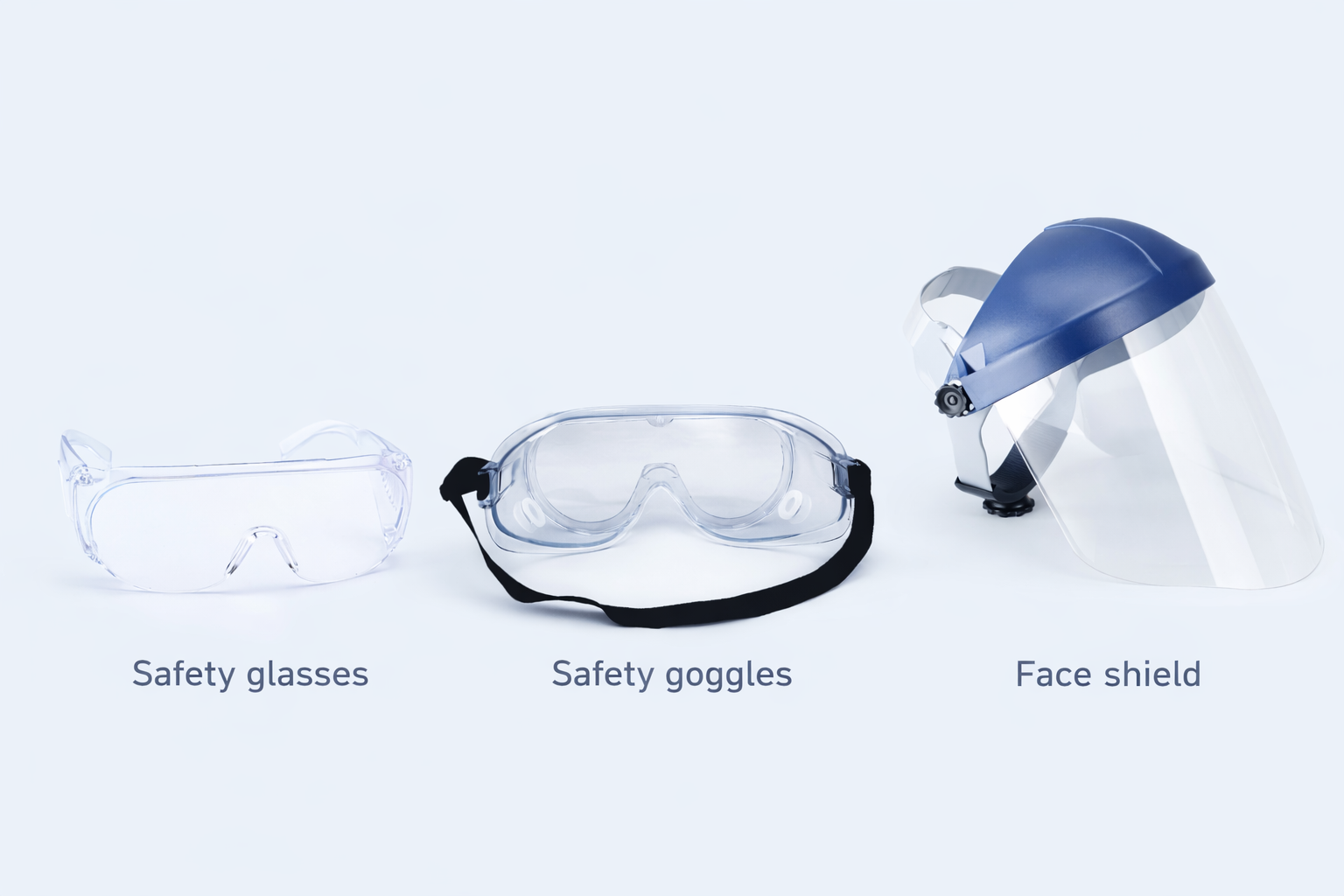
What definitely does not count
These need to be stated plainly because beginners get them wrong all the time:
- ordinary prescription glasses by themselves
- sunglasses
- casual protective-looking eyewear without real side protection
- uncertified eyewear of unknown suitability
- a face shield worn by itself
- fogged, scratched, loose, or damaged eye protection that the user cannot keep on properly
- damaged face shields with major scratches, cracks, yellowing, or unstable headgear
Contact lenses
Local rules vary, but one principle should stay clear:
If your lab prohibits contact lenses, follow that rule fully. Even where they are allowed, eye protection should still be chosen conservatively from the start.
If something gets into the eye
If a chemical reaches the eye, the first priority is not diagnosis. The first priority is flushing.
- Start flushing immediately.
- Hold the eyelids open while rinsing.
- Continue flushing according to local emergency guidance.
- Do not rub the eye.
- Seek prompt medical evaluation.
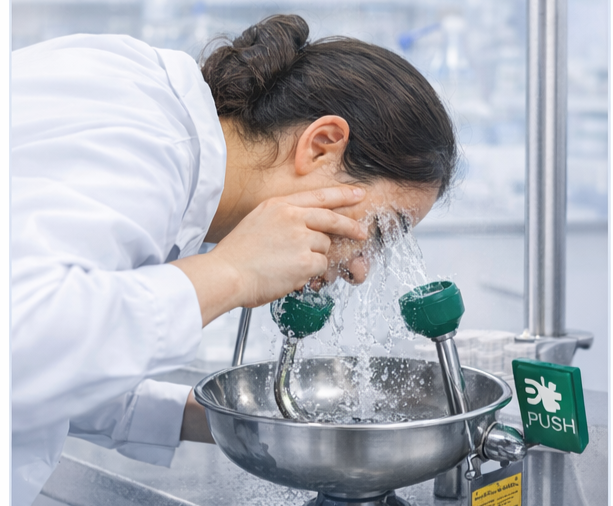
If a lab has an eyewash station, everyone working there should already know where it is before anything goes wrong.
For broader beginner safety readiness, see Safety & Protection and Troubleshooting.
Bench check before you start
Before starting a task, ask:
- What is the likely hazard here: impact, splash, dust, vapor, or violent failure?
- Could material reach the eye from the side, top, or below?
- Am I close enough to the operation that ordinary glasses are no longer enough?
- Does my protection fit well enough that I will keep it on?
- Do I need a sealed goggle?
- Do I need a face shield over that inner layer?
This is the habit worth teaching: do not ask “Do I have something on my face?” Ask “Is this actually enough for this operation?”
If you want a printable version of that judgment step, the right next destination is Downloadables, where this kind of bench-check logic can later become a quick reference or TA handout.
What beginners usually miss
- treating a quick step as if it carries no real splash risk
- assuming ordinary glasses count because they already cover the eyes somewhat
- waiting too long to upgrade from glasses to goggles
- using a face shield as a substitute rather than an added layer
- accepting severe fogging, poor fit, or damaged lenses because the task seems short
Many of these misses show up early, especially when students are copying motions before they understand why the protection level needs to change. For the training side of this problem, see Safety & Protection.
FAQ
Are ordinary glasses enough in a chemistry lab?
Usually no. Ordinary glasses do not provide reliable side protection, do not seal against splash, and should not be treated as qualified lab eye protection by themselves.
When do I need goggles instead of safety glasses?
You should upgrade when corrosives, meaningful splash risk, dust, vapor, or side-entry exposure become plausible. Goggles matter when the problem is not just front impact, but material reaching the eye around the edges.
Can a face shield replace goggles?
No. A face shield is an added outer barrier. It should normally be worn over qualified glasses or goggles, not instead of them.
What makes eye protection qualified in practice?
It has to do the job the hazard requires: provide the right barrier, use real safety materials, carry a recognizable marking, stay in place during work, and remain usable enough that the wearer keeps it on.
Why does fogging matter so much?
Because protection that the user keeps lifting, peering under, or half-removing is not working well in real bench use. Good protection has to remain usable long enough that the wearer actually keeps it in position.