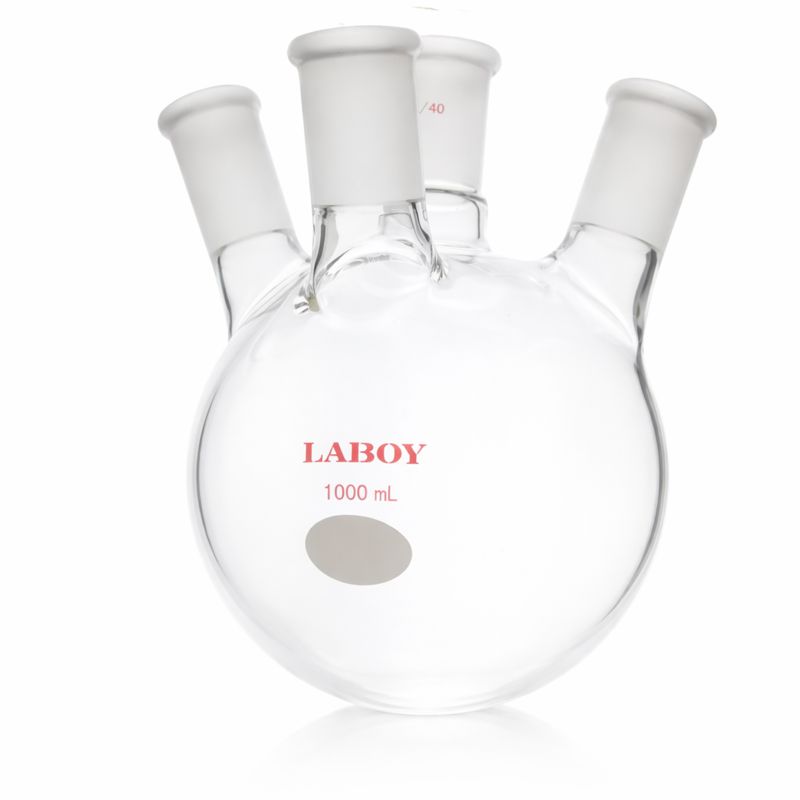
Is Your Reaction Setup Smart Enough?
In an organic synthesis laboratory, assembling a reaction apparatus is not unlike performing delicate surgery. As experiments evolve from simple, single-step reactions into multi-task systems—requiring simultaneous heating, stirring, controlled addition, temperature monitoring, and inert gas protection—one inevitable question arises:
Do I still have enough ports?
I’m ChemNorth, someone who spends a lot of time working with glassware and reaction setups. Today, we’ll set reaction mechanisms aside and talk about something far more practical: the economics of interfaces. When should you rely on a classic three-neck flask, improvise with a Claisen adapter, or step up to a dedicated four-neck flask?
1. The Classic Choice: The Three-Neck Flask — Adequate, but Restrained
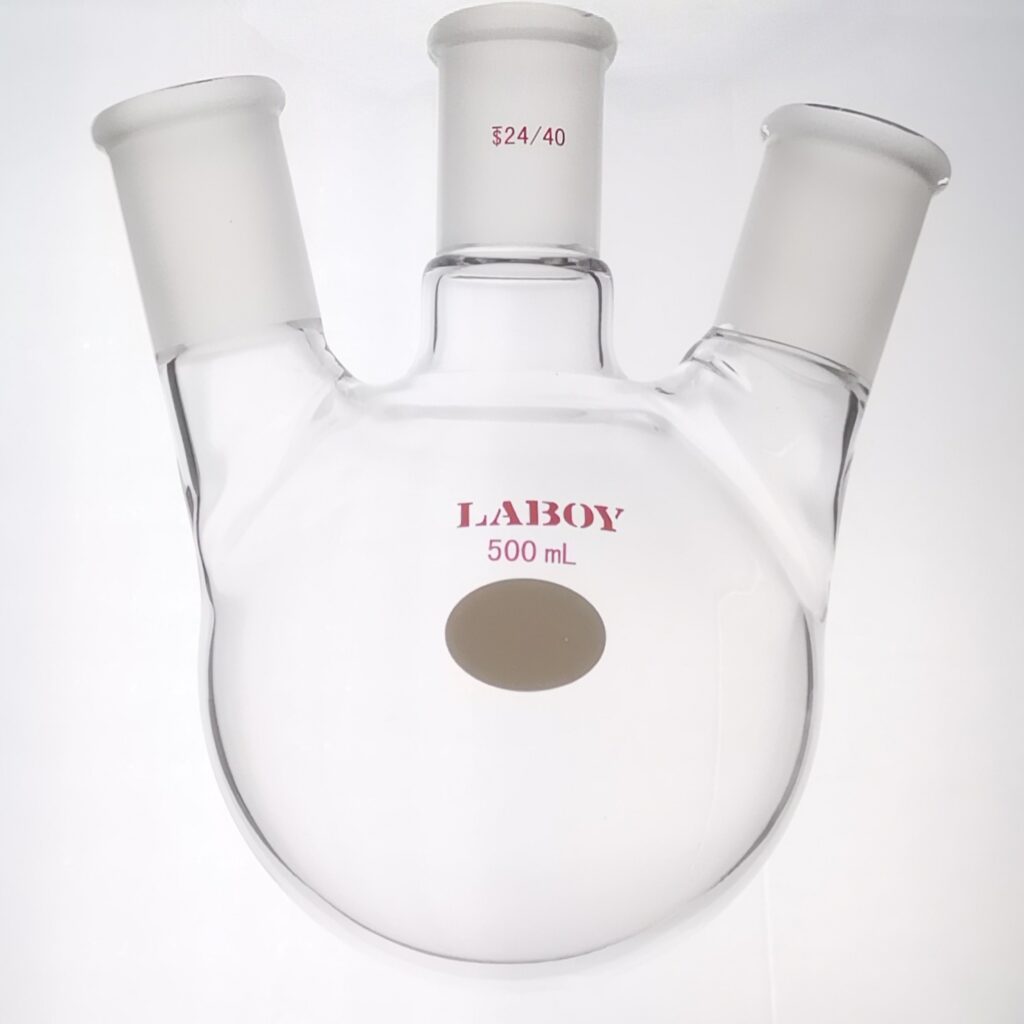
For most teaching laboratories and straightforward reflux reactions, the three-neck round-bottom flask is a dependable workhorse. Its roles are clearly defined:
- Left neck: Condenser for reflux
- Center neck: Mechanical stirrer or thermometer—the heart of the reaction
- Right neck: Addition funnel or stopper
Its limitation lies precisely in its simplicity. When a reaction requires simultaneous reflux, temperature monitoring, slow addition, and inert gas protection, three ports quickly feel insufficient. Any temporary removal of a joint risks introducing air or moisture—often undoing hours of careful preparation in a single moment.
2. Creative Improvisation: Three-Neck Flask + Claisen Adapter
This is where many experienced chemists reach for a familiar rescue tool: the Claisen adapter. By splitting one joint into two, it instantly expands your available interfaces.
Is it clever? Absolutely.
Is it ideal? Not quite.
Advantages
- Flexible and cost-effective
- Quickly solves interface shortages without replacing core glassware
Trade-offs
- Top-heavy assemblies: Stacked adapters raise the center of gravity. Under vigorous stirring, the setup can become unstable—more “bobblehead” than bench-safe.
- Hidden dead volume: Complex internal channels trap condensate, complicate cleaning, and can negatively impact yields for volatile or precious products.
- More joints, more risk: Every additional ground-glass connection increases the chance of leaks—particularly problematic for high-vacuum or air-sensitive work.
Claisen adapters are a smart contingency plan—but rarely the best long-term solution.
3. The Professional Upgrade: Four-Neck Flasks, Designed for Complexity
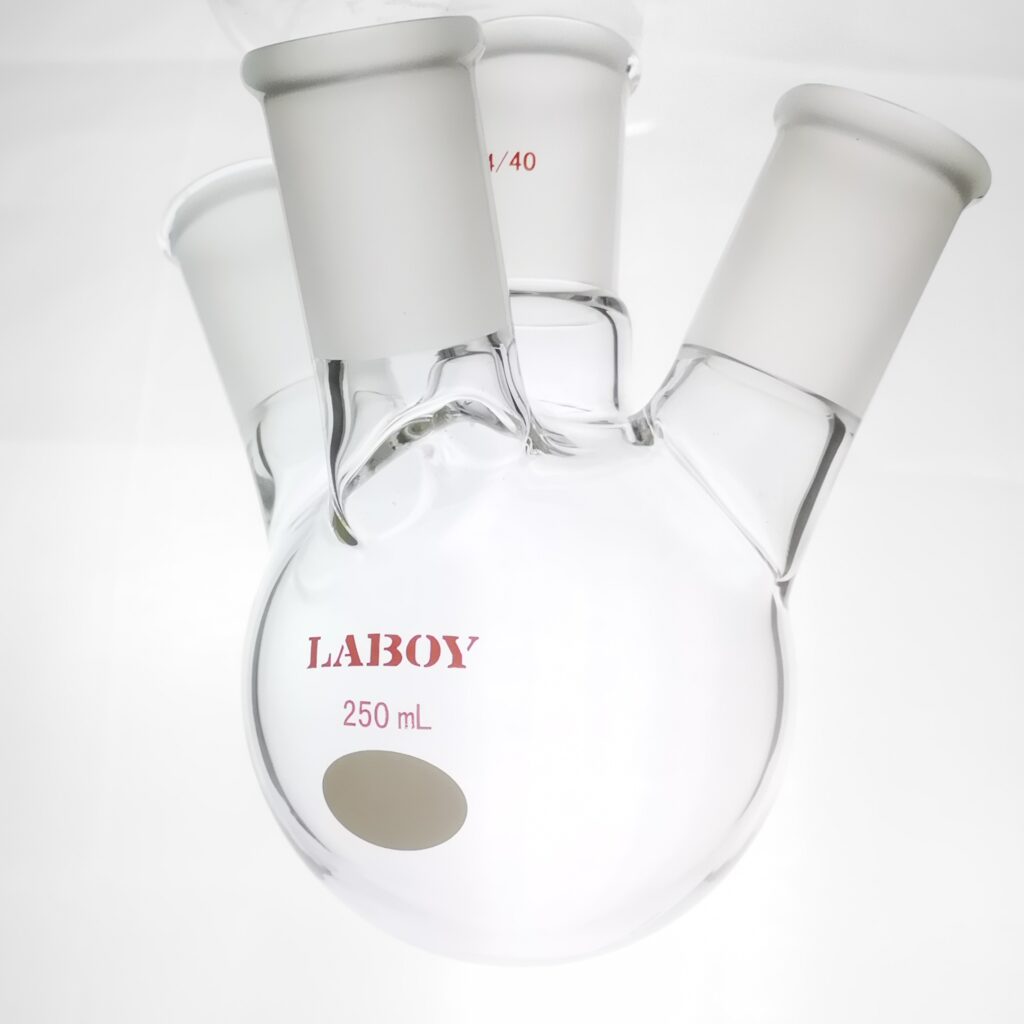
When experimental demands increase, a purpose-built four-neck round-bottom flask doesn’t just add one more port—it fundamentally changes how you work.
Why is it the professional choice?
True Parallel Operation
Each neck can be permanently assigned—reflux, temperature probe, addition funnel, inert gas inlet or pressure control—without ever disassembling the system. The reaction remains sealed, controlled, and undisturbed throughout the entire process.
Design with Intent
Well-designed four-neck flasks (such as those in the Laboy series we trust) feature side necks angled at approximately 20°. This is not cosmetic. The geometry naturally separates condensers, funnels, and probes, preventing crowding and making adjustments intuitive rather than awkward. In contrast, Claisen-stacked assemblies often feel congested and unwieldy.
Stability Through Integration
A one-piece structure lowers the center of gravity and distributes mechanical stress more evenly. Combined with heavy-wall glass construction, four-neck flasks handle extended reflux, thermal cycling, and demanding conditions with greater confidence. This is a level of stability no modular workaround can truly replicate.
Decision Time: One Table, Clear Answers
| Experimental Scenario | Recommended Setup | Core Reasoning |
|---|---|---|
| Teaching labs, simple reflux | Three-neck flask | Simple, economical, and easy to clean—ideal for foundational laboratory work. |
| Occasional multifunction use, strict budget | Three-neck flask + Claisen adapter | A temporary workaround that trades stability and sealing performance for flexibility. |
| Multi-step synthesis, air- or moisture-sensitive reactions, high vacuum | Four-neck flask | ChemNorth’s top recommendation: a stable, integrated platform that lets you focus on chemistry, not glassware improvisation. |
A Final Thought
In the laboratory, good equipment is more than a tool—it is an extension of your thinking. If you find yourself repeatedly running out of ports and building increasingly acrobatic glass assemblies, it may be time to rethink the approach.
Investing in a well-designed four-neck flask is often one of the most cost-effective upgrades a synthetic chemist can make. It shifts your attention back to where it belongs: the chemistry itself, not a balancing act of adapters and clamps.
Let your experiments be about discovery—not about wrestling with glass.
You should upgrade to a four-neck flask for multi-step synthesis, air-sensitive reactions, or when using high vacuum. It offers better stability and allows for dedicated ports for probes and inert gas without needing adapters.
Claisen adapters can make the setup top-heavy and unstable. They also add dead volume which is hard to clean and increase the risk of leaks due to the extra glass joints.
Yes. For teaching labs and simple reflux reactions, a three-neck flask is a dependable and economical choice.