Round-Bottom Flasks
Round-bottom flasks are one of the main working vessels in the organic lab. They are especially useful when a setup needs heating, reflux, distillation, vacuum work, or a reliable way to connect multiple glass parts into one system.
Their round body and standard taper joint are not just a style difference. Those features make the flask better suited to even heating, smoother stirring, safer vacuum use, and cleaner integration into a full apparatus.
Fast answer: If the job involves heat, boiling, distillation, vacuum, or several connected glass parts, a round-bottom flask is usually the right place to start. If the job is mainly temporary holding, quick mixing, or ordinary benchtop handling, a standing vessel may be more convenient.
How to Recognize It
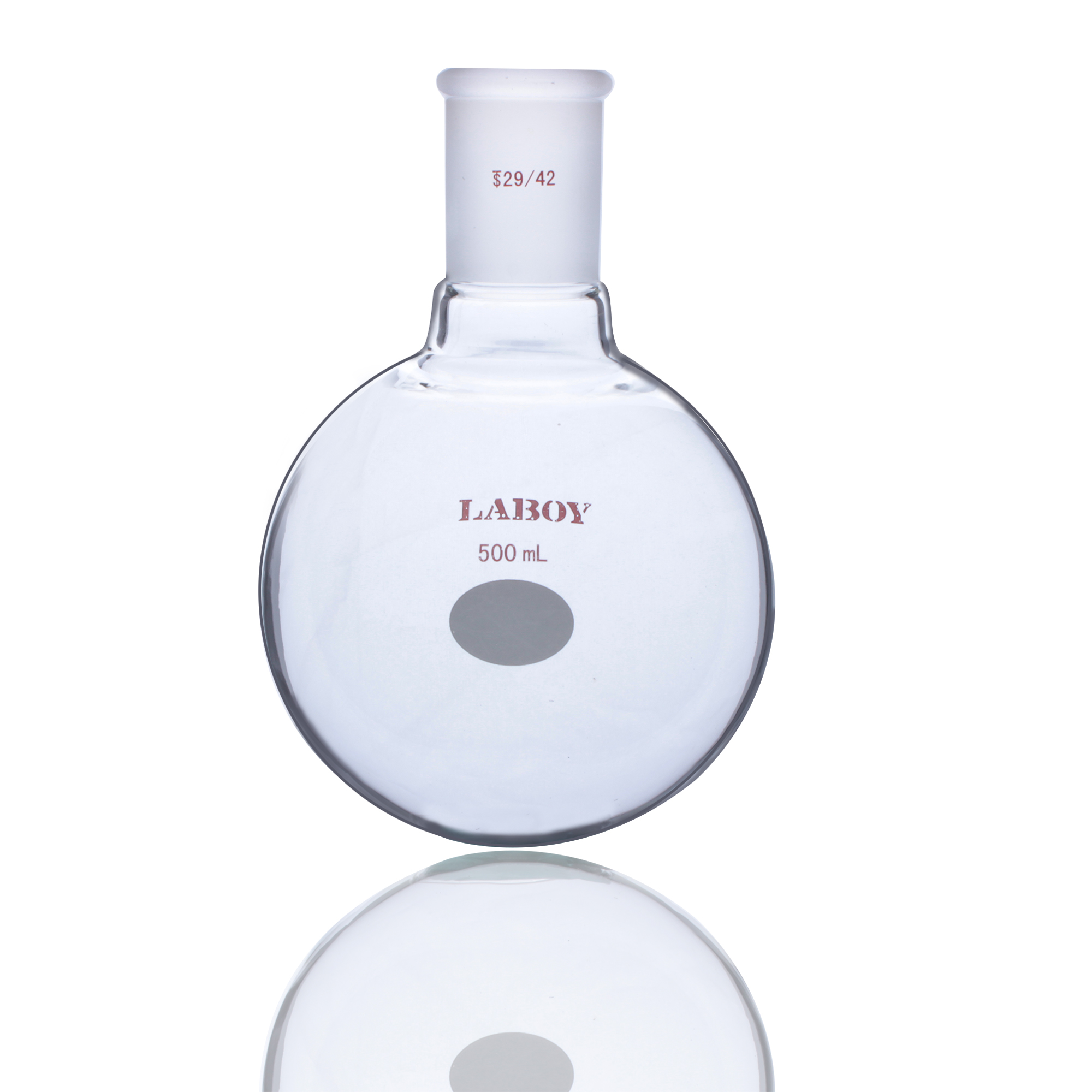
A round-bottom flask is easy to recognize once you know what matters: a spherical or near-spherical body, one or more narrow necks, and usually a standard taper joint at the top.
The more useful clue, though, is not just that the bottom is round. It is that this flask usually does not work as a simple benchtop container. It is usually meant to go into a heated, clamped, connected setup.
What It Does at the Bench
At the bench, a round-bottom flask is usually doing one of these jobs:
- holding a reaction while it is heated
- serving as the main vessel in a reflux setup
- serving as the boiling flask in a distillation setup
- handling vacuum more safely than many common benchtop vessels
- giving you one vessel that can also support addition, temperature measurement, gas flow, or inert-atmosphere work through extra necks
It is so common not because it is simply “the standard flask,” but because it balances several things well at the same time. The round shape heats more evenly, works well with stir bars, and fits naturally into heating mantles, oil baths, water baths, and distillation or reflux assemblies.
Another point beginners often miss is that a round-bottom flask is not just heat-resistant. It is better suited to staying in a working state for a long stretch: boiling, stirring, clamped in place, and connected to other parts without the whole setup feeling improvised.
When You Would Choose It, and When Not
Round-bottom flasks are most useful when the job is not just holding liquid, but building a working setup around that liquid. In practice, that usually means heating, boiling, reflux, distillation, vacuum work, or a reaction that needs multiple connected parts.
Situations where a round-bottom flask is usually the right choice
| Situation | Typical use case | Why a round-bottom flask fits well |
|---|---|---|
| Heating operations | Heating or boiling liquids, reflux, extended heating | The round body handles heat more evenly and tolerates boiling and thermal stress better than many simple benchtop vessels. |
| Distillation work | Atmospheric distillation, vacuum distillation, rotary evaporation | The shape fits naturally into standard distillation systems and handles vacuum stress more safely than vessels not designed for it. |
| Organic synthesis | Reactions that need stirring, temperature control, reflux, or staged addition | Standard joints make it easy to connect condensers, thermometers, addition funnels, gas lines, and other apparatus parts. |
| Long heating or higher-temperature work | Reactions that stay hot for a long time, sometimes under reduced pressure | The flask is better suited to remaining in a heated, stirred, connected working setup over time. |
| As part of a standard apparatus | Rotary evaporation, reflux systems, many distillation setups | The round shape works naturally with heating baths, mantles, and the rest of the apparatus. |
Situations where it may not be the best first choice
- Simple holding, mixing, or temporary storage with no heating: An Erlenmeyer flask or beaker is often easier to handle because it stands on its own.
- Atmospheric distillation receiving: A round-bottom flask can work, but an Erlenmeyer flask is often easier to set down, weigh, and transfer from.
- Very small-scale work where recovery matters a lot: A pear-shaped flask or heart-shaped flask may leave less liquid behind.
- A task that needs a simple benchtop container, not a connected apparatus vessel: Round-bottom flasks are less convenient when the main priority is just standing, pouring, and setting the vessel down easily.
- Vacuum receiving with a vessel that is not vacuum-suitable: In vacuum work, convenience is not the main issue. You need a vessel that can tolerate the stress safely.
Quick decision guide: If the job involves heating, boiling, reflux, distillation, vacuum, or a full glass setup, a round-bottom flask is usually the safer starting point. If the job is mainly temporary holding, quick mixing, or ordinary bench handling, a simpler standing vessel may be better. If the work is very small-scale and recovery matters a lot, a pear-shaped or heart-shaped flask may be worth considering.
Boundaries, Variants, and Similar Tools
Common Round-Bottom Flask Variants
Single-Neck Round-Bottom Flask
The single-neck round-bottom flask is the simplest and most common version. It is a good starting point for understanding what this family of vessels is for: one main working vessel, one joint, one straightforward path into a reflux or distillation setup.
It works well for basic heated reactions, simple reflux, and many standard boiling-flask roles. Its main strength is simplicity. Its main limit is also simplicity: once the setup also needs addition, temperature monitoring, gas flow, or inert-atmosphere handling, one neck starts to feel crowded.
Two-Neck Round-Bottom Flask
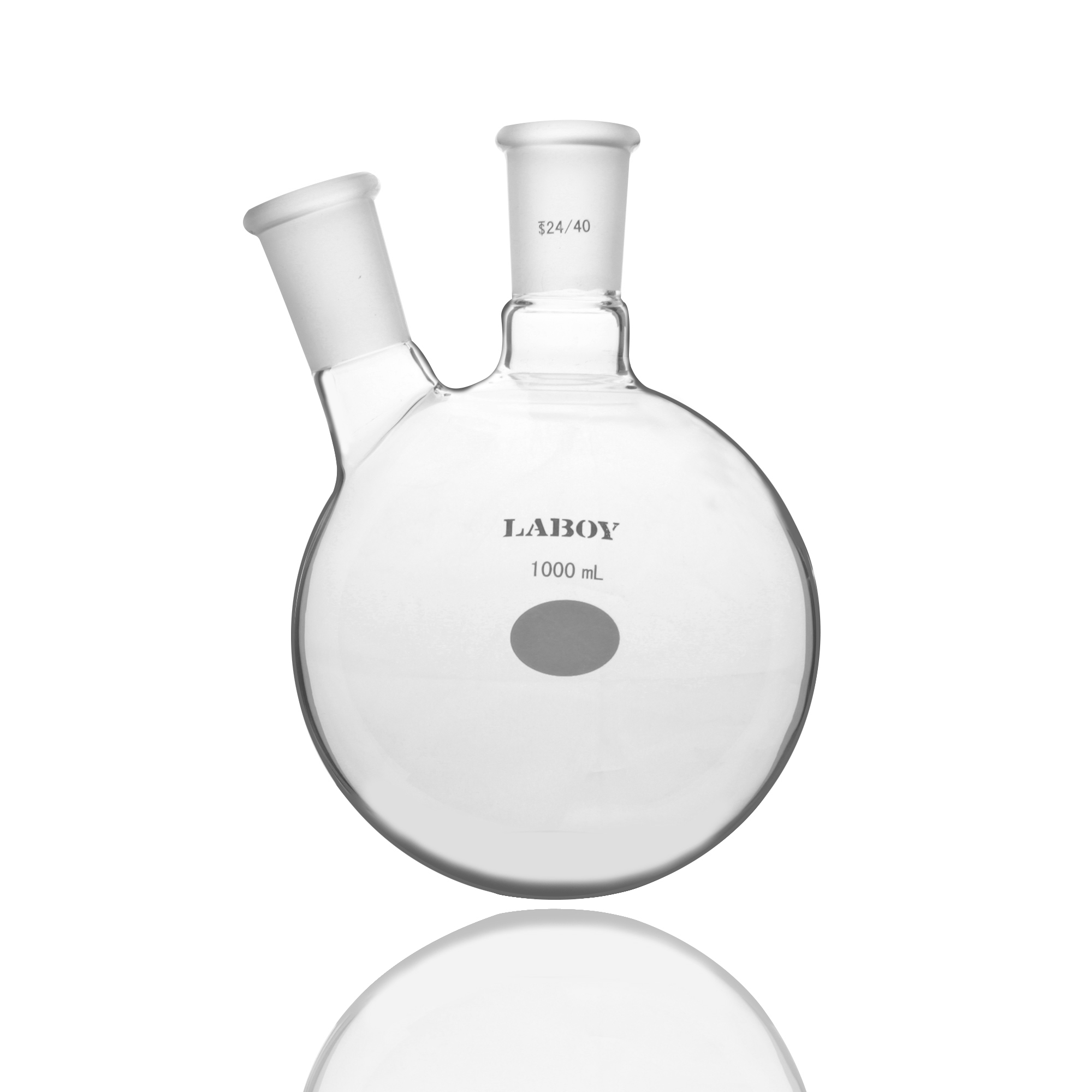
A two-neck flask is useful when one reaction needs two jobs handled at once. A common pattern is one neck for the main vertical path, and the second for addition, temperature monitoring, or gas inlet.
Its real value is not just one more neck. It is that it often lets you avoid an extra adapter and keep the setup lower, cleaner, and easier to balance.
Three-Neck Round-Bottom Flask
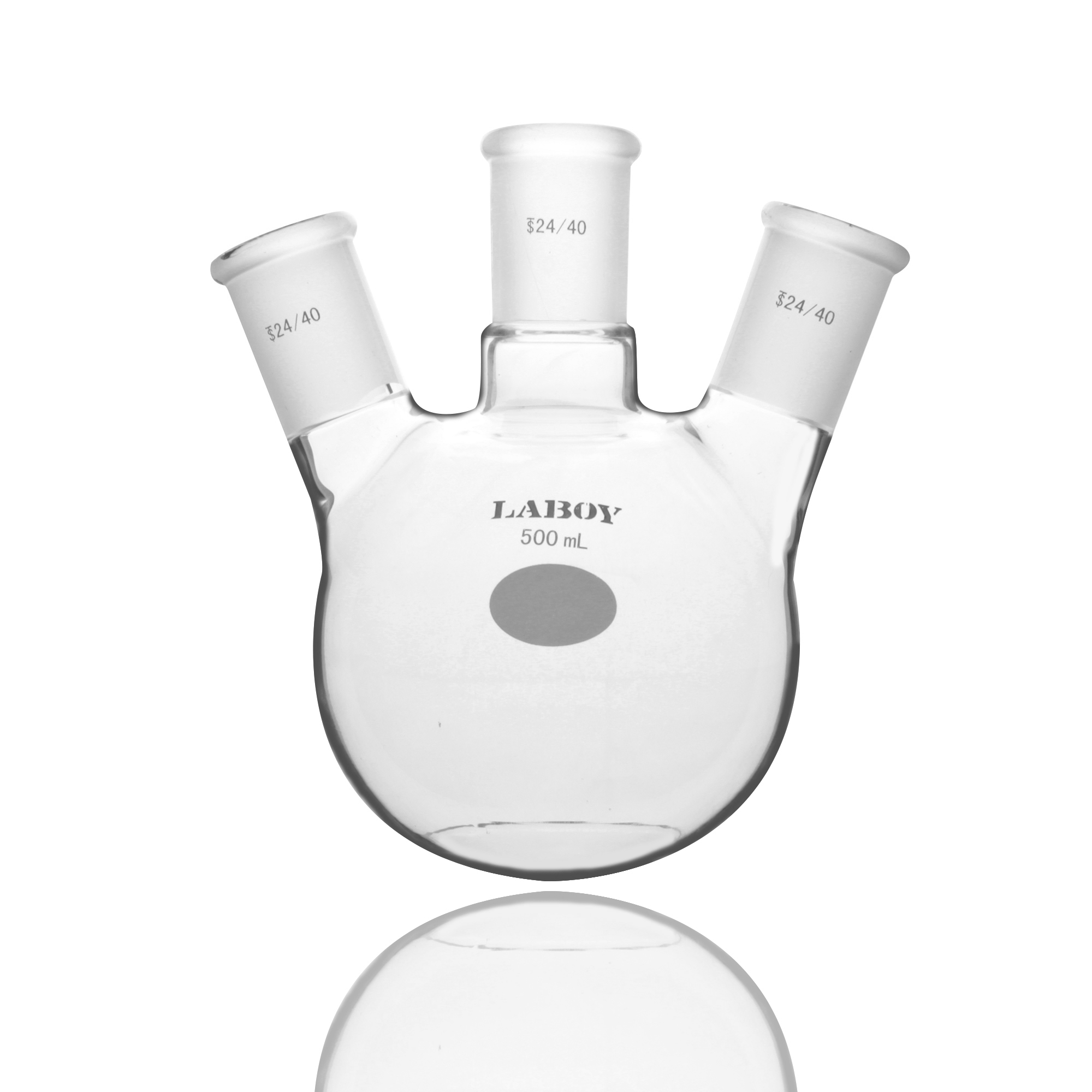
A three-neck flask is the classic multi-task reaction vessel. It is useful when the setup needs reflux, addition, temperature monitoring, gas handling, or stirring support all at once.
What matters here is not that it looks more advanced. What matters is that it lets several jobs happen in one vessel without the whole setup turning into a stack of improvised connections.
Four-Neck Round-Bottom Flask
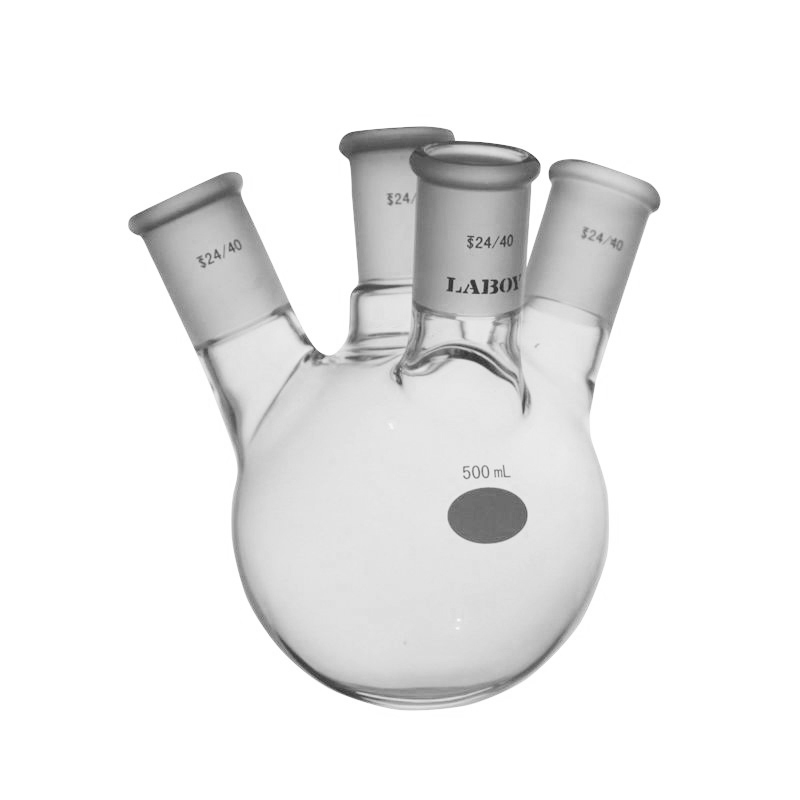
A four-neck flask is for more crowded or more specialized setups that need several separate paths at once. The benefit is extra flexibility. The cost is that support, clamping, and balance matter even more.
It is easy for beginners to assume that more necks always means a better setup. Usually it just means the setup has more demands and less tolerance for sloppy support.
Long-Neck Round-Bottom Flask
A long-neck round-bottom flask is more specialized. The longer neck can help in certain distillation-related situations by giving extra space before liquid or foam reaches the next part of the apparatus.
That does not make it better than a standard round-bottom flask. It makes it better for a narrower set of problems.
Round-Bottom Flask with Side Port
A side-port round-bottom flask changes the path layout of the setup. Instead of putting every function at the top, one flow path can come in from the side.
That can be useful when the top necks are already busy, or when the orientation of the connection matters as much as the number of connections.
Round-Bottom Flask Variants at a Glance
| Variant | Best for | Main advantage | Main limitation | Common beginner mistake |
|---|---|---|---|---|
| Single-neck round-bottom flask | Basic heated reactions, simple reflux, simple distillation | Simple and easy to manage | Limited expansion | Choosing only by volume and ignoring apparatus needs |
| Two-neck round-bottom flask | Reflux plus addition or temperature monitoring | Cleaner two-function setup | Still limited if the setup grows more complex | Thinking it is only a cosmetic change from one neck |
| Three-neck round-bottom flask | Multi-step or multi-function reaction setups | Handles several jobs at once | More support and layout planning needed | Treating it as more advanced instead of more purpose-built |
| Four-neck round-bottom flask | More crowded or specialized multi-path setups | Extra connection flexibility | Balance and support become more demanding | Underestimating how easily a complex setup becomes unstable |
| Long-neck round-bottom flask | Certain distillation-related situations | Extra buffer space in the neck | Less general-purpose | Thinking the long neck is only a shape variation |
| Round-bottom flask with side port | Setups that need a side path | More flexible path layout | Less intuitive than simpler neck layouts | Focusing only on neck count, not path direction |
Similar Tools and Key Boundaries
Round-Bottom Flask vs Erlenmeyer Flask
These two are often confused because both can hold reaction mixtures. The real difference is in how they work. A round-bottom flask is much better suited to heating, reflux, distillation, vacuum, and connected apparatus. An Erlenmeyer flask is usually easier for standing, swirling, temporary holding, and ordinary benchtop handling.
So the real question is not which one is more common. It is whether you need a setup vessel or a benchtop working vessel.
Round-Bottom Flask vs Flat-Bottom Flask
A flat-bottom flask stands on its own. That is its biggest practical advantage. A round-bottom flask gives up that convenience in exchange for better heating behavior, better setup compatibility, and a shape that works more naturally in vacuum and distillation work.
If the job is mostly setup-driven, round-bottom usually makes more sense. If the job is mostly standing, holding, and simple handling, flat-bottom may be more convenient.
Round-Bottom Flask vs Pear-Shaped Flask
A pear-shaped flask can be better when the scale is small and liquid recovery matters. A round-bottom flask is usually the more general-purpose setup vessel. A pear-shaped flask is more of a small-scale optimization.
Round-Bottom Flask vs Heart-Shaped Flask
A heart-shaped flask is even more specialized toward very small-scale work and minimizing hold-up. A round-bottom flask is the more general workhorse. A heart-shaped flask is a more targeted choice when recovery and low residual liquid matter more than broad setup flexibility.
Round-Bottom Flask vs Other Flask Types
| Flask type | Better for | Advantage over a round-bottom flask | Limitation compared with a round-bottom flask | When round-bottom is the better choice |
|---|---|---|---|---|
| Erlenmeyer flask | Temporary mixing, holding, transfer, some atmospheric receiving | Stands on its own and is easy to handle on the bench | Poorer choice for connected heated or vacuum setups | When heating, reflux, distillation, vacuum, or standard taper connections matter |
| Flat-bottom flask | Standing on the bench while keeping a flask form | Self-supporting | Less natural for many heated or vacuum apparatus roles | When the vessel is part of a real setup rather than just a standing container |
| Pear-shaped flask | Smaller-scale work, lower hold-up situations | Better recovery in some small-scale cases | Less general-purpose | When you need a more standard all-around setup vessel |
| Heart-shaped flask | Very small-scale work with strong emphasis on recovery | Lower residual liquid in some cases | More specialized | When the setup is not primarily a micro-scale recovery problem |
Common Beginner Mistakes
1. Choosing by volume alone
Mistake: Picking 250 mL or 500 mL first, then treating everything else as secondary.
Why it causes trouble: Many setup problems come from the wrong neck arrangement, not the wrong volume. A one-neck flask may hold enough liquid but still be wrong for the job if the setup also needs reflux, addition, temperature monitoring, or gas flow.
A better approach: Decide what the flask needs to do first, then choose the neck arrangement, then choose the size.
2. Treating a round-bottom flask as the default for every reaction
Mistake: Assuming every reaction belongs in a round-bottom flask.
Why it causes trouble: Round-bottom flasks are best when the job involves heating, connection, stirring, vacuum, or extended reaction time. They are not automatically the most convenient vessels for short mixing, temporary storage, or simple receiving.
A better approach: Ask whether you need a setup vessel or just a convenient bench vessel.
3. Clamping the wrong place
Mistake: Clamping the round body directly just because it seems fast.
Why it causes trouble: Bad clamp position can make the setup unstable and put stress where the glass is less happy carrying it.
A better approach: Clamp at the neck or an appropriate support point, and think about balance, not just whether the flask is technically being held.
4. Underestimating the fact that it cannot stand on its own
Mistake: Treating this as a minor inconvenience.
Why it causes trouble: It changes how the whole setup must be supported. If support and balance are handled badly, reflux, distillation, and vacuum work all become less safe.
A better approach: Treat support as part of flask selection from the start, not as an afterthought.
5. Using damaged glass for heating or vacuum work
Mistake: Keeping a scratched, chipped, or slightly cracked flask in circulation.
Why it causes trouble: Minor damage can become a much bigger problem under heat or vacuum.
A better approach: Inspect the body and the joint before the setup is built, not after.
6. Assuming “heat-resistant” means “fine over direct flame”
Mistake: Treating heat resistance as permission for harsh local heating.
Why it causes trouble: The value of a round-bottom flask is that it works well with even heating, not that it is meant to tolerate careless heating.
A better approach: Default to mantles, oil baths, water baths, or other more even heating methods unless there is a clear reason to do otherwise.
What to Check in Use
Before you start
- Check for cracks, star cracks, or deep scratches
- Check for damaged joints
- Make sure the size and neck arrangement fit the job
- Ask whether the setup really needs a round-bottom flask
During assembly
- Use a stable clamp position
- Keep weight distribution sensible
- Avoid a badly crowded top section
- Do not force joints that do not fit well
- Leave enough headspace for boiling and reflux
During operation
- Watch whether heating looks even
- Check whether stirring is actually working
- Make sure the setup stays stable as it warms and runs
- Re-check support and vessel choice if the setup starts behaving badly
Related Pages
Learn the setup
- Reflux Apparatus Basics
- Simple Distillation Apparatus
- Understanding Core Setups
Compare related tools
- Erlenmeyer Flasks
- Flat-Bottom Flasks
- Pear-Shaped Flasks
- Ground Glass Joints Basics
Fix a related problem
- Common Beginner Setup Mistakes
- Why Is My Reflux Not Returning Properly?
- Why Is My Distillation Unstable?
Use a quick reference
- Flask Shape Comparison Sheet
- Basic Glassware Inspection Checklist
- Core Clamp and Support Positioning Quick Guide