How to Choose a Condenser for Reflux
A reflux condenser is not chosen just by asking which one cools harder. The real question is whether the condenser can cool vapor and let the condensed liquid return smoothly to the same flask while the setup stays readable, stable, and open to the atmosphere unless a more controlled arrangement is deliberately being used.
Fast answer: For ordinary student-lab reflux, an Allihn condenser is often the best starting choice because it supports repeated condensation and smooth liquid return. A Liebig condenser can still work in milder cases, but it is not usually the most forgiving reflux default. More specialized reflux condensers can be useful in stronger or more demanding setups, but they are not automatically better just because they look more efficient.
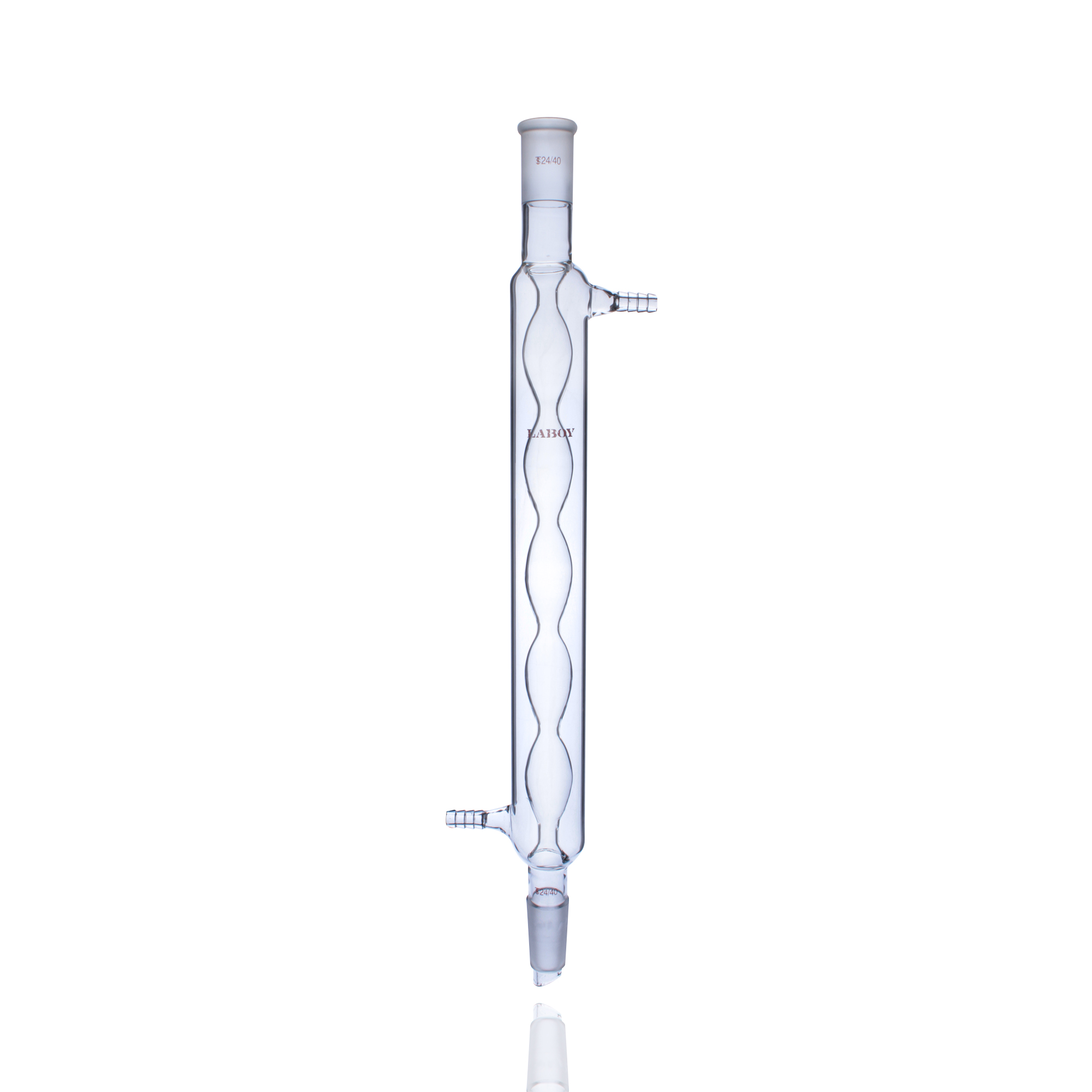
Allihn
The bulb structure supports repeated condensation and a return-friendly vertical path, which is why it appears so often in ordinary reflux work.

Liebig
A Liebig condenser can be acceptable for gentler reflux conditions, but it is usually less forgiving when vapor load becomes higher.
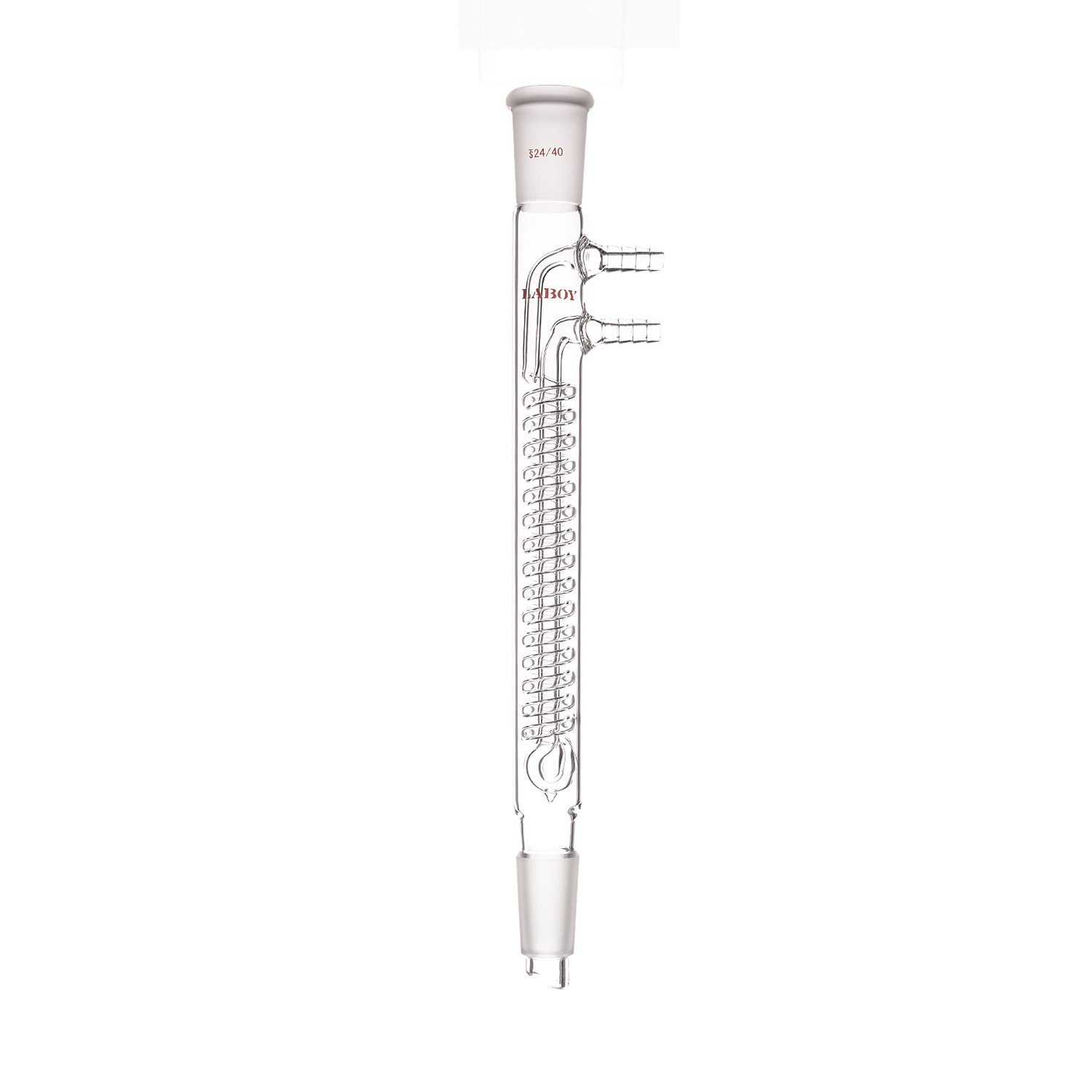
Higher-efficiency reflux condensers
More specialized reflux condensers can offer stronger cooling, but they should be chosen because the setup needs them, not because they look more advanced.
What the condenser is doing in a reflux setup
In reflux, vapor rises from the heated flask, enters the condenser, cools, and returns to the same flask as liquid. That return step matters just as much as the cooling step. A reflux condenser is not just there to remove heat. It is there to support a controlled cycle: boil, rise, condense, return, repeat.
This is why reflux condenser choice is not the same as distillation condenser choice. In distillation, the liquid should move forward into a receiver. In reflux, the liquid should fall back cleanly into the original flask. If a condenser cools well but makes that return awkward, it is not automatically a good reflux choice.
Bench-first way to think about it: a good reflux condenser does not just condense vapor. It also makes the return path easy to read and easy to trust.
What makes a condenser good for reflux
A good reflux condenser needs to do three things at once. It needs to condense enough vapor to prevent material loss. It needs to let the condensed liquid return smoothly to the flask. And it needs to match the actual setup rather than just looking powerful on paper.
That means you should not choose only by internal surface area. Surface area matters, but so do the vapor load, the solvent behavior, the heating intensity, and the ease of liquid return. A condenser that looks strong may still be a poor fit if the return path becomes awkward or the setup becomes hard to read while running.
Why Allihn is so common in ordinary reflux
For ordinary student-lab reflux, an Allihn condenser is often the most natural starting point. The bulb structure increases condensation area, but the more useful practical point is that it also supports repeated condensation in a vertical return path. That fits the basic logic of reflux very well.
In a good reflux setup, the goal is not violent boiling. The goal is steady circulation. Vapor should rise, condense, and return without the setup looking overloaded. That is exactly why the Allihn condenser is so often taught as the ordinary reflux default.
The main boundary is orientation. An Allihn condenser should be used vertically. If you turn it into an awkward path, liquid can collect in ways that make the setup less clear and less reliable.
When a Liebig condenser can still work
A Liebig condenser is not useless for reflux. It can still work in gentler cases, especially when the vapor load is not especially high and the setup is not being driven hard. But “can work” is not the same as “best default.”
The strength of a Liebig condenser is its straightforward path. That simplicity is ideal in many distillation setups. In reflux, though, a straight-path condenser is often a little less forgiving than an Allihn when vapor load increases or when the setup is less gentle than it first looked.
When an air condenser may make sense
An air condenser is not just a water condenser with less cooling. It belongs to a narrower judgment. In some higher-boiling, less volatile, smaller-scale, or gentler reflux situations, an air condenser may be enough. But this should be treated as a boundary decision, not as a universal shortcut.
The safe beginner habit is not to assume that “higher boiling” automatically means “air condenser is fine.” You still need to think about how much vapor is actually being produced, how hard the setup is being driven, and whether the condensation line stays where it should. If you are unsure, treat water-cooled reflux as the more dependable starting point.
How to read the reflux while it is running
Choosing a reflux condenser is only part of the job. You also need to read what the setup is doing. A good reflux should look active but controlled. Vapor should rise into the condenser, and condensed liquid should return steadily to the flask.
One of the most useful observations is the position of the visible condensation zone. If that zone sits very high in the condenser, the setup may be running too hard or cooling may be inadequate. If there is almost no visible condensation activity, the heating may be too weak to maintain an effective reflux. What you want is a stable zone that shows the system is cycling without looking overloaded.
What “good reflux” usually looks like: visible activity, steady return, no obvious solvent escape, and no sense that the condenser is barely keeping up.
Water flow, top opening, and basic reflux logic
Water should normally enter the condenser from the bottom and leave from the top. That is how the cooling jacket fills properly and stays effective. The goal is not maximum water flow. The goal is a filled, stable cooling path.
The top of an ordinary reflux setup should also remain part of an open system unless you are deliberately using a controlled arrangement such as a drying tube or a proper inert-gas setup. A condenser does not make it safe to heat a sealed system. That is one of the most important setup rules beginners need to keep in mind.
A simple framework for choosing a reflux condenser
Start with four questions.
- How volatile is the solvent? More volatile systems usually demand more dependable condensation.
- How strong is the vapor load? Gentle reflux and hard-driven reflux are not the same decision.
- Does the liquid return path stay clean? A condenser that condenses well but returns poorly is not a good reflux choice.
- Is this a routine open reflux or a more controlled condition? Drying tubes, inert gas, or stronger cooling needs may change the best choice.
A condenser that works well in a calm student-lab setup may stop feeling like the right choice once the vapor load climbs or the setup is pushed harder. That is why reflux condenser choice should always be read together with how the setup is actually being run.
Reflux condenser choice quick guide
| Situation | Usually the better starting choice | Why | What to watch |
|---|---|---|---|
| Ordinary student-lab reflux | Allihn | Good repeated condensation with a return-friendly vertical path | Do not overheat and assume the condenser will compensate |
| Milder reflux / lighter vapor load | Liebig may be acceptable | Can still condense and return adequately in some cases | Watch whether vapor rises too high or return becomes less stable |
| More demanding reflux conditions | More specialized reflux condenser | The setup may genuinely need stronger or more efficient cooling | Choose because the setup needs it, not because the glass looks more advanced |
| Higher-boiling / less volatile / gentle cases | Air condenser may be reasonable in some cases | Cooling demand may be lower | Do not generalize this boundary too broadly |
| What you see | What it may mean | First adjustment to consider |
|---|---|---|
| Condensation zone very high | Too much heat or insufficient cooling | Reduce heat first |
| Very little visible condensation activity | Heating may be too weak | Increase heat carefully if reflux is supposed to be active |
| Solvent clearly seems to escape | Cooling or condenser choice may be inadequate | Check heat, cooling, and whether the condenser is the right fit |
| Liquid return looks awkward or uneven | Return path may be poor or the setup may be mismatched | Recheck condenser type, vertical orientation, and setup stability |
Common beginner mistakes
- Thinking any condenser automatically gives a good reflux. A condenser can be present and still be a poor fit for the actual setup.
- Choosing only by cooling strength. Reflux depends on smooth return, not just aggressive condensation.
- Running the water too hard or ignoring fill direction. The point is a filled, stable cooling jacket, not maximum water use.
- Heating too strongly and blaming the condenser. A good condenser cannot rescue every overdriven setup.
- Closing the top because it feels safer. A reflux condenser does not make it safe to heat a sealed system.
- Treating air condensers as a universal convenience option. They belong to a narrower boundary than many beginners assume.
Final takeaway
If you only remember one thing, remember this: a good reflux condenser is chosen for stable return, not just strong cooling.
For ordinary student-lab reflux, start by thinking Allihn.
For gentler cases, a Liebig condenser may still work.
For stronger or more specialized reflux conditions, choose a more specialized condenser because the setup genuinely needs it, not because it looks like an upgrade.