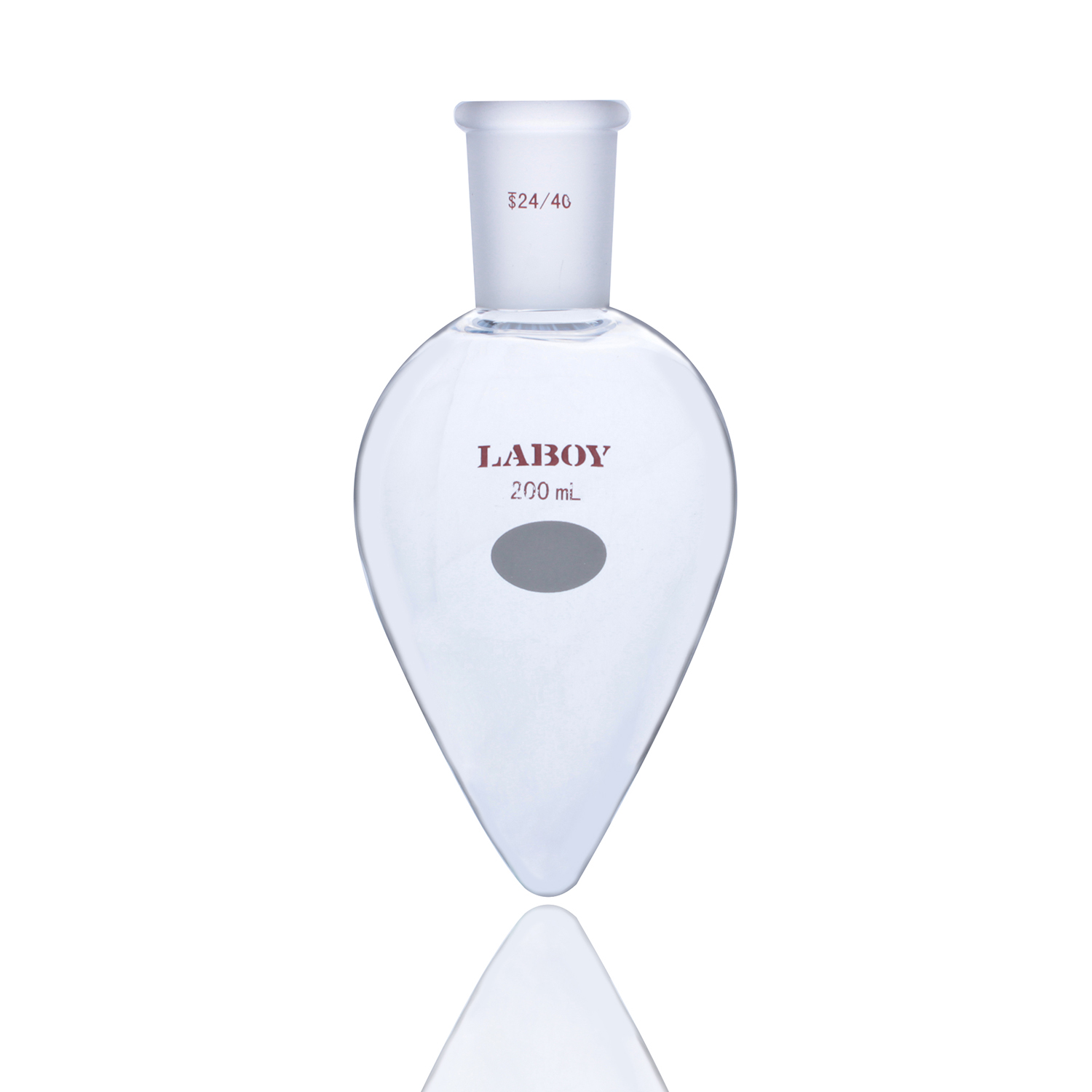
1. Quick Definition
The Pear-Shaped Flask is a specialized laboratory vessel characterized by its conical, tapering base. Engineered from Borosilicate Glass 3.3, it is primarily designed for rotary evaporation and small-scale distillation. Its unique geometry allows for the creation of thin liquid films during rotation and ensures the centralized collection of concentrated residues at the tapered tip.
2. Core Physical Logic
The physical logic of the pear-shaped design centers on minimizing hold-up volume. Unlike standard round-bottom flasks, the V-shaped bottom forces small volumes of liquid to pool at a single point, significantly reducing the surface area where the sample might “smear” or stick to the glass. This is crucial for high-yield recovery in microscale synthesis. For insights into how joint selection affects the vacuum integrity of these vessels, see The Ultimate Guide to Glassware Joints. Detailed structural behavior is further explored in The Physics of Glassware.
[Zoe’s Shop Talk]
“In the glass shop, the ‘V’ at the bottom is a critical stress point. We have to ensure the wall thickness remains uniform through that taper; otherwise, it becomes a bomb under vacuum. A common mistake in the lab is trying to use a standard magnetic stir bar in there—it won’t spin right and can actually etch the glass. Use these for evaporation, and if you must stir, use a tiny ‘flea’ bar or stick to a round-bottom flask.”
3. Technical Specifications
[Dr. Vance’s Lab Protocol]
“When performing small-scale concentration, the pear-shaped flask is your best defense against sample loss. However, be aware of thermal gradients. Because the liquid volume at the base is small, it can heat up rapidly, leading to ‘bumping’ if your vacuum isn’t carefully regulated. Always start rotation before applying vacuum, and ramp up the vacuum level gradually until a steady evaporation rate is achieved.”
4. Lab Survival Guide
- 🚫 No Heavy Stirring: Avoid high-speed magnetic stirring which can damage the tapered glass tip.
- 🏗️ Secure Clamping: Always use a Keck clip to secure the joint to the rotary evaporator.
- 🔍 The Tip Scan: Inspect the bottom taper for stress fractures or “stars” before every vacuum use.
- ⚖️ Unstable Base: These flasks cannot stand on flat surfaces. Always store them in a cork ring or secured in a clamp.