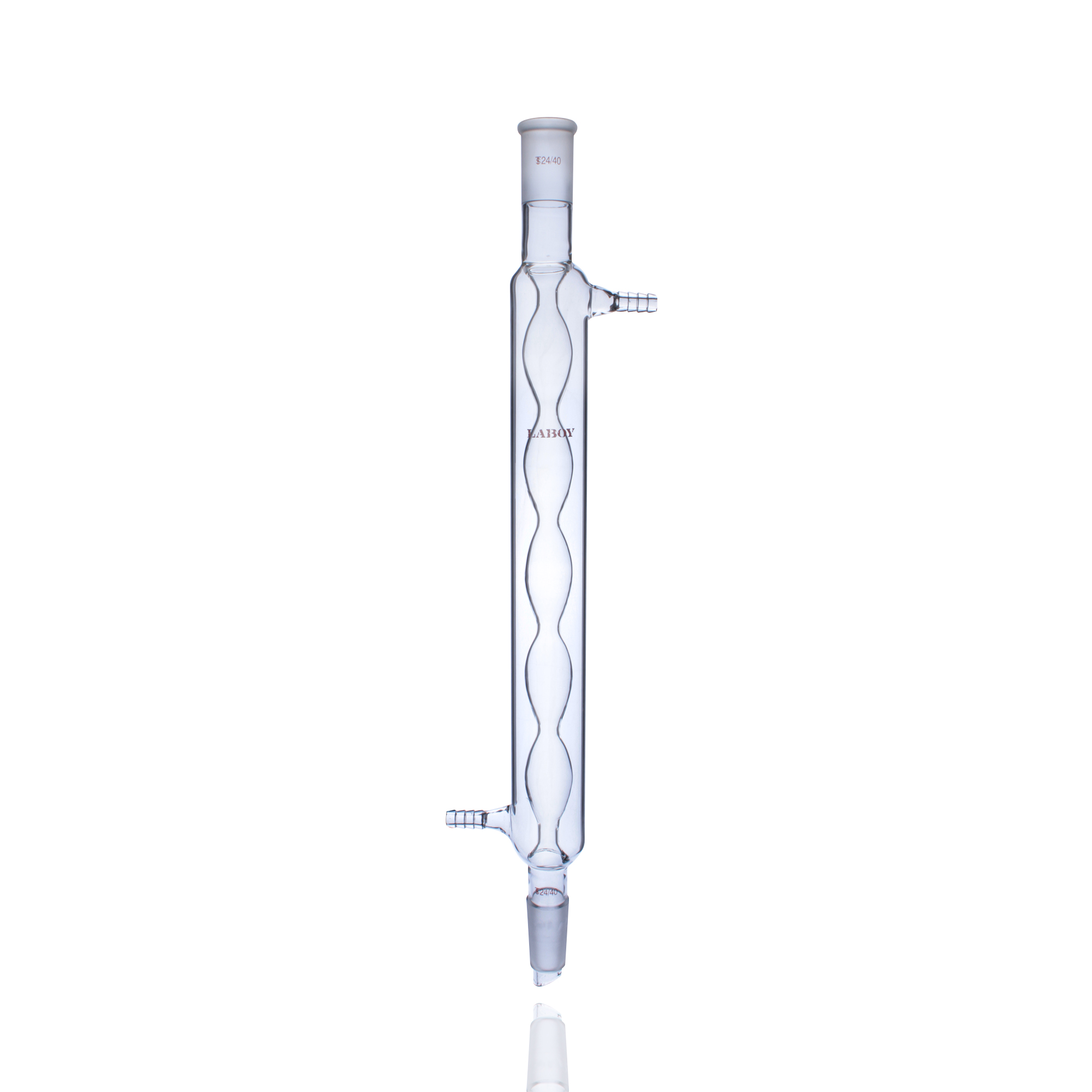
The Allihn condenser, often called a bulb condenser, is one of the classic standard condensers for reflux in the organic lab. Its bulb-shaped inner tube gives more cooling surface than a simple straight condenser and helps condensed liquid return to the flask in a way that suits routine vertical reflux work.
Fast answer
Best for: routine vertical reflux and other return-cycle setups such as Soxhlet extraction
Not usually the first choice for: ordinary inclined distillation
Why it matters: the bulb design improves cooling surface and supports liquid return in a reflux system
What It Is and Why It Is Designed This Way
The Allihn condenser has the same broad idea as other water-cooled condensers: vapor passes through an inner tube, and cooling water flows through an outer jacket. What makes it different is the inner tube. Instead of a straight passage, it contains a series of rounded bulbs.
That shape matters for two practical reasons. First, it increases the amount of cold surface available for vapor to contact, so condensation is more effective than in a simple straight tube. Second, it helps condensed liquid run back down along the walls rather than more easily interfering with the upward movement of vapor. That is why the Allihn condenser is not just “a condenser with more surface area.” It is a condenser whose geometry fits the continuous up-and-down traffic of a reflux setup.
Where It Is Most Useful
In practice, the Allihn condenser is most at home in routine laboratory reflux. If the goal is to heat a reaction for an extended period while condensing solvent and returning it to the reaction flask, an Allihn is often one of the most natural choices. It is common in undergraduate organic labs, general synthesis work, and many ordinary bench-scale reactions where the apparatus is arranged vertically and the purpose is steady solvent return rather than product collection.
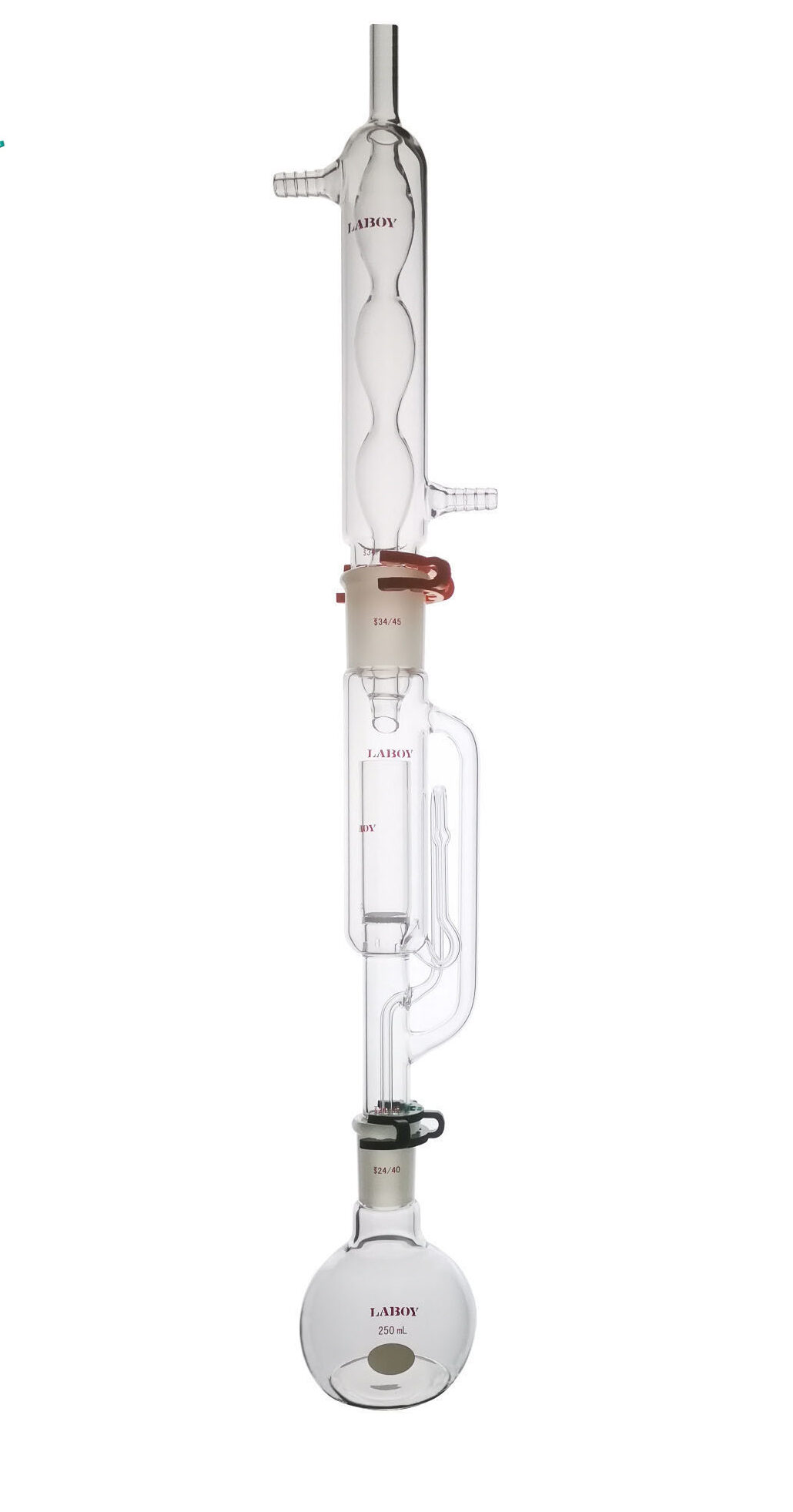
It also appears in systems such as Soxhlet extraction, where solvent is repeatedly boiled, condensed, and returned through a continuous cycle. In that kind of setup, the Allihn condenser sits above the extractor body and serves as the cooling section that keeps the solvent circulating through the apparatus.
| Use an Allihn condenser when… | Consider another condenser when… |
|---|---|
| You are setting up a routine vertical reflux | You are doing ordinary inclined distillation |
| You want more cooling surface than a simple Liebig condenser | You want a simpler straight path for condensate to move toward a receiver |
| The main goal is to return solvent to the reaction flask | The main goal is to condense vapor and collect product efficiently |
| You are working in a return-cycle setup such as Soxhlet extraction | You need a different condenser geometry for a more specialized cooling task |
When It Is Less Suitable
The Allihn condenser is highly useful, but it is not a universal default. The place where it is usually less attractive is ordinary inclined distillation. In a standard distillation setup, condensed liquid is supposed to move efficiently toward the receiving side of the apparatus. The bulb structure of an Allihn is better suited to liquid returning downward than to clean, direct flow through an inclined condenser, so liquid can linger more easily around the bulb walls.
That is why a Liebig condenser often feels simpler and more appropriate for ordinary distillation. This does not mean the Allihn is a poor condenser. It means it is strongest in a different task. It should be understood as a condenser designed around reflux behavior, not as a straight-tube condenser that automatically replaces other designs everywhere.
How It Compares with Other Common Condensers
For beginners, comparison is often more useful than memorizing names. The question is not which condenser looks more advanced, but which one best matches the job in front of you.
| Condenser | Main strength | Best fit | Main limitation |
|---|---|---|---|
| Liebig | Simple, direct, and versatile | Ordinary distillation and general-purpose condensation | Less optimized for reflux return |
| Allihn | Good cooling surface and practical liquid return | Routine vertical reflux and Soxhlet-style return cycles | Less ideal for inclined distillation |
| Graham | High surface area | Some specialized cooling tasks | More prone to liquid hold-up and less balanced for routine reflux teaching use |
| Dimroth | Very efficient cooling | More demanding reflux work and volatile systems | More complex than needed for many routine setups |
In other words, the Allihn condenser occupies a very practical middle ground. It is more purpose-built for reflux than a Liebig, but less specialized than a Dimroth. That balance is part of why it remains such a common and useful condenser in teaching labs and ordinary synthesis work.
What Matters Most in Actual Use
The most important thing is to understand the Allihn condenser in the way it is meant to be used. It is primarily a vertical reflux condenser. Cooling water should run in from the bottom and out from the top, and the condenser should be secured so it remains stable above the reaction flask during heating.
It also helps to remember what the condenser is doing in the apparatus. It is not just “cooling vapor.” In reflux, it has to condense vapor while still allowing liquid to return smoothly to the flask. That is exactly the kind of task the Allihn design handles well.
Common beginner mistake
Do not assume an Allihn condenser is simply a “better Liebig.” Its bulb design makes it especially useful for reflux, but that does not mean it is automatically the best choice for ordinary distillation.
Bottom Line
The Allihn condenser is one of the classic standard condensers for reflux because its bulb-shaped inner tube provides both effective cooling and a practical path for condensed liquid to return to the flask. That makes it common, reliable, and highly useful in routine vertical reflux and in return-cycle setups such as Soxhlet extraction.
It is not the best answer for every setup, and it should not be treated as a universal upgrade over straight-tube condensers. But for the task it is actually designed for, it remains one of the most practical and recognizable condensers in the organic lab.