The air condenser is a simple condenser that relies on surrounding air, rather than circulating water, to cool vapor. Its role is not to provide the strongest possible condensation. Its real value is in handling high-temperature, high-boiling systems more safely, especially when direct water cooling would create excessive thermal stress in the glassware.
Fast answer
Best for: high-boiling liquids, high-temperature reflux, and other situations where water cooling is not the safest choice
Not usually the first choice for: low-boiling, highly volatile solvents or setups that require strong condensation
Why it matters: an air condenser trades cooling power for simplicity and safer handling of hot vapor
What It Is and How It Works
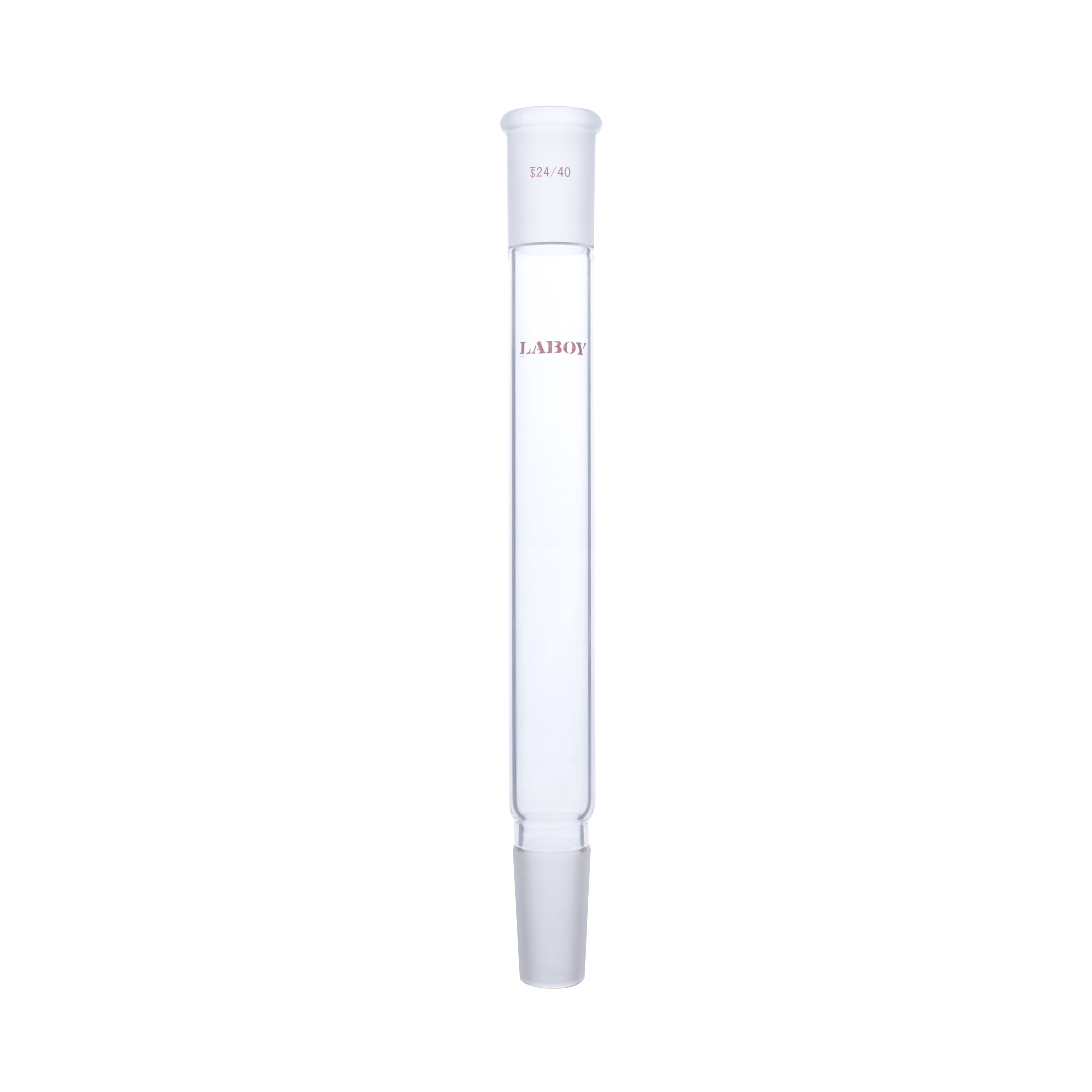
An air condenser is usually just a single-walled glass tube with standard ground-glass joints at the ends. Unlike a Liebig, Allihn, or Graham condenser, it has no water jacket and no internal cooling coil. Vapor rises into the condenser, loses heat through the glass wall to the surrounding air, and then condenses as the temperature drops.
In a reflux setup, the condensed liquid runs back into the reaction flask. In a distillation setup, the condensed liquid moves onward toward the receiving side of the apparatus. The principle is simple, but the important point is that air is a much weaker cooling medium than water. That means the air condenser is only appropriate when the vapor is hot enough, and the condensation demand modest enough, for air cooling to be sufficient.
Where It Is Most Useful
The air condenser is most useful in work involving high-boiling liquids or high-temperature reaction mixtures. In these situations, the main concern is often no longer “how do I maximize cooling?” but rather “how do I condense this hot vapor without placing water-cooled glass under an unnecessarily large temperature gradient?”
That is why air condensers are strongly associated with high-boiling distillation and high-temperature reflux. When a system is hot enough, direct water cooling can impose substantial thermal stress on the glass, especially near fused joints and jacketed sections. An air condenser avoids that problem by removing the water-cooling layer entirely.
They also appear in some microscale and semimicroscale experiments, where the vapor load is low and a simple air-cooled tube is often adequate. In those cases, the condenser is attractive not because it is “better” in absolute terms, but because it is simple, light, and sufficient for the scale of the work.
| Use an air condenser when… | Consider a water-cooled condenser when… |
|---|---|
| You are working with a high-boiling liquid or a high-temperature reaction mixture | You are using a low-boiling or highly volatile solvent |
| The main concern is avoiding strong thermal shock in hot glassware | The main concern is maximizing condensation efficiency |
| The vapor load is modest enough for air cooling to be adequate | The setup produces large amounts of vapor that must be cooled aggressively |
| You are working on a microscale or semimicroscale setup where simplicity helps | You want to minimize solvent loss during ordinary low- or medium-boiling reflux |
What Its Real Advantage Is
The air condenser is sometimes misunderstood as a “basic” or “cheap” condenser. That misses the real point. Its most important advantage is not low price or easy setup. Its most important advantage is that it provides a safer and more appropriate cooling approach for hot vapor when water cooling would create an unnecessarily sharp temperature difference across the glass.
It also has obvious practical benefits. The structure is simple. There are no cooling-water hoses to connect, no inlet or outlet orientation to worry about, and no jacket space to clog or fill with deposits. Cleaning is straightforward, and the apparatus is often quicker to assemble.
But those practical benefits are secondary. The core lesson is that the air condenser exists to serve a different operating window, not to act as a lower-performance version of a Liebig condenser.
Its Main Limitation
The air condenser has one very clear limitation: its cooling power is limited. Air simply does not remove heat as efficiently as circulating water. That makes an air condenser a poor choice for low-boiling solvents and for systems where vapor must be condensed rapidly and completely.
In practice, that means it is generally unsuitable for solvents such as ether, dichloromethane, acetone, or other highly volatile materials. In those cases, air cooling is usually too weak to prevent significant vapor loss. The result may be poor reflux, solvent escape, odor and exposure problems, or failure of the intended setup behavior altogether.
It is also more sensitive to the surrounding environment. Room temperature, airflow, and crowding around the apparatus can all affect performance. A condenser that works acceptably in one setting may perform worse in a hot or poorly ventilated room.
How It Compares with Common Water-Cooled Condensers
The most useful comparison is not “which condenser is more advanced,” but “which condenser is designed for this task.”
| Condenser | Main strength | Best fit | Main limitation |
|---|---|---|---|
| Air condenser | Safer handling of hot vapor without water cooling | High-boiling distillation, high-temperature reflux, small-scale hot systems | Limited cooling power |
| Liebig / West | Simple and effective water-cooled condensation | Ordinary distillation and general-purpose use with lower- to medium-boiling systems | Less appropriate when hot vapor meets very cold glass too abruptly |
| Allihn | Good liquid return and increased cooling area | Routine reflux with water cooling | Not intended for the same high-temperature safety role as an air condenser |
| Graham / Dimroth | Higher cooling efficiency | More demanding reflux or specialized cooling tasks | More complexity than needed for the high-temperature niche served by an air condenser |
So the air condenser is not an “upgrade” or a “downgrade” relative to these condensers. It is better understood as a different answer to a different problem.
What Matters Most in Actual Use
The most important step is to judge whether the system truly belongs in the operating range where an air condenser makes sense. This is a question of boiling point, vapor load, and safety, not just convenience.
- Check the boiling behavior first. Air condensers are most appropriate when the system is hot enough that water cooling becomes less attractive, but not so vapor-heavy that air cooling becomes clearly inadequate.
- Keep the condenser exposed to air. Since the condenser depends entirely on surrounding air, it should not be crowded by nearby equipment or blocked from airflow.
- Be especially careful near the lower edge of suitability. If the boiling point is only marginally high, or the vapor load is large, observe carefully whether condensation is actually keeping up.
- Do not ignore support and alignment. The absence of water hoses does not make the setup casual. Ground-glass connections, vertical alignment, and stable support still matter.
Common Beginner Mistake
Do not treat an air condenser as a general substitute for water cooling
An air condenser is not simply the easiest condenser to install. It is only the right choice when the vapor is hot enough, and the cooling demand modest enough, for air cooling to work safely and effectively. Used outside that range, it can lead to poor condensation and significant solvent loss.
Bottom Line
The air condenser is a simple, high-temperature, safety-oriented condenser. It is most useful when the job involves hot vapor from high-boiling liquids or reaction mixtures, and when direct water cooling would expose the glassware to an unnecessarily sharp temperature gradient.
Its purpose is not to deliver the strongest cooling. Its purpose is to provide a more suitable and safer way to condense vapor in a specific temperature range. Once that is clear, the air condenser stops looking like a primitive condenser and starts looking like what it really is: a specialized tool for the right thermal conditions.
Frequently Asked Questions About the Dimroth Condenser
These questions focus on the issues readers are most likely to care about in real lab use: structure, reflux performance, hose layout, very low-boiling solvents, and moisture control.
What makes a Dimroth condenser different from a Liebig or Allihn condenser?
A Dimroth condenser uses an internal double spiral cooling coil rather than a simple outer water jacket. Cooling water flows through that internal coil, while the vapor rises through the surrounding space and condenses around the cooled glass. That is the key reason it is usually more efficient than a simpler straight-tube condenser and why it is often associated with stronger reflux performance.
Why is a Dimroth condenser so often used for reflux?
Its main advantage in reflux is not just that it cools well, but that it can recover a large amount of vapor efficiently and return condensate reliably when vapor production is heavy. That makes it especially useful when solvent loss matters, when the reflux is vigorous, or when a simpler condenser may be starting to feel marginal.
Why are both water connections usually at the top?
Because the coolant path is built inside the condenser. In a typical Dimroth design, cooling water enters through one top connection, travels through the internal spiral circuit, and exits through the other top connection. The vapor path is separate: it rises through the outer space around the coil. This top-connection layout is one of the easiest visual clues that the condenser is not working like a standard outer-jacket design.
Is a Dimroth condenser a good choice for very low-boiling solvents such as ether?
The honest answer is: not automatically. Some sources describe the Dimroth condenser as an excellent option for volatile solvents because of its strong cooling capacity. Other sources warn that for very low-boiling solvents such as ether, vapor may still escape under some conditions because the outer wall region is relatively warm. The practical lesson is that performance depends on cooling-water temperature, flow rate, vapor load, sealing quality, and the exact setup, not on the condenser name alone.
When should a drying tube be added above a Dimroth condenser?
A drying tube is a common addition in moisture-sensitive reflux setups. Even though the outer wall of a Dimroth condenser is not especially prone to heavy external condensation, the open top region can still be a vulnerable place for atmospheric moisture to condense or enter. That is why many protective reflux assemblies place a drying tube above the condenser when keeping moisture out of the system matters.