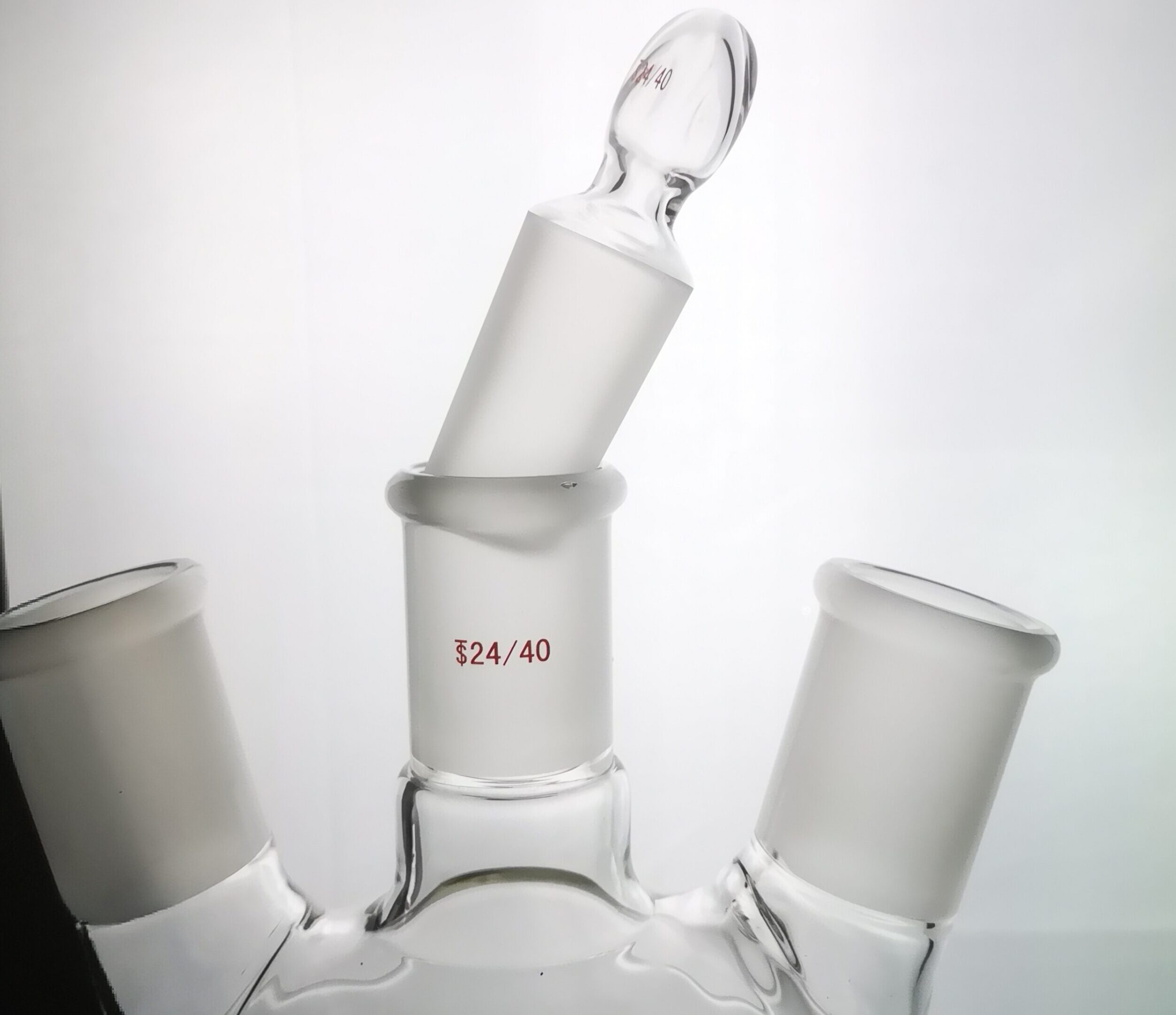
Have you ever had that moment of quiet despair in the lab? Your reaction is ready, you reach for a new addition funnel, but the laboratory glassware joints don’t match. This common frustration often stems from the confusing world of standard taper joints, where a 24/40 joint and a 24/29 joint look similar but behave differently. Glassware joints are our hardware, yet clear explanations of these connections are strangely rare in textbooks. This lack of clarity leads to real frustration at the bench—especially when you are trying to figure out the critical difference between ASTM and ISO standards before a reaction starts.
The box says “24 mm standard joint,” so why is one connector long and the other short? Why do some ground glass joints seal beautifully while others always seem to leak? This guide is ChemNorth’s answer to that confusion. We will map out the main joint types, decode exactly what the numbers (like 24/40) mean, explain the difference between US and European standards, and provide a practical compatibility cheat sheet you can rely on.
Types of Laboratory Glassware Joints
Before getting lost in the numbers, it helps to see the whole map. Not all connections are created equal—each joint type has its own “personality” and typical role.

Standard Taper (ST) Joints
The Lab Workhorse: Precision Ground Glass.
- Features conical, ground-glass surfaces available in 14/20, 24/40, 29/42, and NS 24/29 sizes.
- Standard connection for boiling flasks, condensers, and distillation adapters.
- Provides a rigid, airtight vacuum seal; the primary focus of this guide.
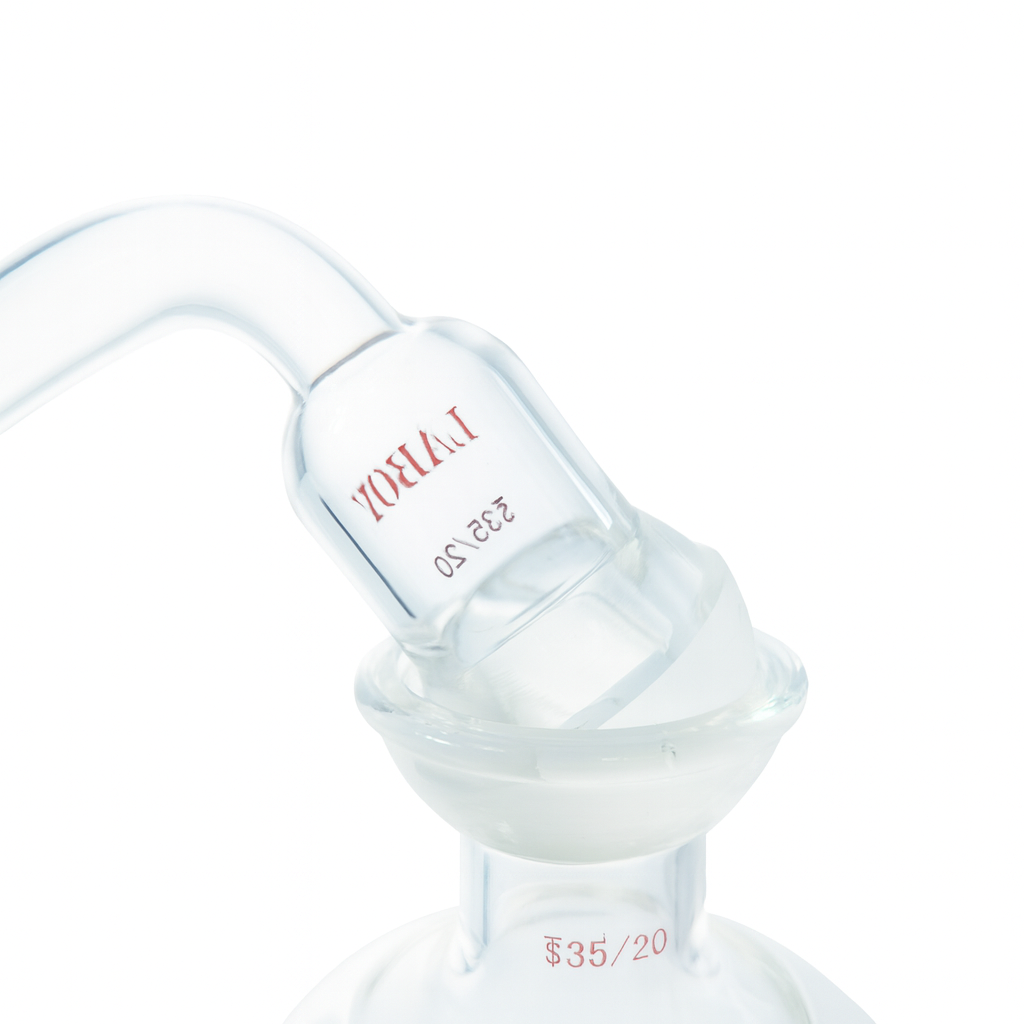
Spherical (Ball & Socket) Joints
The Flexible Gymnast: Angular Mobility.
- Rounded “ball” fits into a cup-shaped socket to prevent glass breakage under stress.
- Allows 10–15° of angular flexibility, ideal for complex vacuum manifolds.
- Commonly used on Rotary Evaporators and large-scale condenser setups.
- Requires metal pinch clamps (spherical joint clamps) for security.
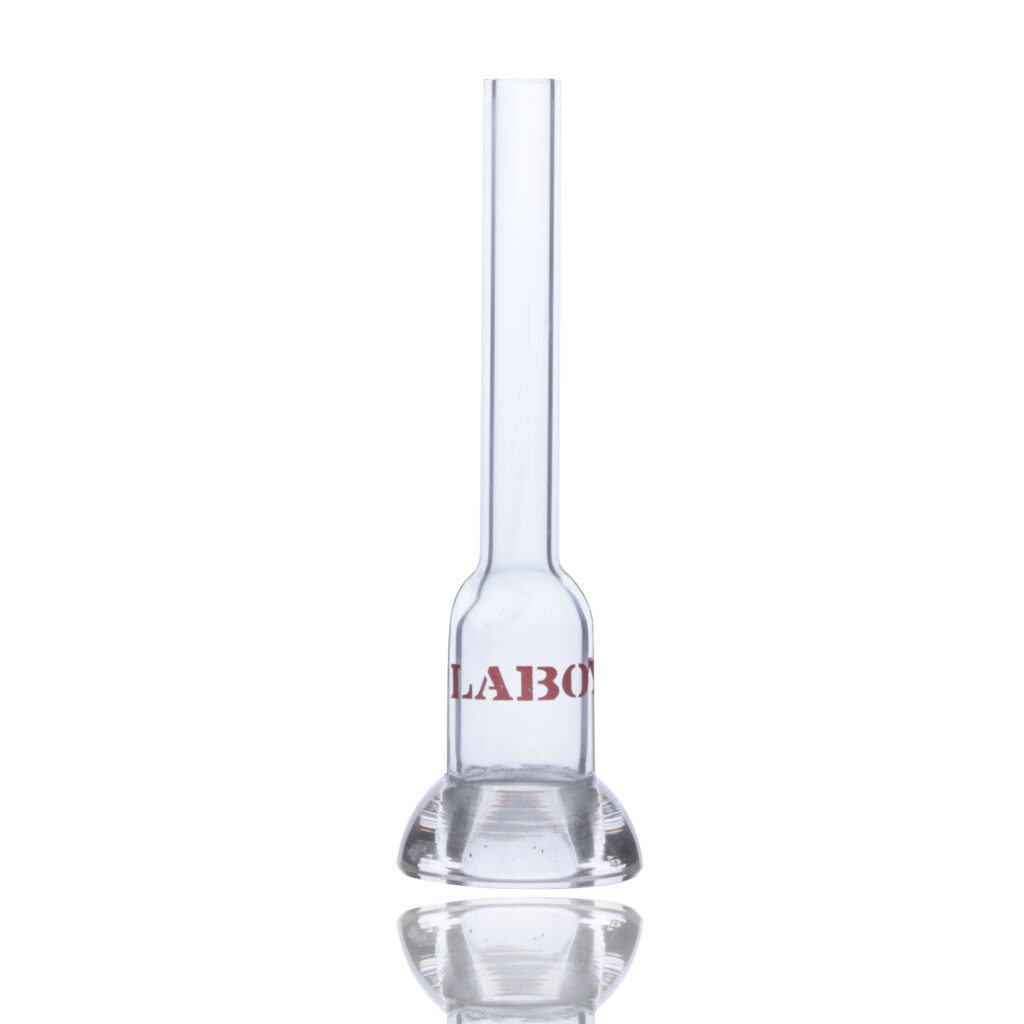
Flat Flange Joints
The Heavy-Duty Solution: Large Bore Access.
- Wide, flat sealing faces secured with an FKM or Silicone O-ring.
- Provides a massive opening for jacketed reactors and large vacuum vessels.
- Best for high-viscosity reactions requiring large stirrer shafts and easy cleaning.

Screw Thread (GL) Joints
The Modern Modular Connector: Grease-Free Sealing.
- External glass threads paired with a PBT or PTFE cap and gasket.
- Height-adjustable and requires zero vacuum grease, preventing contamination.
- Commonly found on GL45 storage bottles and GL14/18/25 tubing adapters.
The Chemnorth Take: While all four types are essential, the one that causes the most headaches is undoubtedly the Standard Taper Joint.
Why? Because of the confusing numbers, conflicting international standards, and joints that claim to be the same size but turn out to be different lengths. In the next section, we’ll peel back the layers of this mystery and solve the compatibility puzzle once and for all.
Standard Taper Joint Dimensions & Sizes Explained
To understand laboratory glassware compatibility, you simply need to decode the two-number designation (written as A/B).
What do the numbers (e.g., 24/40) mean?
- The First Number (A): Represents the nominal outer diameter (OD) of the joint at its widest point, in millimeters.
- The Second Number (B): Represents the length of the ground-glass zone (the frosted area), in millimeters.
Examples:
- 24/40 Joint: Has a nominal width of 24 mm and a ground length of 40 mm.
- 14/20 Joint: Has a nominal width of 14 mm and a ground length of 20 mm.
Note on Precision: The first number is a “nominal” category. For instance, in a 14/20 joint, technical diagrams often show the actual diameter is slightly larger (e.g., ~14.5 mm) to accommodate manufacturing tolerances and ensure a tight seal.
What does a 1:10 taper mean?
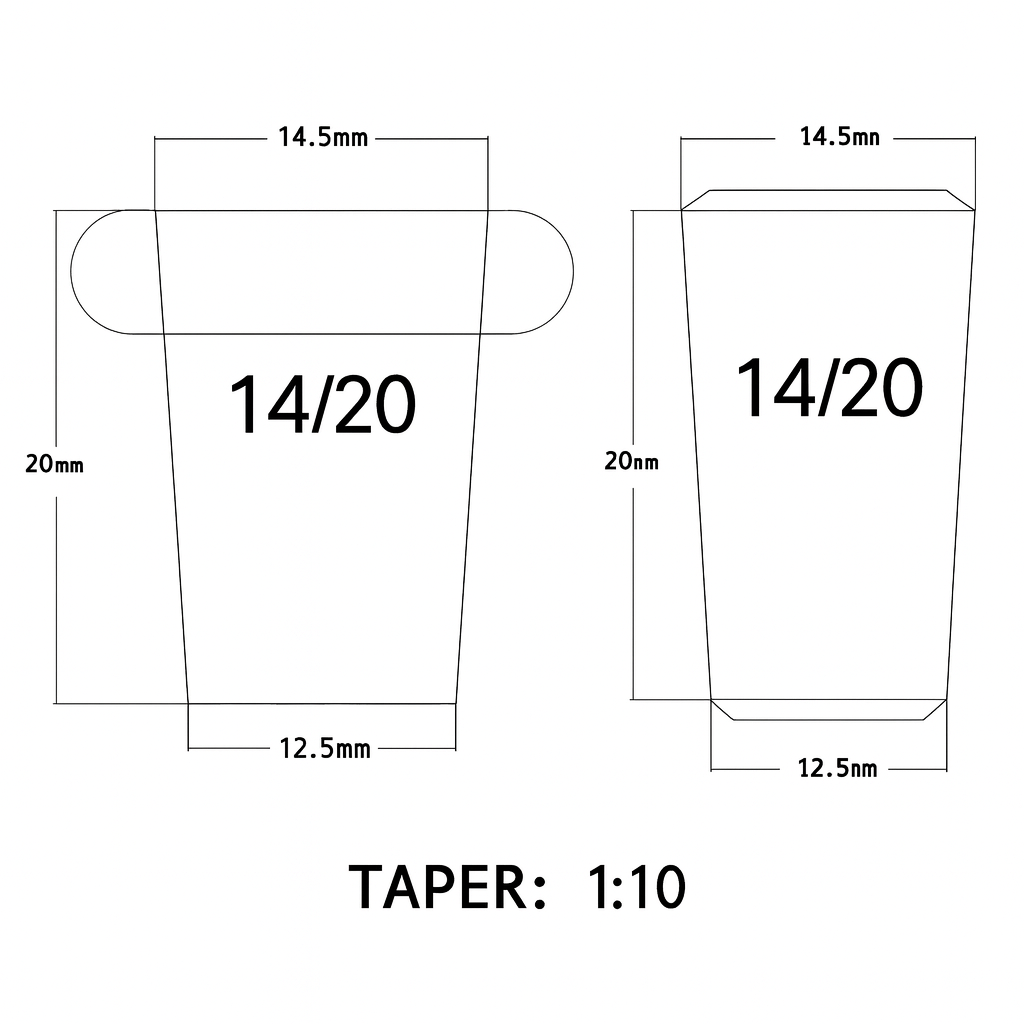
Regardless of the size—14/20, 24/40, or 45/50—all standard taper joints share the same 1:10 geometric slope.
So what does “1:10 taper” actually mean? It means that for every 10 mm of length along the joint, the diameter changes by 1 mm. This matters because such a gentle, consistent slope allows the joint to self-center as it is inserted, creating a tight seal without excessive force.
ASTM (US) vs. ISO (Europe): Same Taper, Different Lengths
The answer is geometry. Since the taper is identical and the nominal diameter is the same, ASTM and ISO/DIN standards are simply two different ways of slicing the same 1:10 cone.
| Feature | US Standard (ASTM) | European Standard (ISO/DIN) |
|---|---|---|
| Common Name | Full-Length Joints | Medium-Length Joints |
| Typical 24 mm Joint | 24/40 | 24/29 |
| Ground Zone Length | Longer (40 mm) | Shorter (29 mm) |
| Best For | Heavy, vertical assemblies | Easy separation and economical glassware |
Real-World Compatibility: Can You Mix Them?
Short answer: yes, in most routine setups. Because they share the same 1:10 taper, a 24/40 and a 24/29 joint will usually seal.
Chemnorth Pro Tip: When mixing ASTM and ISO joints, ALWAYS use Keck clips. Since the lengths don’t match perfectly, the clip is essential to fix the relative position.
The Master Cheat Sheet
| Lab Scale | Common Diameter | US Standard (ASTM) | EU Standard (ISO) | Typical Application |
|---|---|---|---|---|
| Micro | 14 mm | 14/20 | 14/23 | < 50 mL reactions |
| Standard | 24 mm | 24/40 | 24/29 | Standard for 50 mL–1 L flasks |
| Large | 29 mm | 29/42 | 29/32 | 1 L+ flasks |
Maintenance & The Art of Clips
Apply a very thin ring of vacuum grease to the upper part of the male joint only. For more details, see our guide on how to use and maintain ground-glass joints.
If you are choosing hardware for a new setup, explore our guide on how to choose clamps and clips for laboratory glassware.
Conclusion
Understanding glassware joints isn’t just about buying parts with matching numbers. It is about knowing what those numbers mean and recognizing the difference between standards.
About the Author: Zoe.W
With over 20 years of experience in hand-blown glass manufacturing, Zoe.W specializes in solving complex equipment challenges for organic chemistry experiments.
Connect with Zoe:
Email
Check out our Laboratory Condenser Selection Guide to choose the right cooling setup.