Small-Scale Reaction Tubes
Small-scale reaction tubes are compact reaction vessels used when the chemistry is small enough that material economy, low hold-up, and simpler small-scale handling matter more than the flexibility of a larger flask.
This family includes more than one kind of vessel. Some are just simple small reaction tubes. Others add a side arm, a glass stopcock, or a high-vacuum valve and start to overlap with Schlenk-style setup logic. The useful beginner question is not just “Is this a small tube?” but “What extra job is this tube designed to do?”
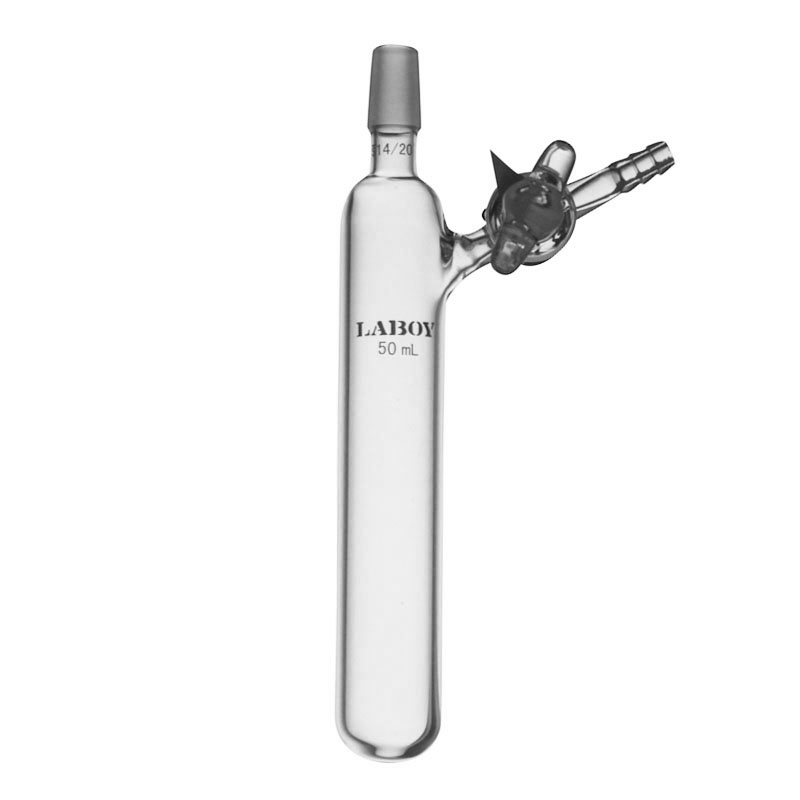
Fast answer: Choose a small-scale reaction tube when the reaction is genuinely small and you want a vessel that matches the scale, wastes less material, and may also support sealing, inert-gas handling, or compact setup design. Do not assume that every small reaction tube is a pressure tube, and do not assume that every side-arm version is equally suitable for demanding air-sensitive work.
What This Family Includes
At the bench, “small-scale reaction tube” usually refers to a compact cylindrical reaction vessel with a standard taper joint at the top, or with a side arm and valve system added. If you want the wider context for how these pieces fit into assembled reaction apparatus, start with Mixing & Reaction Setup. The family is easiest to understand by function.
| Type | What it adds | Best used when | Not the first choice when |
|---|---|---|---|
| Plain small reaction tube | A compact vessel sized for micro-scale or semi-micro work | You mainly want a scale-matched container with less waste and less hold-up | You need built-in gas control, repeated vacuum cycling, or a more connected apparatus |
| Side-arm reaction tube with glass stopcock | Controlled gas access plus a more organized small-scale setup | You want routine small-scale inert handling or simple vacuum/inert-gas work without moving to a larger flask | The chemistry is highly sensitive or repeated vacuum/inert-gas cycling is critical |
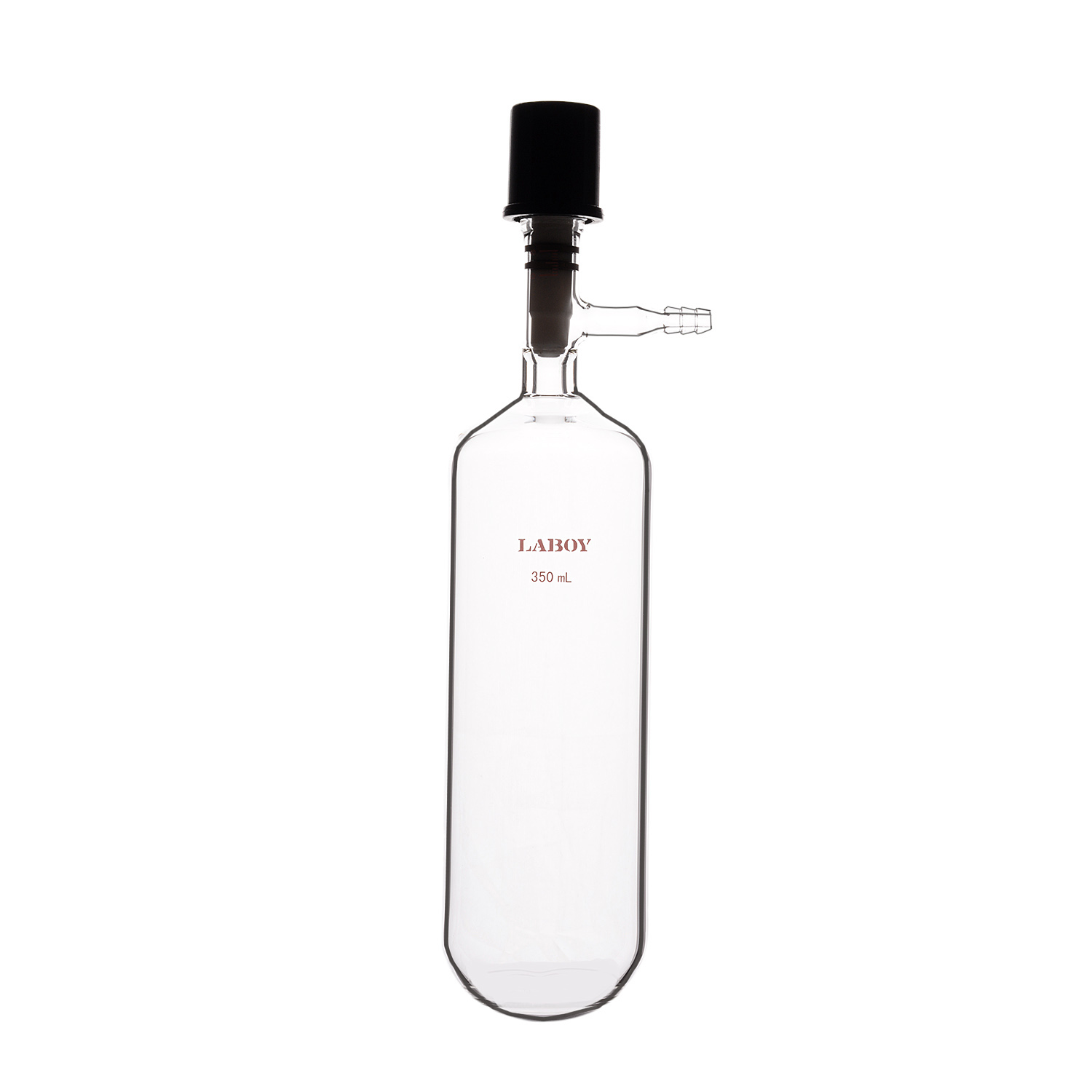
| High-vacuum Schlenk tube | A better valve system and more reliable atmosphere-control behavior | You need a truly small Schlenk-style vessel for air-sensitive or moisture-sensitive chemistry | The job is just simple small-scale heating, holding, or screening |
Joint orientation also matters. Inner-joint and outer-joint versions are not separate functional categories in the same way, but they do affect what connects directly and what requires an adapter. That becomes important as soon as the tube has to mate cleanly with condensers, adapters, inlets, or other fitted parts.
What It Does at the Bench
A small-scale reaction tube is usually solving one or more practical problems:
- keeping a micro-scale or semi-micro reaction in a vessel that better matches the amount of material
- reducing hold-up and transfer loss when the available material is limited or expensive
- making small-scale screening easier when several conditions must be tested
- combining reaction, sealing, and gas access in one compact piece of glassware
- making small low-temperature or inert-atmosphere work easier to handle than it would be in an oversized flask
The real advantage is not simply that the vessel is small. The advantage is that the vessel can be better matched to the scale and, in some versions, can also handle atmosphere control without forcing the operator into a larger, more cumbersome setup.
This matters because small reactions often go wrong for practical reasons. The vessel is oversized, the transfer loss becomes significant, the stirring is poor, or the atmosphere control is clumsy. A good small-scale reaction tube can reduce some of those losses, but only when its features match the job.
When You Would Choose It, and When Not
Small-scale reaction tubes make the most sense when the chemistry is actually small, when material loss matters, or when you want a compact vessel that can also support sealing or controlled gas handling. They are less attractive when the reaction really wants the mixing space, visibility, and general flexibility of a flask.
| Situation | Typical use case | Why a small-scale reaction tube fits well |
|---|---|---|
| Micro-scale or semi-micro synthesis | Reactions with small liquid or solid quantities | The vessel is better matched to the scale, with less wasted reagent and less material left spread over oversized glass surfaces. |
| Condition screening | Trying several small reaction conditions in parallel | The small format makes screening easier without consuming large amounts of starting material. |
| Small-scale inert-atmosphere work | Reactions where the vessel must connect to inert gas or be vacuum-cycled | Side-arm and high-vacuum variants bring Schlenk-style logic into a smaller, more economical vessel. |
| Low-temperature work | Small reactions run in cooling baths | The compact shape is easy to immerse and usually easier to manage than a larger flask holding a very small charge. |
| Reaction plus short-term sealed holding | Keeping a sensitive intermediate in the same vessel after the reaction | The same vessel can sometimes serve as both reaction container and controlled storage vessel, reducing transfers. |
When it may not be the best first choice
- Ordinary larger-scale heated work: A round-bottom flask is usually easier to build around and easier to stir well.
- Heterogeneous or viscous mixtures: Very small tubes often become poor stirring vessels once solids, slurries, or higher viscosity enter the picture.
- Work that needs clear visual observation: A narrow compact vessel can make it harder to judge reflux behavior, phase behavior, or precipitation.
- Setups with many attachments: Once the setup becomes too adapter-heavy, a small flask may be cleaner and easier to manage.
- Pressure chemistry: A small-scale reaction tube is not automatically a pressure-rated vessel.
- Simple small holding or heating: If a plain test tube already solves the problem, a more specialized reaction tube may add complexity without real benefit.
Quick decision guide: If the chemistry is small, valuable, screening-heavy, or genuinely needs compact atmosphere control, a small-scale reaction tube may be the right choice. If the work mainly needs strong stirring, general reflux, straightforward setup flexibility, or pressure resistance, step back and ask whether a round-bottom flask, Schlenk flask, or pressure tube is the better tool.
How the Top Joint and Side Arm Change the Job
What the top joint is usually doing
The top joint is not just a nicer opening. It turns the vessel into something that can connect cleanly to other fitted parts. Depending on the setup, the top joint may be used to:
- seal the tube with a stopper or septum
- connect to a condenser or adapter
- accept an inlet, thermometer adapter, or transfer connection
- make the small vessel part of a more deliberate assembled setup rather than a stand-alone tube
That is one reason these tubes are different from ordinary test tubes. The joint lets the vessel participate in apparatus logic rather than just hold liquid.
What the side arm is usually doing
A side arm gives the vessel a controlled route for gas or vacuum access that is separate from the main opening. In practice, that can mean:
- connecting to inert gas without leaving the top fully open
- carrying out basic evacuate-and-refill handling on a small scale
- reducing the need to improvise awkward gas access through the main neck
- keeping the top joint available for another fitted part
The side arm is useful only when that control is actually needed. If the chemistry does not need it, the added complexity may not be worth it.
Glass stopcock versus high-vacuum valve
| Feature | Glass stopcock version | High-vacuum valve version |
|---|---|---|
| Best role | Routine small-scale inert handling and simple controlled gas access | More demanding air-sensitive work and repeated vacuum/inert-gas cycling |
| Main bench advantage | Simpler and often sufficient for modest small-scale handling | More reliable sealing and better fit for genuinely sensitive chemistry |
| Main limitation | Less forgiving when the chemistry is very sensitive or the sealing demands are high | More specialized, more expensive, and less worth using casually when the chemistry does not need it |
| Common misuse | Assuming every side-arm stopcock tube is “basically a Schlenk tube” in every practical sense | Treating it as just a premium version of the same tool rather than a different level of atmosphere-control vessel |
For beginners, the important point is simple: these two versions may look related, but they are not interchangeable in every situation. The more air-sensitive the chemistry and the more important repeated vacuum handling becomes, the more the valve system starts to matter.
Heating, Stirring, and Scale Limits
Small-scale reaction tubes are often attractive because they look efficient, but they still have practical limits. A vessel can be the right size for the amount of material and still be the wrong shape for how the reaction behaves.
Where they often work well
- small heating or cooling tasks where the tube sits cleanly in a bath or heating block
- micro-scale reactions where magnetic stirring remains effective
- small inert-atmosphere setups where a larger flask would mostly be empty space
- short screening reactions where compact handling matters more than apparatus flexibility
Where problems often start
- the mixture becomes viscous, slurrylike, or full of suspended solid
- the magnetic stir bar no longer couples well in the narrow vessel
- the reaction needs more headspace than the small tube comfortably provides
- the setup needs multiple additions, prolonged reflux, or clearer visual monitoring
If those warning signs appear, the answer is often not “force the tube to do more.” The better answer is usually to move up to a small round-bottom flask or a Schlenk flask that gives the reaction more room and better overall setup logic.
Similar Tools and Important Boundaries
| Vessel | Better for | Advantage over a small-scale reaction tube | When the small-scale reaction tube is the better choice |
|---|---|---|---|
| Ordinary test tube | Simple small-volume holding or heating | Simpler when no fitted connection or gas-control feature is needed | When the job needs more than just “a small tube” |
| Round-bottom flask | General heated work, reflux, and more flexible assembled setups | Usually easier to stir, easier to build around, and easier to monitor | When the chemistry is small enough that the flask starts to feel oversized and wasteful |
| Schlenk flask | Larger air-sensitive reactions | More familiar and often easier to manage when the setup needs more space | When the same atmosphere-control logic is needed at a much smaller scale |
| Pressure tube | True pressure chemistry | Chosen for pressure design rather than compactness alone | When the chemistry needs small scale or atmosphere control, but not actual pressure-rated operation |
Small-scale reaction tube vs ordinary test tube
A test tube is mainly a small vessel. A small-scale reaction tube is often a small vessel plus fitted connection logic. If the work only needs a small container, a test tube may be enough. If the work needs sealing, gas access, or clean integration with other apparatus, the specialized reaction tube makes more sense.
Small-scale reaction tube vs round-bottom flask
A round-bottom flask remains the more general reaction vessel for heating, reflux, and broader apparatus work. A small-scale reaction tube becomes attractive when the amount of material is so small that the larger flask creates unnecessary loss, awkward handling, or too much empty volume.
Small-scale reaction tube vs Schlenk flask
A Schlenk flask is usually the better choice once the reaction needs more room, stronger stirring, or more standard air-sensitive setup logic at a larger scale. A small-scale reaction tube is better when the same basic atmosphere-control idea is needed, but on a smaller and more economical scale.
Small-scale reaction tube vs pressure tube
This is the boundary beginners most need to respect. A side arm, stopcock, or valve does not make a vessel pressure-rated. If the work is truly sealed and pressurized, choose a vessel because it is designed for pressure, not because it looks sturdy or seals well. Do not use a small-scale reaction tube for pressure work unless the design is specifically made and clearly identified for that purpose.
Common Beginner Mistakes
1. Treating every side-arm tube like a true Schlenk vessel
Mistake: Assuming that any small reaction tube with a side arm automatically gives the same practical atmosphere control as a high-vacuum Schlenk vessel.
Why it causes trouble: Similar-looking vessels do not always handle sensitive chemistry equally well.
A better approach: Match the valve system to the sensitivity of the chemistry and the actual demands of the handling.
2. Assuming “small and sturdy” means pressure-safe
Mistake: Thinking that a compact glass tube with a valve or thick-looking walls must be suitable for pressure chemistry.
Why it causes trouble: Pressure design is a separate question from size, compactness, or sealing features.
A better approach: Treat pressure tubes and small-scale reaction tubes as different categories unless the design clearly says otherwise.
3. Choosing the tube before deciding what must connect to it
Mistake: Ignoring joint orientation and connection logic until assembly is already underway.
Why it causes trouble: A small clean setup can turn into an awkward adapter chain if the joint direction does not match the rest of the apparatus.
A better approach: Decide first what needs to connect directly, then choose the reaction tube variant that fits that plan.
4. Overfilling the vessel
Mistake: Treating the nominal volume as if it were usable reaction volume.
Why it causes trouble: Small vessels still need headspace for boiling, gas movement, and ordinary safe handling.
A better approach: Leave room for how the reaction behaves, not just for how much liquid technically fits.
5. Forcing a difficult mixture to stay in too small a vessel
Mistake: Continuing with a narrow compact tube even after stirring becomes poor or the mixture becomes hard to manage.
Why it causes trouble: The right reaction scale does not guarantee the right stirring or handling behavior.
A better approach: If the mixture needs more room, clearer observation, or more reliable stirring, move to a flask that better fits the reaction.
6. Using a specialized tube when a simple vessel would already work
Mistake: Choosing the most elaborate version by default.
Why it causes trouble: Extra features only help when they solve a real apparatus or handling problem.
A better approach: Start with the simplest vessel that genuinely fits the chemistry, then add complexity only when the work requires it.
7. Neglecting the valve or stopcock itself
Mistake: Checking only the glass body and ignoring the moving sealing parts.
Why it causes trouble: A reaction tube with a sticky, dirty, or leaking valve is failing at the part that makes it special.
A better approach: Treat the stopcock or valve as part of the vessel, not as an accessory added afterward.
What to Check in Use
Before you start
- Check the glass body for chips, cracks, and scratches
- Check whether the stopcock or valve moves properly and seals cleanly
- Make sure the vessel size really matches the reaction scale
- Decide whether the chemistry actually needs gas-control features
During assembly
- Check joint orientation and compatibility before building the setup
- Use the top joint and side arm deliberately rather than improvising around them
- Leave realistic headspace for boiling, gas movement, and additions
- Choose a stirring method that is realistic for the mixture, not just for the scale
During operation
- Watch whether stirring is still effective as the mixture changes
- Check whether the valve or stopcock is still sealing as expected
- Look for signs that the vessel is too full, too narrow, or too ambitious for the job
- Re-check atmosphere control if sensitive reactions become inconsistent
If you are still deciding whether this vessel belongs in your workflow, it is often easier to step back and compare it against the broader setup categories in Mixing & Reaction Setup, review the bench sequence in Start Here, or move to Troubleshooting if the setup already feels wrong in practice.
Related Pages
Learn the setup logic
- Start Here
- Mixing & Reaction Setup
- Understanding Core Setups
- Basic Inert-Atmosphere Hardware
- Evacuate-and-Refill Basics
Compare related vessels
- Reaction Vessels in Mixing & Reaction Setup
- Schlenk Vessels
- Pressure Tubes
- Round-Bottom Flasks
- Ordinary Test Tubes
Troubleshoot related problems
- Troubleshooting Organic Lab Work
- Common Beginner Setup Mistakes
- Why Your Inert-Atmosphere Work Keeps Failing
- Why Your Small-Scale Setup Feels Wrong
Use a practical resource
- Downloadables
- Small-Scale Vessel Selection Quick Guide
- Basic Schlenk Handling Checklist
- Basic Glassware Inspection Checklist