Schlenk Vessels
Schlenk vessels are specialized glass reaction containers for air-free and moisture-free work. Their real value is not just that they have a side arm. Their value is that they combine a reaction vessel, a controllable gas-access path, and a standard glass connection in one piece of apparatus.
If a reaction, intermediate, or solvent has to stay away from air and water, a Schlenk vessel often makes more sense than trying to improvise the same job with an ordinary flask. They are not simply “more advanced flasks.” They are small atmosphere-control platforms built for air-sensitive and moisture-sensitive work.
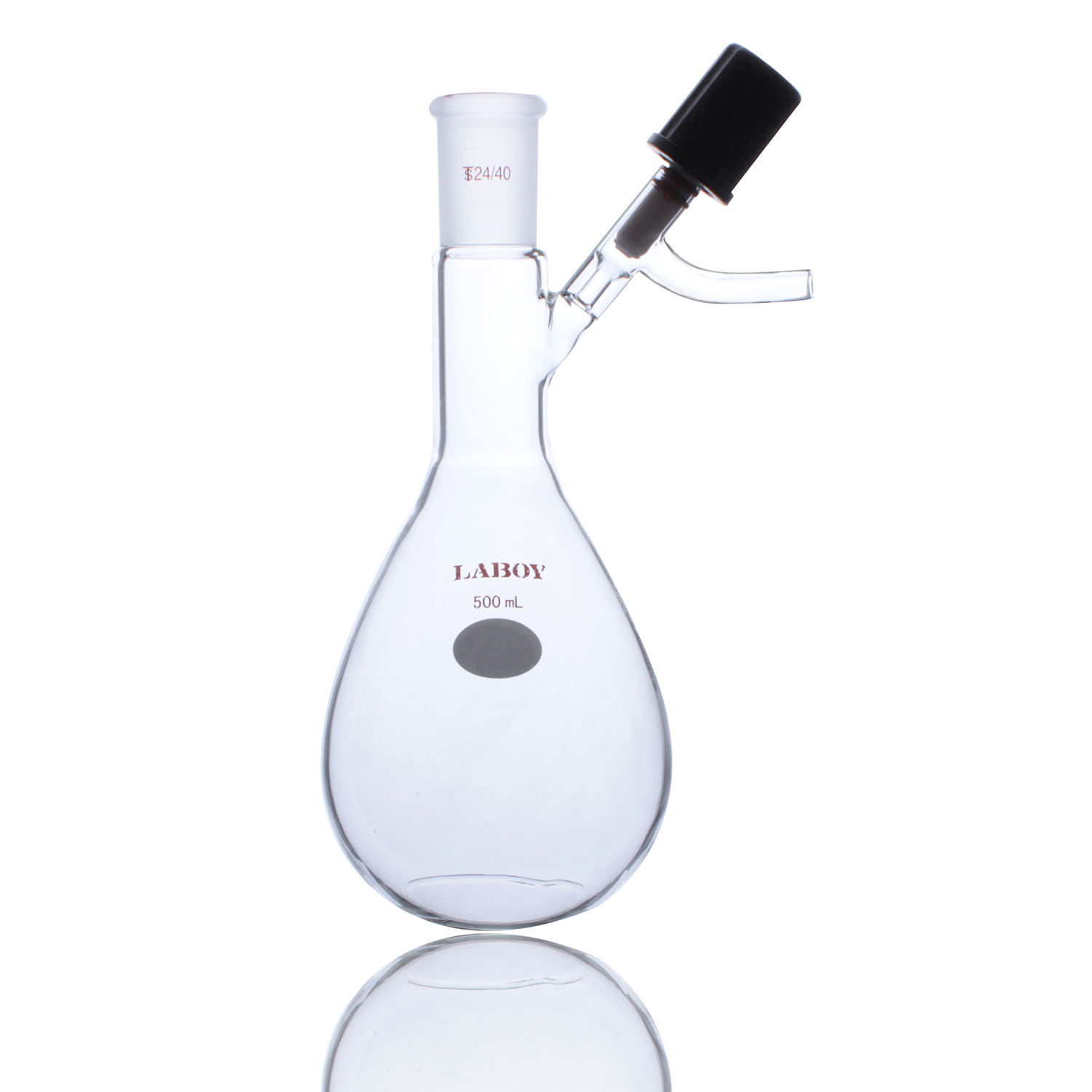
Fast answer: Choose a Schlenk vessel when the chemistry needs repeated vacuum / inert-gas cycling, sealed air-free handling, or a vessel that can move more naturally between reaction, transfer, and short-term protected storage. Do not choose one just because it looks more specialized. Its real value appears only when atmosphere control is part of the job.
How to Recognize It
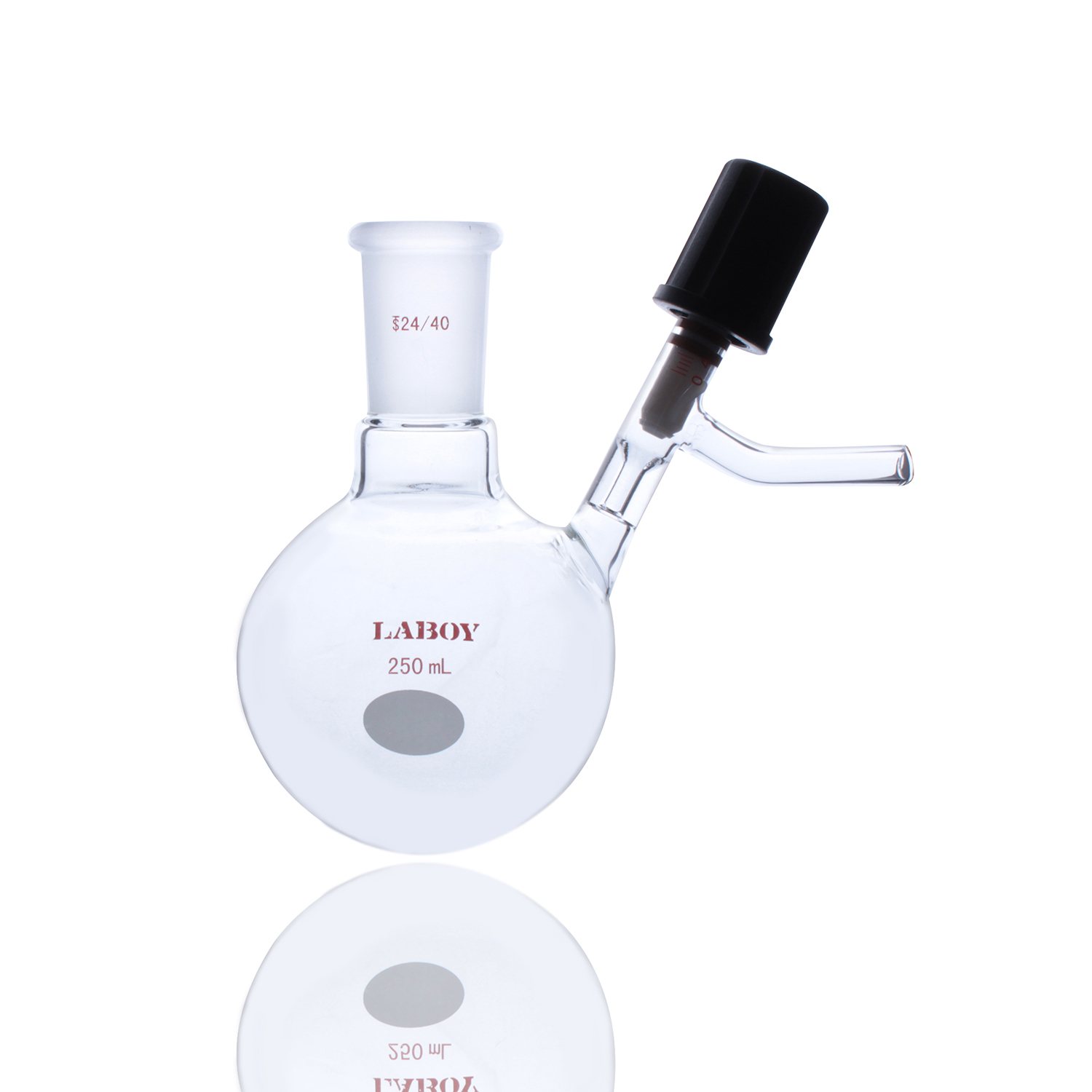
A Schlenk vessel usually has three identifying features: a side arm, a valve or stopcock on that side arm, and one or more standard taper joints. The body may look like a flask or a tube, but the important point is structural, not visual. It is designed to connect to a Schlenk line system and allow the interior atmosphere to be changed deliberately rather than left open to room air.
That is the most useful beginner definition: this is not just a vessel with an extra branch. It is a vessel built to be evacuated, refilled with inert gas, sealed, and used as part of an air-free workflow.
What It Does at the Bench
At the bench, a Schlenk vessel is usually doing one or more of these jobs:
- holding an air-sensitive or moisture-sensitive reaction
- serving as a protected storage vessel for an intermediate, reagent, or dry solvent
- acting as a vacuum / inert-gas cycling unit connected to a Schlenk line
- giving a smaller or more controlled platform for low-temperature or sensitive handling
- reducing transfers by letting reaction, protection, and short-term storage happen in the same vessel
The important point is integration. An ordinary flask can sometimes be adapted for air-free work, but the Schlenk vessel was designed around that job from the beginning. It gives you a reaction container and an atmosphere-control path at the same time.
That is why Schlenk vessels matter so much in organometallic chemistry, coordination chemistry, sensitive reagent handling, and dry-solvent workflows. They are not just “glassware for advanced labs.” They are a practical answer to a very specific bench problem: how to keep air and water from turning into uncontrolled variables.
When You Would Choose It, and When Not
Schlenk vessels make the most sense when atmosphere control is not optional. If the reaction, transfer, or storage step must stay dry and air-free, the vessel starts to justify itself very quickly.
Situations where a Schlenk vessel is often the right choice
| Situation | Typical use case | Why a Schlenk vessel fits well |
|---|---|---|
| Air-sensitive reactions | Organolithium, organomagnesium, sensitive transition-metal, phosphine, or similar chemistry | The vessel is built to connect directly to an air-free system and support repeated vacuum / inert-gas cycling. |
| Dry-solvent storage and transfer | Holding or dispensing rigorously dried solvents | The vessel can stay sealed and connected to inert gas instead of being treated like an ordinary storage bottle. |
| Small or medium-scale sensitive work | Reactions where a general flask feels too open or too improvised | The vessel integrates reaction space and atmosphere-control access in one body. |
| Low-temperature or degassing operations | Cold-bath work, freeze–pump–thaw, or similar handling | The sealed, side-arm design fits low-temperature and vacuum logic naturally. |
| Reaction plus protected short-term storage | Keeping a sensitive intermediate in the same vessel after reaction | The vessel can be closed and kept under inert conditions without immediate transfer. |
Situations where it may not be the best first choice
- Ordinary heating or reflux with no air-sensitivity problem: A round-bottom flask is usually simpler and more natural.
- Larger, more routine heated work: A Schlenk vessel may add complexity without solving a real problem.
- Tasks driven mainly by strong stirring, larger volume, or ordinary setup flexibility: The air-free structure may not be the main need.
- Cases where the vessel is being chosen for “advanced” appearance rather than atmosphere control: Specialty glassware only helps when the chemistry actually needs it.
Quick decision guide: If the chemistry must stay away from air or moisture, and especially if you will be connecting to a line for vacuum / inert-gas cycling, a Schlenk vessel is often worth choosing. If the job is ordinary reflux, standard distillation, or routine heated reaction work, start by asking whether a round-bottom flask or another simpler vessel already solves the real problem.
Common Types and What Actually Matters
Standard Schlenk Flask or Tube
This is the basic family form: a vessel body, one side arm, one valve or stopcock, and a standard joint. Some are more flask-like and some are more tube-like.
Glass Stopcock Versions
These are the more traditional versions. They are usually more economical and can work well for ordinary air-free handling, but they often depend on grease for sealing and can be less convenient to maintain cleanly.
High-Vacuum Valve Versions
These are the more research-oriented versions. They are more appropriate when the chemistry is more sensitive, the vacuum demands are higher, or the vessel will be cycled repeatedly between vacuum and inert gas.
Storage and Transfer Vessels
Some Schlenk vessels are really chosen less for “reaction” and more for protected storage or solvent transfer. These are still part of the same family, but the main decision is not reaction geometry. It is atmosphere control plus safe handling.
Glass Stopcock vs PTFE Stopcock vs High-Vacuum Valve
This is one of the most useful distinctions on the page, because many readers underestimate how much the valve type changes day-to-day reliability.
Glass Stopcock
A glass stopcock is the more traditional choice. It is often economical and can be perfectly workable for ordinary air-free handling. The tradeoff is that it commonly depends on grease for sealing, can be less clean in use, and can become annoying if cleaning and lubrication are not handled well.
PTFE Stopcock
A PTFE stopcock is often the “middle” option many users encounter in practice. It is usually easier to use cleanly than a traditional glass stopcock and less dependent on grease, but it should not automatically be treated as equivalent to a true high-vacuum valve.
High-Vacuum Valve
A true high-vacuum valve is the more dependable choice when the chemistry is highly sensitive, the vessel is vacuum-cycled repeatedly, or the sealing demands are clearly higher. These versions are usually the better fit for more demanding research-level air-free work.
| Valve type | Better for | Main advantage | Main limitation |
|---|---|---|---|
| Glass stopcock | Ordinary air-free handling | Traditional, economical, workable | Often grease-dependent and less convenient to keep clean |
| PTFE stopcock | Ordinary air-free handling with cleaner operation | Usually easier and cleaner to use than glass stopcocks | Not automatically a substitute for a true high-vacuum valve |
| High-vacuum valve | More sensitive chemistry and stronger vacuum demands | More reliable sealing and more serious air-free performance | More specialized, more expensive, and more dependent on valve maintenance |
What Else Is Usually Used with a Schlenk Vessel
A Schlenk vessel is not a self-contained solution. It only makes full sense when seen as part of a wider air-free system.
- Vacuum Manifolds: the core switching system for vacuum and inert gas
- Bubblers: pressure indication, gas flow indication, and atmosphere barrier
- Cold Traps: solvent-vapor capture and vacuum-pump protection
- Gas source and vacuum source: the actual inert gas and pump behind the line
- Injection and addition tools: syringes, needles, septa, funnels, and related transfer tools
- Support and clamping: rings, clamps, and stable support, which remain safety-critical even in “small” air-free setups
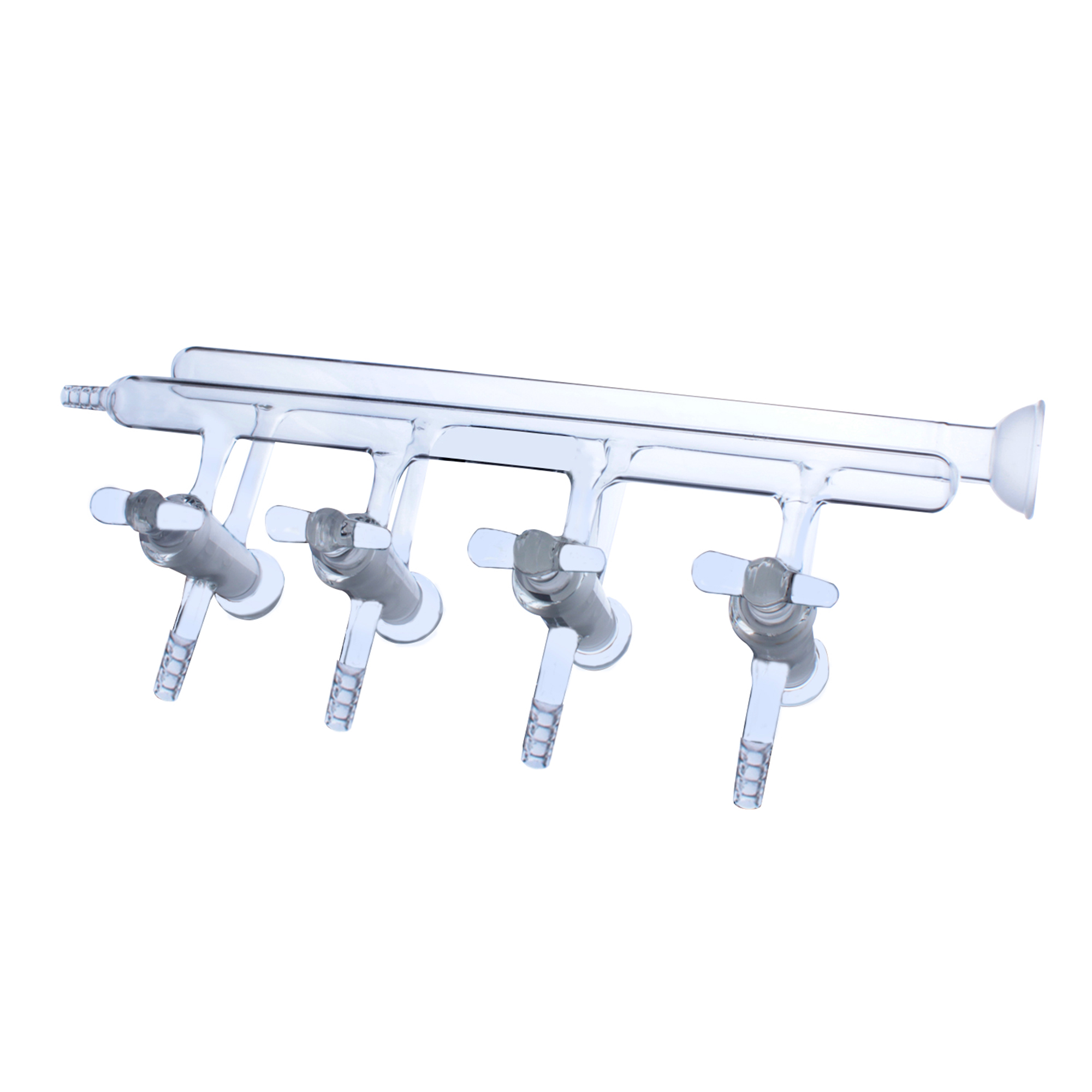
In ChemNorth terms, this is why Schlenk Vessels should not be read as a detached product family. It connects directly to Atmosphere-Control Logic, Basic Setup Principles, Safety, Sealing, and Leak Checking, and Setup Readiness and Startup Checks.
How It Is Usually Used
1. Pre-use check
Before the chemistry matters, the glassware and the line have to be worth trusting. That means checking the vessel body, the valve, the joints, the cold trap, and the bubbler before the setup becomes live.
2. Vacuum / inert-gas cycling
This is the defining move: the vessel is connected to the line and taken through repeated evacuation and refill with inert gas. That is the practical reason this family exists, and it is why Evacuate-and-Refill Basics deserves its own linked page.
3. Protected addition, assembly, and reaction
Once the atmosphere is controlled, the vessel becomes the platform for addition, stirring, cooling, heating, or reflux under protection. If reflux is needed, this page should naturally connect to Reflux under Inert Atmosphere.
4. Protected shutdown, transfer, or storage
When the reaction ends, the logic does not stop. Product isolation, transfer, or storage may still need protection. That is one reason Schlenk vessels are often more than “reaction flasks.”
Safety: What Actually Matters
1. Glass integrity is the first safety barrier
What matters: Any crack, star crack, or serious defect becomes much more serious once vacuum is involved.
Why it matters: In Schlenk work, damaged glass is not a cosmetic problem. It is a real implosion hazard.
2. Valves are not safer because they feel tighter
What matters: PTFE high-vacuum valves generally need only finger-tight closure.
Why it matters: Overtightening can damage the valve seat and create exactly the reliability problem the operator thinks they are preventing.
3. Vacuum-system risks are not limited to the pump
What matters: Oil backflow, bubbler suck-back, and liquid-air formation in a cold trap are real risks in this system.
Why it matters: The danger in Schlenk work often comes from the whole connected system, not from the vessel alone.
4. How the vessel is supported still matters
What matters: The vessel should be supported sensibly and not just left on a hard surface as if it were ordinary bench glassware.
Why it matters: Apparatus logic and glass stress are part of air-free work too, not separate from it.
5. PPE has to scale with the chemistry
What matters: Eye protection is the baseline. Low-temperature handling, strongly reactive chemistry, or high-risk air-sensitive work may require more.
Why it matters: A vessel designed for more sensitive chemistry changes the safety environment around it.
Common Beginner Mistakes
1. Treating a Schlenk vessel as just a “better flask”
Mistake: Reaching for it because it feels more advanced.
Why it causes trouble: Its value only appears when atmosphere control is actually part of the problem.
A better approach: Ask first whether the chemistry really needs air-free handling.
2. Not distinguishing glass stopcocks, PTFE stopcocks, and high-vacuum valves
Mistake: Treating all “valved” vessels as if they perform the same way.
Why it causes trouble: These options overlap, but they do not support demanding air-free work equally well.
A better approach: Match the valve type to the sensitivity and vacuum demands of the chemistry.
3. Assuming the vessel solves the whole air-free problem by itself
Mistake: Focusing on the vessel and ignoring the line, the bubbler, the cold trap, and the rest of the system.
Why it causes trouble: Real air-free work is a system skill, not just a vessel choice.
A better approach: Learn the vessel and the line together.
4. Neglecting valve and seal maintenance
Mistake: Checking only the glass body while ignoring moving parts and seals.
Why it causes trouble: A clean-looking vessel with a dirty or unreliable valve is not actually ready for use.
A better approach: Treat the valve as part of the vessel, not an accessory.
5. Confusing a Schlenk vessel with a pressure vessel
Mistake: Assuming sealed plus vacuum-capable means pressure-safe.
Why it causes trouble: Pressure-rated chemistry is a different vessel-selection problem.
A better approach: Keep Pressure Tubes and Schlenk vessels conceptually separate.
Selection and Maintenance
When choosing a Schlenk vessel, look first at glass quality, valve type, working volume, joint orientation, and whether the expected use is routine air-free handling or more demanding high-vacuum / highly sensitive work.
After use, the vessel needs more than ordinary rinsing. The valve area matters. The seals matter. Long-term storage posture matters. A vessel that is technically “clean” but poorly maintained at the valve is not really ready for serious air-free work.
What to Check in Use
Before you start
During setup
- Make sure the vessel is actually matched to the chemistry
- Do not overtighten a PTFE high-vacuum valve
- Support the vessel sensibly
- Keep the atmosphere-control logic clearer than the glass geometry
During operation
- Watch for loss of vacuum or loss of inert pressure
- Watch whether the valve is still behaving properly
- Re-check the system if sensitive chemistry behaves inconsistently
- Remove liquid-nitrogen cooling from the trap at the right stage of shutdown