A hot plate is the standard heating platform for flat-bottomed vessels. A hot plate stirrer adds magnetic stirring to that same platform, turning one of the most common bench tasks—heating and mixing a liquid—into a single, compact setup. Their usefulness is obvious. Their safety boundary should be equally obvious: they are not the default tool for boiling highly flammable organic solvents.
Fast Answer
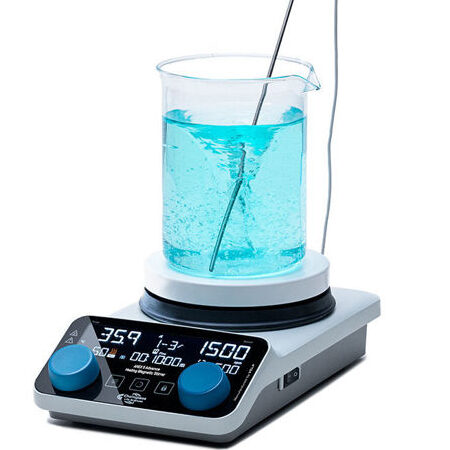
A hot plate is a flat electric heater for flat-bottomed vessels. A hot plate stirrer does the same job, but also spins a stir bar so the liquid can be heated and mixed at the same time.
They are especially useful for beakers, Erlenmeyer flasks, crystallizing dishes, baths, solution heating, hot filtration support, TLC stain development, and other flat-bottom work. They are not the right default answer for every heating problem, and they are not the safe choice for boiling highly flammable organic solvents.
What They Are and How They Work
A hot plate is a flat electric heating device. Inside the unit, a resistance element generates heat. That heat is transferred into a metal or ceramic-coated top plate, and then into the vessel sitting on the surface. The whole system depends on direct contact between a flat vessel bottom and a flat heated surface.
A hot plate stirrer adds a second system underneath that top plate: a motor-driven magnetic field. When a stir bar is placed in the vessel, that magnetic field drives the stir bar around, which keeps the liquid moving while the plate supplies heat. That combination is what makes hot plate stirrers so common. Many bench tasks do not just need heat. They need heat and mixing at the same time.
The crucial point is that these are platform heaters. They are designed around a flat surface and a flat vessel base. Their usefulness comes from that simplicity.
Why They Show Up Everywhere
These devices are common because a very large share of routine laboratory work happens in flat-bottomed glassware. Beakers, Erlenmeyer flasks, crystallizing dishes, evaporating dishes, and many improvised bath setups all sit naturally on a hot plate. There is no special support geometry to figure out, no custom heater shape to match, and no need to build a separate stirring platform when the work calls for both heat and mixing.
That is also why a hot plate stirrer often becomes a kind of default bench platform. Once the vessel can sit directly on it and the stir bar can stay coupled, the setup is easy to read and easy to control.
Where They Fit Best
Heating baths
One of the most natural uses for a hot plate is to heat a water bath, oil bath, or sand bath. In that setup, the plate is not heating the sample vessel directly. It is heating the bath medium, and the bath medium then heats the sample more gently and more evenly.
Heating flat-bottom vessels directly
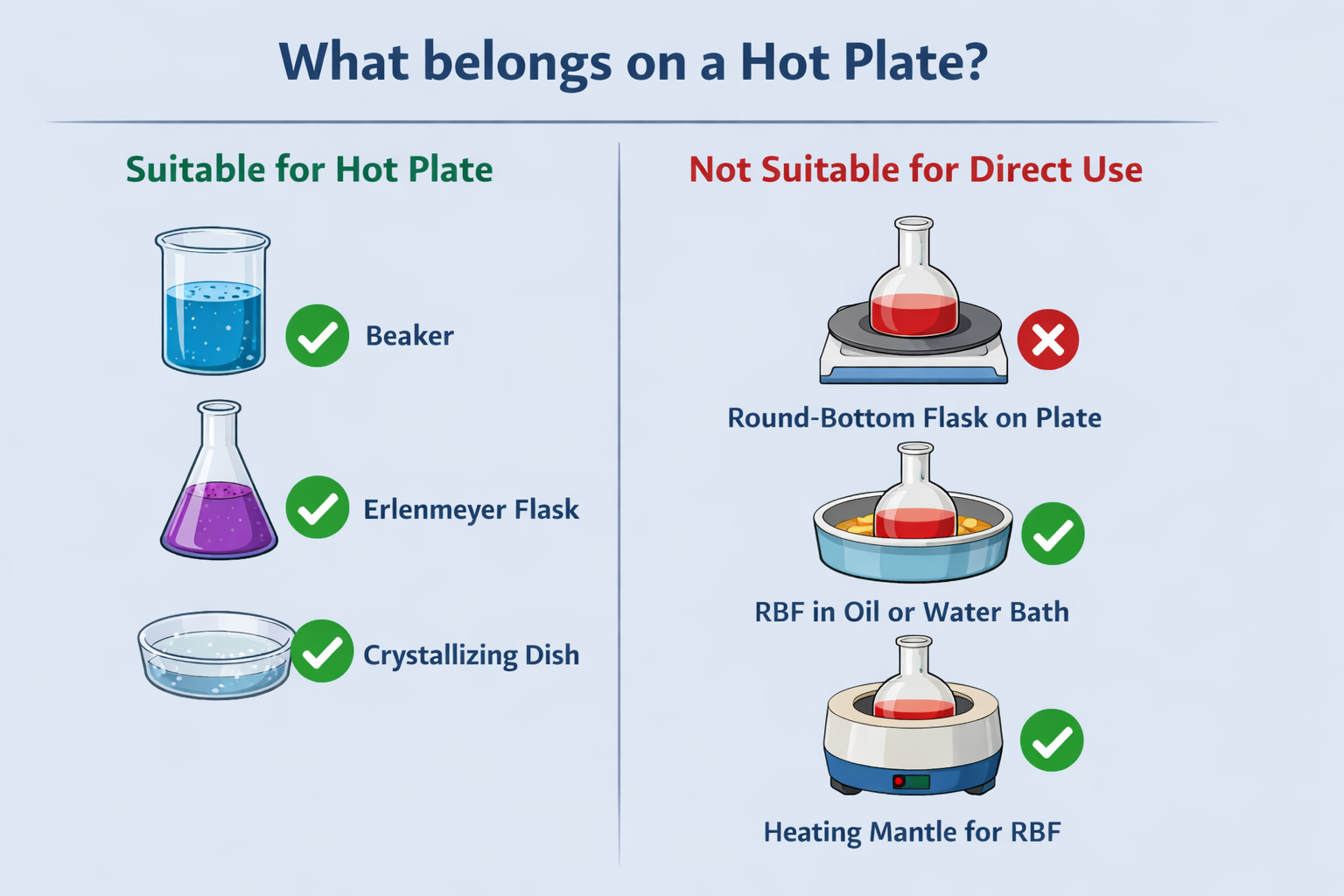
Hot plates and hot plate stirrers are at their best with vessels that actually match the flat surface: beakers, Erlenmeyer flasks, crystallizing dishes, and similar containers. If the vessel can sit flat and stable, the plate is working in the kind of geometry it was built for.
Heating and stirring together
This is where a hot plate stirrer earns its place most clearly. If the liquid needs to stay mixed while it is being heated—during dissolution, evaporation, warming, or bath equilibration—the built-in stirring turns two separate tasks into one compact routine.
Round-Bottom Flasks Are Not the Main Job Here
This is one of the most useful boundaries to understand early. A hot plate is built around flat contact. A round-bottom flask does not have that contact relationship. It does not sit naturally, and it does not heat efficiently from a flat surface.
If a round-bottom flask needs heat, the usual answer is either:
- place the flask in a water bath, oil bath, or sand bath that is being heated by the plate, or
- switch to a heating mantle, which is built for round-bottom flasks directly.
That distinction matters more than many beginners expect. A lot of heating mistakes come from treating all heat sources as if they were interchangeable.
The Most Important Safety Boundary
The biggest danger with hot plates is not that they are hot. It is that people see “no open flame” and assume that means “safe for flammable solvents.” That is not a safe assumption.
Do not boil highly flammable organic solvents on an ordinary hot plate
The risk comes from two places. First, the hot surface itself can ignite solvent vapor. Second, depending on the design, the unit may contain switches or relays that are not explosion-proof and may generate sparks internally while the surrounding air contains flammable vapor.
That means the real question is not “Is there a flame?” The real question is “Can flammable vapor reach a hot or sparking device?” If the answer is yes, the setup already deserves a different heating strategy.
This is also why a recently used hot plate should not be left sitting in the immediate area while volatile solvent is being poured or transferred. A switched-off plate may still be hot enough to matter.
Where They Are Most Useful in Practice
- Water baths, oil baths, and sand baths: one of the safest and most standard ways to use a hot plate.
- Heating aqueous solutions: especially when the vessel is already a beaker or Erlenmeyer flask.
- Recrystallization support work: dissolving solids, keeping liquids warm, and supporting hot filtration setups.
- TLC stain development: when the staining method calls for controlled plate warming.
- Heating while stirring: where hot plate stirrers become much more useful than a plain hot plate.
A practical way to think about it
A hot plate is a bench platform for flat-bottom work. A hot plate stirrer is that same platform plus mixing.
Good Operating Habits
- Match the vessel to the heater. If the vessel is not flat-bottomed, stop and rethink the setup.
- Center the vessel. This improves both heating and stir-bar stability.
- Do not overdrive the stirring. A violently decoupling stir bar does not mean “more mixing.” It often means the setup is already unstable.
- Keep the top clean. Residues can damage the surface and make later spills more dangerous.
- Treat the plate as hot until it is genuinely cool. Power off does not mean touch-safe or vapor-safe.
How They Compare with Other Heat Sources
| Heat Source | Best Match | Main Strength | Main Limit |
|---|---|---|---|
| Hot Plate | Flat-bottom vessels and bath setups | Simple, direct, useful as a platform heater | Not appropriate as the default tool for highly flammable solvent boiling |
| Hot Plate Stirrer | Flat-bottom vessels that need heating and mixing together | Heating and stirring in one device | Same flammable-vapor boundary, plus stir-bar stability issues if overloaded |
| Heating Mantle | Round-bottom flasks | Natural geometric match for reflux and many round-bottom flask operations | Not a flat-platform heater; not the right tool for beakers or dishes |
| Bath + Hot Plate | Indirect heating when gentler transfer or a round-bottom flask is needed | More controlled and more flexible than direct plate contact | Bulkier setup and slower response |
| Open Flame | Special cases only | Direct, intense heating | Usually the wrong choice in solvent-rich organic bench work |
Related Pages
Frequently Asked Questions
What is the difference between a hot plate and a hot plate stirrer?
A hot plate only heats. A hot plate stirrer heats and also drives a magnetic stir bar. If the job needs both temperature and mixing control in the same vessel, the stirrer version is usually the more useful tool.
Can I boil flammable organic solvents on a hot plate?
Ordinary hot plates and hot plate stirrers should not be treated as the default answer for boiling highly flammable organic solvents. The hazard is not only open flame. Hot surfaces and non-explosion-proof switching components can both become ignition sources when vapor is present.
Can I put a round-bottom flask directly on a hot plate stirrer?
That is usually not the right setup. A hot plate is designed around flat contact with a flat-bottom vessel. A round-bottom flask usually belongs in a bath or in a heating mantle, not directly on the plate.
Should I choose a ceramic top or an aluminum top?
Ceramic tops are often preferred for chemical resistance and easy cleanup. Aluminum tops are often valued for robustness and good temperature uniformity. The right choice depends less on brand language and more on whether chemical resistance or mechanical toughness matters more in your actual work.
Why does the display temperature not always match what I think the vessel is experiencing?
Because the set temperature, the plate-surface temperature, and the sample temperature are not the same thing. The vessel shape, the contact area, the sample volume, and whether a bath is involved all change what the sample actually feels.
Final Takeaway
Hot plates and hot plate stirrers are fundamental because they turn flat-bottom heating into a clean, repeatable bench routine. They are easy to use, easy to read, and especially useful when a vessel needs to sit directly on a heated surface or when heating and stirring need to happen together.
Their real value only stays clear if their limits stay clear too. They are excellent platform heaters for the right vessels. They are not universal heaters, and they should never be treated as casual boiling tools for highly flammable solvent systems.