A heating block makes the most sense when the real problem is not simply how to heat a reaction, but how to heat a very small vessel cleanly, with decent control, and without forcing a large heating system to do a small-scale job. In that setting, a metal heating block can be a very practical tool.
It is commonly used for vials, reaction tubes, and very small flasks. Instead of surrounding the vessel with oil or relying on a heater sized for larger glassware, the block gives the vessel a shaped metal cavity that transfers heat by close contact. That is what makes it feel more deliberate than an improvised small-scale setup and more specialized than a general hot plate arrangement.
What a heating block is really for
A heating block is not a universal heater. It is a scale-matched heater for small vessels when close fit and controlled heat transfer matter more than flexibility.
What it is
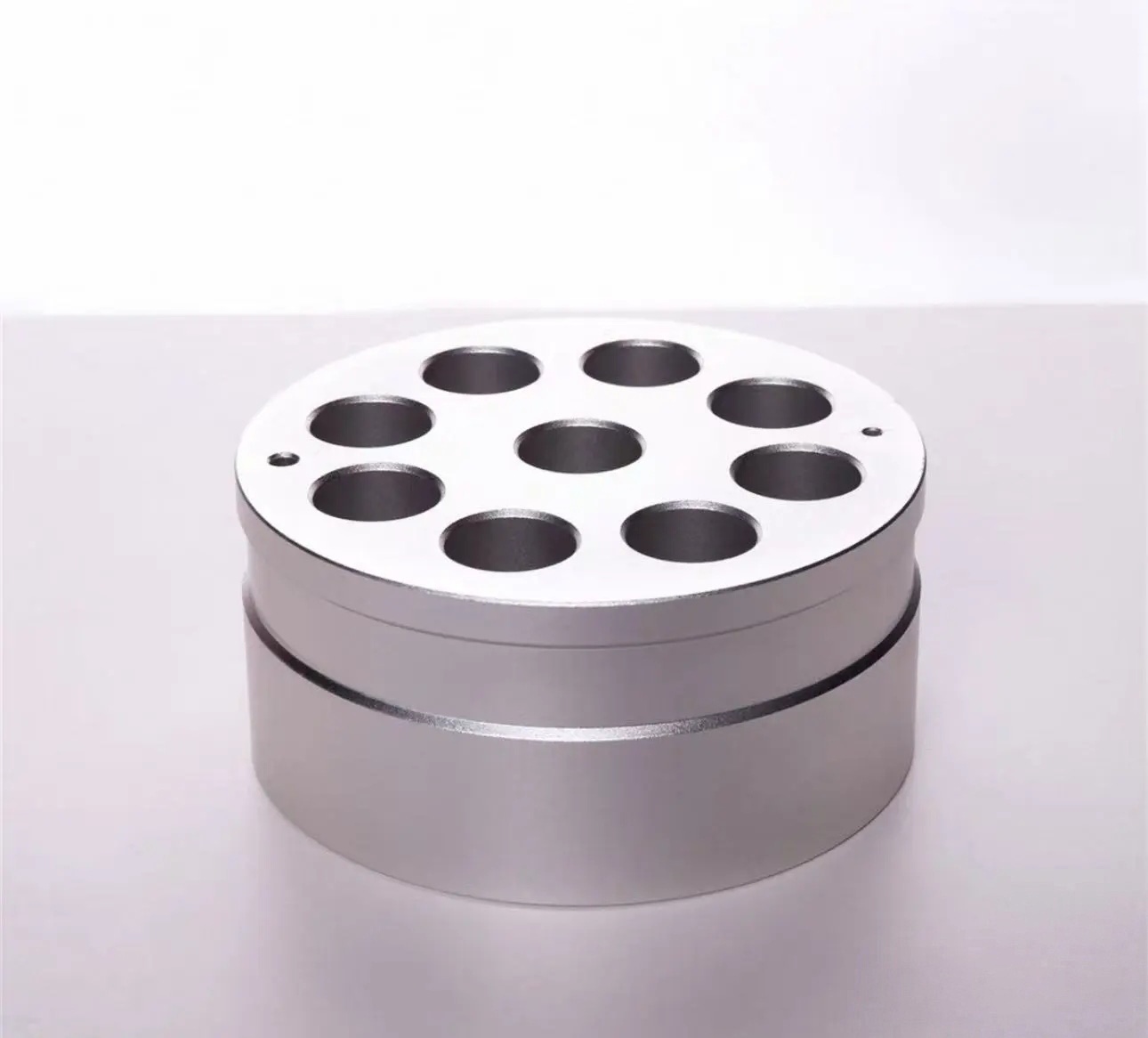
A heating block—often an aluminum block, sometimes another metal block—is a solid metal heater designed to hold small reaction vessels in shaped wells or cavities. The block itself usually sits on a hot plate or hot plate stirrer, which heats the metal. The metal then transfers heat into the vessel by direct contact and by radiative warming around the exposed glass.
That design works best with genuinely small vessels: reaction tubes, vials, and very small round-bottom flasks. Some blocks are drilled for narrow tubes. Others are machined for 5 mL or 10 mL round-bottom flasks. Some include removable collars or sleeves that warm more of the upper vessel wall rather than only the lower body. The details vary, but the bench logic stays the same: close fit, small scale, compact heating.
Most lab vessels used this way are borosilicate glass rather than ordinary soda-lime glass. That matters more than it sounds. ISO 3585 specifies the properties of borosilicate glass 3.3 used for laboratory apparatus, and that material choice is one reason small lab vessels tolerate routine heating better than lower-grade glass. It is still not permission to ignore thermal shock, but it is the right material baseline for repeated laboratory heating.
Technical note on compliance
When you are evaluating a commercial electric heating block, IEC 61010-1 is a more meaningful safety reference than generic “lab safe” language. It is the general safety standard for electrical laboratory equipment and addresses hazards such as excessive temperature, burn risk, and the spread of fire. That does not tell you whether a block is the right tool for your chemistry, but it does tell you the device has been judged as laboratory electrical equipment rather than as a generic hot metal accessory.
Why the fit matters so much
The real value of a heating block is not just that it is made of metal. It is that the vessel and the cavity are meant to fit each other. If that fit is poor, much of the reason to use the block disappears. A loose vial in an oversized well does not heat like a matched vial. A small flask sitting too high, or contacting only one narrow ring of metal, does not behave like a properly seated vessel.
This is why heating blocks work best when the vessel and the heater are chosen together. If the reaction is already planned in a small reaction tube or a very small round-bottom flask, then the next question is not simply whether it can be heated, but whether the heater is actually shaped for that vessel.
Where a heating block fits well
- microscale or semimicroscale reactions
- small reflux work in vials or very small flasks
- parallel small-vessel screening
- small reactions that need both heating and stirring
- cleaner bench work where an oil bath would be excessive
Where it stops making sense
- larger routine flask work
- vessels that do not match the cavity well
- setups that need visual access all around the vessel
- operations where one heater must handle many vessel shapes
- treating one block as a replacement for every bath or mantle
How it heats
A heating block is best understood as a dry indirect heating system. The hot plate heats the block. The block heats the vessel. The vessel heats the reaction mixture. That means the heat path includes several layers, and all of them matter: the block material, the cavity fit, the glass thickness, the vessel shape, the sample volume, and the quality of stirring.
This layered heat path is one reason a block often feels steadier than improvised direct heating for tiny vessels. It is also why block temperature is not the same thing as reaction temperature. The metal can be at one temperature while the liquid is still warming more slowly, running cooler than expected, or developing gradients inside the vessel.
The temperature mistake beginners make most often
If the probe is reading the block, it is reading the block—not the liquid inside the vial or flask. The difference between those two temperatures can be large enough to matter, especially during heat-up, with poor vessel fit, or when stirring is weak.
What they are especially good at
Heating blocks are most useful when the chemistry is small enough that a larger heating system starts to feel clumsy. That includes screening reactions in parallel, running a small reaction tube under reflux, holding a small flask at a stable heating level while a stir bar runs, or replacing an oil bath for a limited-scale reaction where the mess and spill risk of hot oil are simply not worth it.
They are also attractive for practical reasons. A block is cleaner than an oil bath. There is no bath liquid to spill, no oily flask exterior to wipe off, and no question about water dropping into hot oil. That does not make a heating block harmless, but it removes a class of problems that matter in real lab use.
What they do not do well
A heating block is not a general answer for ordinary 50 mL, 100 mL, or 250 mL flask work. Once the vessel becomes larger, the block becomes less natural, less flexible, and often less useful than a proper heating mantle, a real bath, or a different setup choice altogether.
They are also unforgiving when the vessel is wrong for the cavity. A bath can adapt to many shapes more easily than a machined aluminum well can. With a heating block, fit is not a minor detail. Fit is part of the heating method itself.
And like any solid metal heater, a block has thermal inertia. It does not cool instantly because the dial comes down. It does not behave like a flame. If the reaction is sensitive to overshoot or needs careful staged heating, that inertia has to be part of your planning.
Bench judgment: temperature display versus reference temperature
This is the place where it helps to borrow language from standards rather than just drop a standard number into the page. ASTM E3186 is written for dry-block temperature calibrators, not for ordinary synthesis heating blocks, so it should not be presented as a universal compliance standard for chemistry heating blocks. But its temperature-measurement logic is still useful.
ASTM E3186 distinguishes between direct mode and comparison mode. Direct mode means relying on the block’s own control sensor and display as the reference. Comparison mode means using an external reference sensor. For ordinary bench synthesis, that distinction is still helpful: the block display tells you what the heater or block is doing, but an external probe in a thermometer well gives you a much better reference point for what the block itself is actually reaching. Even then, block temperature still does not automatically equal liquid temperature inside your sample.
Heating block versus other common heat sources
| Heat source | Best match | Main strength | Main limit |
|---|---|---|---|
| Heating block | Small vials, reaction tubes, very small flasks | Compact, clean, scale-matched, practical for small heated reactions | Only works well when the cavity and vessel really match |
| Heating mantle | Round-bottom flasks | Natural geometric match for routine flask heating | Less flexible for mixed vessel formats or very small screening work |
| Bath + hot plate | When gentler indirect heating or wider vessel compatibility is needed | Adaptable, even heating across many vessel shapes | Bulkier setup; oil baths add spill and overheating concerns |
| Hot plate / hot plate stirrer | Flat-bottom vessels and bath setups | Simple platform heating, especially with stirring | Not the direct heater for round-bottom flasks |
Where stirring helps and where it stops helping
One reason heating blocks pair naturally with hot plate stirrers is that they allow heating and magnetic stirring in one compact arrangement. That can work very well for small, mobile liquid mixtures. It works much less well once the mixture becomes viscous, heavily suspended, or prone to poor stir-bar coupling in a narrow vessel.
Small scale does not automatically mean easy stirring. A reaction can be small in volume and still be difficult to mix. If the bar repeatedly decouples, the vessel may be too narrow, the mixture too thick, or the heating and stirring geometry may simply be wrong for that reaction.
Common mistakes that make heating blocks seem worse than they are
Using whatever vial or flask happens to fit “well enough”
Almost the right size is often the beginning of poor heat transfer. If the vessel rocks, sits too high, or contacts only a small part of the block, the heater is no longer doing the job it was designed to do.
Reading block temperature as if it were reaction temperature
A probe in the block is useful, but it does not remove the temperature difference between the metal, the glass, and the liquid. That difference may be modest or substantial depending on the setup.
Treating the block like a universal replacement for an oil bath
A heating block removes some oil-bath problems, but it does not replace a bath in every geometry or every scale. Once vessel shapes vary or the system gets larger, a bath may again be the more natural tool.
Ignoring upper-vessel heating
If only the lower part of the vessel is effectively heated, it is easy to assume the entire reaction environment is more uniform than it really is. This is one reason some systems use collars or sleeves around the upper wall of the vessel.
Leaving the block hot and empty for too long
A dry block is still a high-thermal-mass heater. Running it hot without a purpose, or forgetting that it stays hot after use, creates the same kind of avoidable bench problems seen with other electric heating tools.
A good first judgment
If the reaction is genuinely small, the vessel matches the cavity, and you want cleaner heating than an oil bath, a heating block is often the right tool. If the vessel is larger, oddly shaped, or only partly matched, stop treating the block as the default answer.
Related pages
Use the wider setup pages when the heating block is only one part of a larger bench problem.
FAQ
What is a heating block mainly used for in organic chemistry?
Its main role is small-scale heating. A heating block is most useful for vials, reaction tubes, and very small flasks when you want a compact, dry heater that matches the vessel closely and avoids the mess of an oil bath.
Is a heating block better than an oil bath?
Not automatically. A heating block is cleaner and simpler for many small reactions, but it only works well when the vessel fits the cavity properly. An oil bath is still more flexible when vessel shapes vary or when the setup needs broader compatibility.
Can I use any vial or flask in a heating block?
No. Fit is part of the heating method. If the vessel sits loosely, too high, or contacts only a small part of the block, heat transfer becomes much less predictable and the whole point of using the block starts to disappear.
Why do I need a dedicated thermometer well if the hot plate has a digital display?
The digital display tells you what the heater is trying to do, not what your sample is actually experiencing. Borrowing the logic behind ASTM E3186, it helps to distinguish between trusting the block’s own displayed temperature and checking the block with an external reference probe. A thermometer well gives you a better reference point for the block itself, which is much more useful when you are trying to estimate heat transfer into the sample.
Can you run reflux in a heating block?
Yes, on a small scale and with the right vessel and condenser arrangement. But small-scale reflux still depends on the usual setup logic: correct vessel choice, stable support, sensible fill level, and heating that is not too aggressive for the solvent and condenser.