Once a reflux setup needs real temperature tracking or controlled gas flow, it stops being just “a flask, a condenser, and heat.” The assembly has become a managed system. Now the apparatus has to do more than condense solvent. It has to tell you what temperature you are actually looking at, and it has to give gas a controlled way in and a safe way out.
That is why thermometers and gas inlet tubes show up so often in more sensitive organic reactions. They are not decorative upgrades. They appear when the reaction starts depending on temperature interpretation, inert atmosphere, gas reagents, or proper handling of gas byproducts.
Why this setup exists at all
A basic reflux setup works well when the reaction is tolerant: no special atmosphere, no strong need to interpret temperature precisely, no important gas-handling problem. Once any of those conditions changes, ordinary reflux starts to feel too simple. You may still be boiling and condensing solvent, but now the apparatus has to do something extra.
Sometimes that extra job is temperature monitoring. The heating source tells you what you asked the mantle or bath to do, but not necessarily what the reaction mixture is actually experiencing. Sometimes the extra job is atmosphere control. A moisture-sensitive or air-sensitive system may need a gentle positive flow of nitrogen or argon, not open contact with room air. In other cases, the gas itself is a reagent, or the reaction is producing a gas that cannot simply be allowed to drift into the room.
That is the point where thermometer placement, inlet position, outlet handling, and pressure behavior all stop being side details and become part of the apparatus logic itself.
What the thermometer is really measuring
The most common mistake with a thermometer in a reflux setup is to treat it as a purely mechanical part: just insert it somewhere and read the number. In practice, thermometer position only makes sense once you know which temperature matters.
When you care about vapor temperature
If the goal is to know the temperature of vapor leaving the boiling zone, the bulb belongs in the vapor path, not buried in the liquid. This is the logic used when the temperature reading is meant to represent what is reaching the upper part of the apparatus rather than what is happening inside the bulk liquid.
When you care about liquid-phase temperature
If the reaction itself is temperature-sensitive and you need to know what the mixture in the flask is actually experiencing, the thermometer has to read the liquid phase. That is a different question, and it leads to a different placement.
Those two arrangements are not contradictions. They answer different bench questions. If your reading “looks wrong,” the first thing to ask is not whether the thermometer is broken. Ask whether the bulb is even in the zone you intended to measure.
What the gas inlet changes
As soon as gas enters the setup on purpose, the apparatus is no longer just a reflux assembly. It has become a gas-handling assembly as well. That is true whether the gas is there to protect the reaction, react with it, or carry something safely away.
The most familiar use is an inert-gas blanket. Nitrogen or argon is allowed to move through the setup so that room air is no longer the default atmosphere above the reaction. But that is only one case. A gas inlet can also deliver a gaseous reagent into the flask, or it can be part of a broader path that lets gas byproducts leave the system in a controlled way.
This is why a gas inlet tube should never be thought of as “just the input side.” Once you add one, you also have to think about the outlet. Gas needs somewhere safe to go. A reflux system under gas flow is not meant to be sealed shut. It is meant to run as a controlled path.
Should the gas inlet go below the liquid surface?
Not always. This depends on what the gas is supposed to do.
If the gas must contact the liquid directly
When the gas is acting as a reagent or must dissolve into the reaction mixture, the inlet often extends below the liquid surface so the gas actually bubbles through the solution.
If the gas is there mainly to protect the atmosphere
For a simple inert blanket, the point is usually to maintain protected headspace and a gentle positive flow, not to sparge the liquid aggressively. In that situation, a different inlet position may make more sense.
That distinction matters because beginners often learn one version and assume it applies to all setups. It does not. “Gas inlet tube” is a function category, not a single universal geometry.
How the usual layout is organized
Most commonly, these setups are built on a multi-neck round-bottom flask. That is not just for convenience. Once you need reflux, temperature monitoring, and gas handling at the same time, a single-neck flask becomes crowded very quickly.
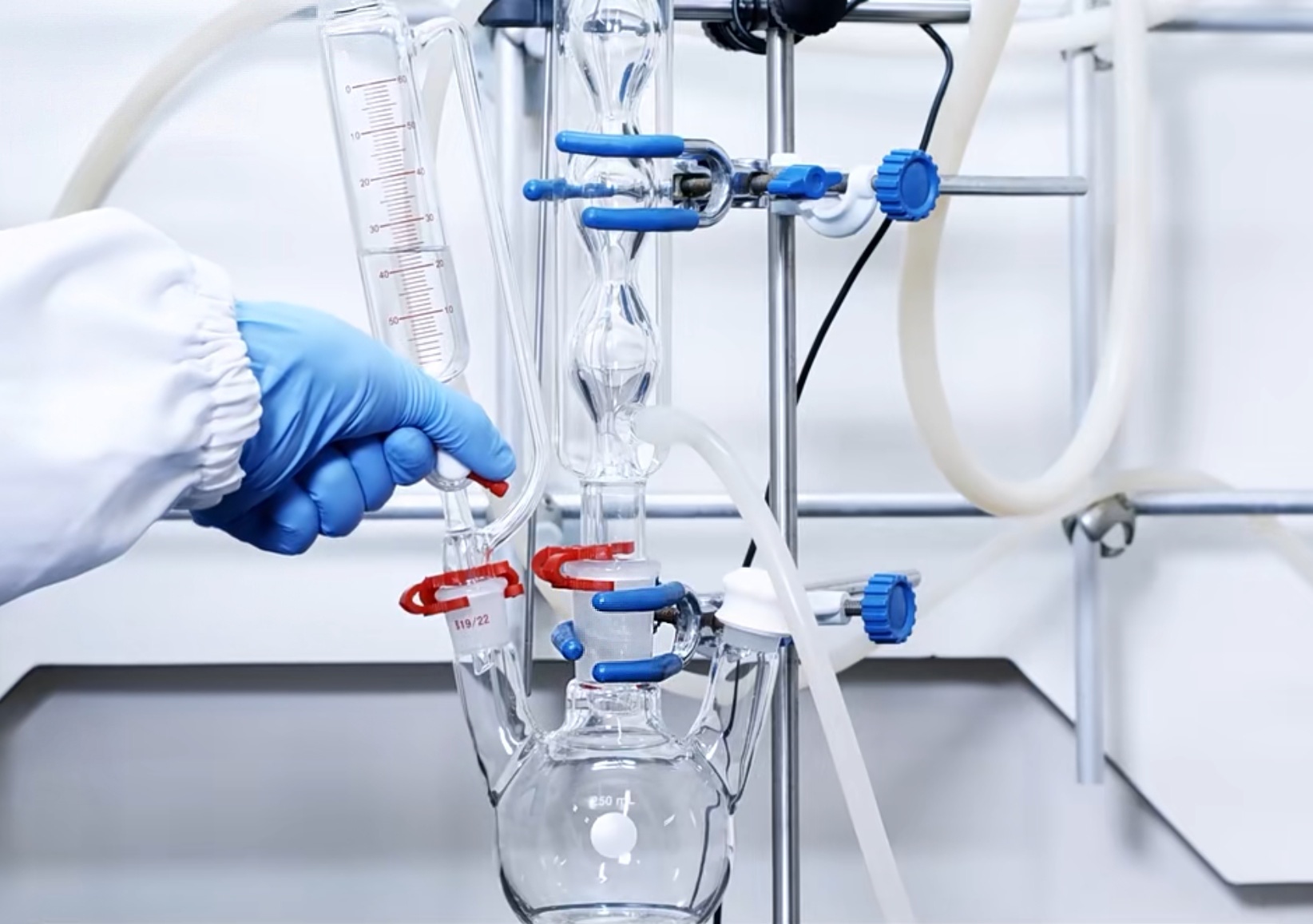
In a common three-neck layout, one neck carries the condenser, one neck carries the thermometer or another monitoring component, and the third neck handles gas entry, reagent addition, or another working attachment. Some setups route gas through a fitting at the top of the condenser rather than through a side neck. Some use a Claisen adapter when only a single-neck flask is available. The exact arrangement can change, but the decision logic stays the same: keep the condenser path stable, place the thermometer for the temperature you actually care about, and make sure the gas path has both a controlled entry and a safe exit.
A short note on materials: many standard laboratory flasks and adapters are made from borosilicate glass specified under standards such as ISO 3585 or ASTM E438 Type I, Class A. That is useful for understanding the glass material. It does not automatically tell you that a particular thermometer position, gas-handling arrangement, or pressure behavior is appropriate for the setup you are building.
What beginners most often misread
One easy confusion is to treat the thermometer, drying tube, bubbler, and gas inlet as if they are all doing the same general “safety” job. They are not.
| Part | What it is mainly doing | What beginners often misread |
|---|---|---|
| Thermometer | Reading a chosen temperature zone in the setup | Thinking there is only one correct position in all reflux assemblies |
| Gas inlet | Introducing inert gas or a gas reagent into a controlled path | Thinking “gas inlet” means the gas must always bubble through the liquid |
| Drying tube | Limiting moisture entry from the atmosphere | Using it as if it replaces proper inert-gas flow or proper outlet planning |
| Bubbler | Showing gas flow and helping maintain slight positive pressure at the outlet | Treating it as just another drying attachment |
| Gas absorber / scrubber | Capturing hazardous gas leaving the system | Forgetting it belongs to the exit logic, not the entry logic |
The broader principle behind all of this is simple: once the setup is handling gas deliberately, you are no longer just building “reflux plus a few extras.” You are building a system with flow direction, pressure behavior, and temperature interpretation built into it.
What usually goes wrong
Many failures in this kind of setup do not start as dramatic failures. They start as small misunderstandings that quietly pull the apparatus off course.
- The thermometer is reading a region nobody actually meant to monitor.
- The gas inlet is positioned for bubbling even though the real need was only headspace protection.
- The outlet side is poorly planned, so the system behaves as if it were more closed than it should be.
- A drying tube, bubbler, and absorber are treated as interchangeable attachments when they are doing different jobs.
- The setup is “under nitrogen” in name only because the gas path is weak, leaky, or badly routed.
When this setup is the right answer
This arrangement makes sense when the reaction really depends on one of the following:
- knowing the temperature in a specific part of the apparatus rather than guessing from the bath or mantle setting,
- protecting the reaction from air or moisture,
- introducing a gaseous reagent,
- or handling gas byproducts in a controlled way.
If none of those things is true, a simpler reflux setup is often the better choice. More glassware is not the same as better control. Extra components only earn their place when the chemistry actually needs the extra control they provide.
If the main challenge is still just understanding how an ordinary reflux assembly works, Stage 1 — Starting Organic Lab Work is usually the better starting point. If the question is broader than this specific setup, Mixing & Reaction Setup gives the wider bench logic. If joints, sealing, or assembly quality are the real weak points, Ground Glass Joints is often the more useful next read. And if the apparatus is already behaving badly, go straight to Troubleshooting Organic Lab Work.
FAQ
Does the thermometer in a reflux setup measure vapor temperature or liquid temperature?
It can do either, depending on where you place it. If the bulb is positioned in the vapor path, you are reading vapor temperature. If the bulb is placed in the liquid, you are monitoring liquid-phase temperature. The right placement depends on which temperature actually matters for the job.
Should the gas inlet tube always go below the liquid surface?
No. Put it below the liquid only when the gas needs to bubble through the reaction mixture or react directly with it. If the purpose is simply to maintain an inert atmosphere above the liquid, a different position may be more appropriate.
Do I need a bubbler if I am running reflux under nitrogen or argon?
A bubbler is often useful on the outlet side because it helps you see that gas is actually flowing and helps maintain slight positive pressure. It is not the same thing as a drying tube, and it does not replace the need for a sensible gas path.
Can I seal the setup once inert gas is connected?
No. A heated reflux assembly with gas flow should not be treated as a sealed system. Gas needs a controlled way out. The exact outlet arrangement may vary, but fully sealing a heated gas-handling setup is the wrong instinct.
Why does my setup still fail even though I added a drying tube and a gas inlet?
Because those parts do not fix everything by themselves. Dryness, leak quality, inlet placement, outlet handling, and actual gas flow all matter. “It has a drying tube” and “it has a gas line” are not the same thing as “the atmosphere control is working well.”