A heating mantle is one of the most common and most important flame-free heat sources in the organic laboratory. It is designed primarily for round-bottom flasks and is especially well suited to reflux, general heated reactions, and some distillation work. Its main strength is not precision, but the combination of safety, good flask fit, and practical bench use.
Fast answer
Best for: reflux, general heated reactions, and other situations where a round-bottom flask needs flame-free heating
Most important safety rules: never run it dry, never let liquid spill into it, and in an emergency remove the heat source from beneath the flask before relying on the power control
Extra caution during distillation: as liquid volume falls, you need to adjust the heating position to avoid local overheating
What It Is and How It Works
A heating mantle is an electrical heating device built around a bowl-shaped or hemispherical cavity. When power is applied, current passes through an internal resistance element, generating heat that is transferred to the round-bottom flask sitting inside the mantle. Because the cavity matches the shape of the flask, the lower portion of the flask is heated more evenly and more securely than it would be with a point heat source.
It is so common in organic lab work because it turns “heating a round-bottom flask safely” into a standard bench operation. There is no open flame, it fits the flask naturally, and it usually works well alongside magnetic stirring.
In normal lab use, a heating mantle should not be plugged straight into the wall. It is typically powered through a variable transformer, which allows the user to control heating power by adjusting the input voltage. So the real idea is not just “this device gets hot,” but “this is a round-bottom-flask heat source that must be used with proper voltage control.”

Common Structural Types
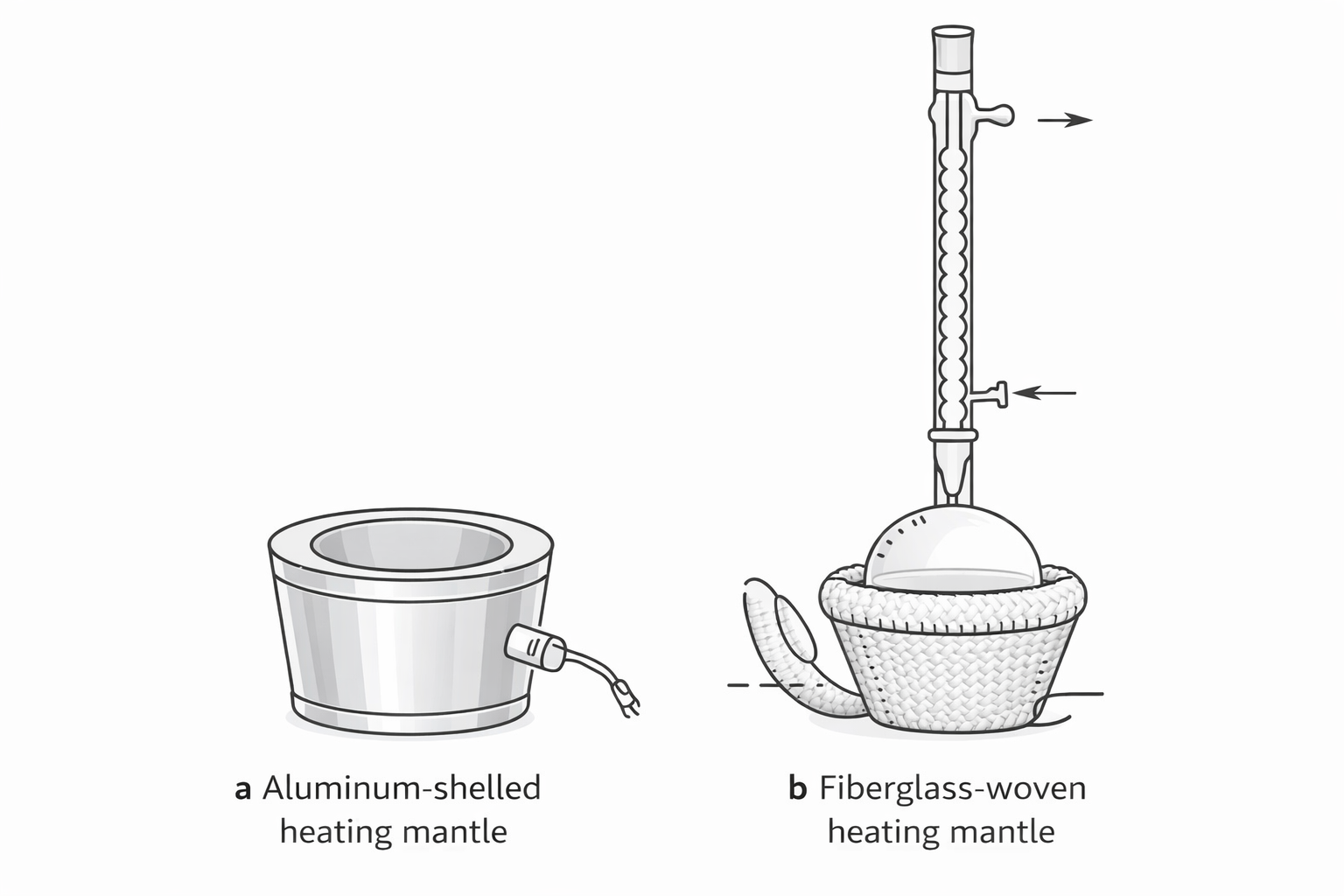
Two broad types are commonly encountered. One is the fiberglass-woven type, which can be understood as a heating layer made by weaving resistance wire into or beneath fiberglass fabric to form a bowl-shaped inner support. This style often looks like a flexible or semi-flexible heating cup, and it is usually sized to match one specific flask capacity.
The other is the ceramic-core type. In this design, the heating element is embedded in a rigid ceramic body, often with a metal outer shell. The cavity is more rigid and can sometimes accommodate smaller flasks with the help of sand or another heat-transfer medium.
Although the construction differs, the operating principle is the same: an internal electrical resistance element produces heat, and that heat is transferred to the flask.
Why It Is So Common in Organic Labs
Heating mantles are common not because they are the most precise heaters, but because they are highly practical in several important ways. First, they provide flame-free heating. That matters a great deal in organic chemistry, where many common solvents are flammable and vapor release is often unavoidable.
Second, they are naturally matched to round-bottom flasks. A round-bottom flask is awkward to heat safely on a flat hot surface, whereas a heating mantle supports it directly and heats it in a geometry that makes sense.
Third, they usually work well with magnetic stirring, which makes them especially convenient for reactions that need both heat and agitation.
Where It Is Most Useful
The most natural and most strongly recommended use for a heating mantle is reflux. Reflux requires sustained, reasonably steady heating of a round-bottom flask, and the heating mantle matches that job extremely well.
It is also well suited to general heated reactions. Whenever the reaction mixture is in a round-bottom flask and needs a period of controlled warming or boiling without an open flame, a heating mantle is often a natural choice.
It can also be used for distillation, including ordinary distillation and some vacuum distillation setups, but distillation requires more judgment than reflux. As liquid volume decreases during distillation, the lower part of the flask can become more vulnerable to local overheating.
| Heating mantles are especially well suited to… | Use extra judgment when… |
|---|---|
| Reflux | Performing ordinary or vacuum distillation |
| General heated reactions | The liquid volume will drop substantially during the run |
| Flame-free heating of round-bottom flasks | The experiment needs very fine temperature control |
| Heating while using magnetic stirring | The system may need rapid emergency heat removal |
What Its Real Advantages Are
The main value of a heating mantle is not that it heats the fastest, but that it provides a safe, practical, and flask-matched heating method for organic lab work. The lack of an open flame is a major safety advantage. Its fit with round-bottom flasks makes setup straightforward. Its compatibility with magnetic stirring makes many reactions easier to run well.
At a deeper level, its real value is that it turns heating a round-bottom flask into a repeatable bench routine rather than an improvised workaround.
Main Limitations and Risks
It has significant thermal inertia
A heating mantle does not cool instantly when power is reduced or turned off. It stores heat, and the materials inside it also retain heat. That means reducing voltage or shutting off power does not immediately stop heating at the flask.
Temperature control is usually not very precise
In many teaching laboratories, the mantle is controlled only through a variable transformer rather than a true temperature feedback system. That lets you adjust heating power, but not with the same precision as a properly controlled bath.
Never run it dry
This rule is far more serious than “performance may get worse.” If the flask has boiled dry, or is close to dry, and heating continues, the temperature of the mantle can rise sharply. In severe cases, the internal resistance wire can melt, and the mantle itself can be burned out.
Liquid must not spill into the mantle
The heating mantle contains electrical heating elements. If liquid enters the mantle, it can cause shorting, electric shock, or equipment damage. This matters especially in reflux and distillation, where dripping, splashing, or leaks are possible.
Emergency shutdown means removing the heat source first
Because the mantle remains hot, simply lowering the voltage or switching off power is often not fast enough when a reaction is clearly going wrong. The safer and more effective sequence is:
- Step 1: Immediately lower the lab jack or otherwise move the heating mantle away from beneath the flask.
- Step 2: Then switch off the variable transformer power.
That sequence matters because stored heat in the mantle continues to affect the flask even after electrical power is cut.
Why Distillation Requires Extra Care
A heating mantle can absolutely be used for distillation, but it cannot be treated in exactly the same way as it is during reflux. In reflux, the liquid volume often remains reasonably stable, and the liquid continuously removes heat from the flask. In distillation, the liquid level drops over time, which means the lower parts of the flask may keep receiving strong heat while less liquid remains to absorb it.
A practical and useful recommendation is to use a slightly larger mantle for distillation and to lower the lab jack gradually as distillation proceeds, so the flask slowly moves away from the hottest central zone. That helps reduce local overheating as the liquid volume falls.
So the right conclusion is not “a heating mantle is bad for distillation,” but rather: it can be used for distillation, but the heat-source position should be adjusted as conditions change.
Good Operating Habits
In practice, the most sensible way to set up a mantle is to place it on a lab jack, then place the round-bottom flask into the mantle, and only then secure the rest of the glassware. That way, if the heating position needs adjustment, or the heat source has to be removed quickly, the operator can act immediately through the jack.
Before heating, at minimum, check that the flask is not empty, that the liquid volume is reasonable, that boiling chips or another anti-bumping measure has been considered, that the mantle is connected through a variable transformer rather than directly to the wall, and that the setup is stable and not likely to drip into the mantle.
One particularly good habit is to operate the variable transformer properly: set the control to zero before turning on the power, and when finished, return the control to zero before unplugging. That is not just tidy bench practice; it is part of safe and consistent use.
During heating, remember that the mantle responds with delay. When you turn it up, it does not instantly reach its final effect. When you turn it down, it does not instantly cool. Good control comes from anticipating that lag rather than reacting only after the system is obviously too hot.
How It Compares with Other Heat Sources
Compared with an oil bath or water bath, a heating mantle is cleaner and easier to manage, and it works very naturally with magnetic stirring. But baths usually make temperature monitoring easier and often give more intuitive control over bath temperature.
Compared with a hot plate, a heating mantle is generally a better match for round-bottom flasks and is often the safer choice in solvent-rich organic work. Hot plates are more naturally suited to flat-bottomed vessels.
Compared with a sand bath, the mantle is more direct. Sand can sometimes help buffer local overheating, especially in rigid ceramic-style mantle setups, but sand baths are also slower and introduce their own temperature gradients.
FAQ
1. How do I choose the right heating mantle size?
In most cases, the mantle should match the nominal flask size. A 250 mL round-bottom flask should usually go into a 250 mL mantle, and so on. The fit matters because these devices are meant to support and heat round-bottom flasks directly. For distillation, some labs prefer a slightly larger mantle and then lower the lab jack gradually as liquid volume falls.
2. Do I really need a variable transformer, or can I plug the mantle directly into the wall?
A variable transformer is the normal and safer way to use a heating mantle. Direct line voltage can overheat the mantle, and safety guidance commonly warns against plugging mantles straight into a wall outlet. The transformer gives you controlled input voltage rather than full uncontrolled line power.
3. Can I use a heating mantle for distillation, or is it mainly for reflux?
You can use a heating mantle for distillation, and mantles are often used that way. But reflux is the more forgiving application. In distillation, the falling liquid level makes local overheating more likely, so the heating position needs more active adjustment than it usually does during reflux.
4. What happens if the flask boils dry in a heating mantle?
This is one of the most serious heating-mantle mistakes. Once the flask is dry or nearly dry, the mantle temperature can rise sharply. In severe cases, the internal resistance wire can melt, insulation can be damaged, and the mantle itself can be burned out.
5. What should I do if I need to stop heating quickly?
Do not rely only on turning the control down. Because the mantle stores heat, the fastest practical response is usually to lower the lab jack or otherwise move the mantle away from beneath the flask first, and then switch off the transformer power. If solvent has spilled into the mantle, stop using it until it has been inspected, cleaned, and dried as appropriate.
Related Reading
Bottom Line
The heating mantle is one of the most important flame-free heat sources in the organic lab. It is widely used not only because it is safer than open flame heating, but because it fits round-bottom flasks naturally and works especially well for reflux and many general heated reactions.
But using it well requires understanding its limits: it stores heat, it is not usually a precision temperature tool, it must never be run dry, liquid must not spill into it, and distillation requires more active adjustment than reflux.
The real skill is not just knowing that a heating mantle can heat a flask. It is knowing when it is the right tool, when extra caution is needed, why emergency response means physically removing the heat source, and why “never run it dry” is a genuine safety rule rather than a minor suggestion.