Manual mixing tools look simple, which is exactly why they are easy to dismiss. But at the bench, they are often the first things that show whether someone understands control, restraint, and vessel behavior. A glass rod used properly is quiet, clean, and precise. Used badly, it splashes liquid, chips glass, gives false temperature readings, or turns a simple operation into an avoidable mess.
That is why manual mixing still matters in a modern lab. It is not a leftover from before magnetic stirrers. It is the right choice when the volume is small, the task is brief, the setup is open, or the chemistry does not justify a more elaborate stirring system. It is also the point where beginners first learn that “mixing” is not one generic action. The tool, the vessel, and the liquid all have to agree.
What manual mixing is really for
Manual mixing works best when the task is short, direct, and easy to judge by hand. Once the system needs long unattended mixing, strong torque, or sealed operation, it usually stops being the best tool.
The first tool most people meet: the glass stirring rod
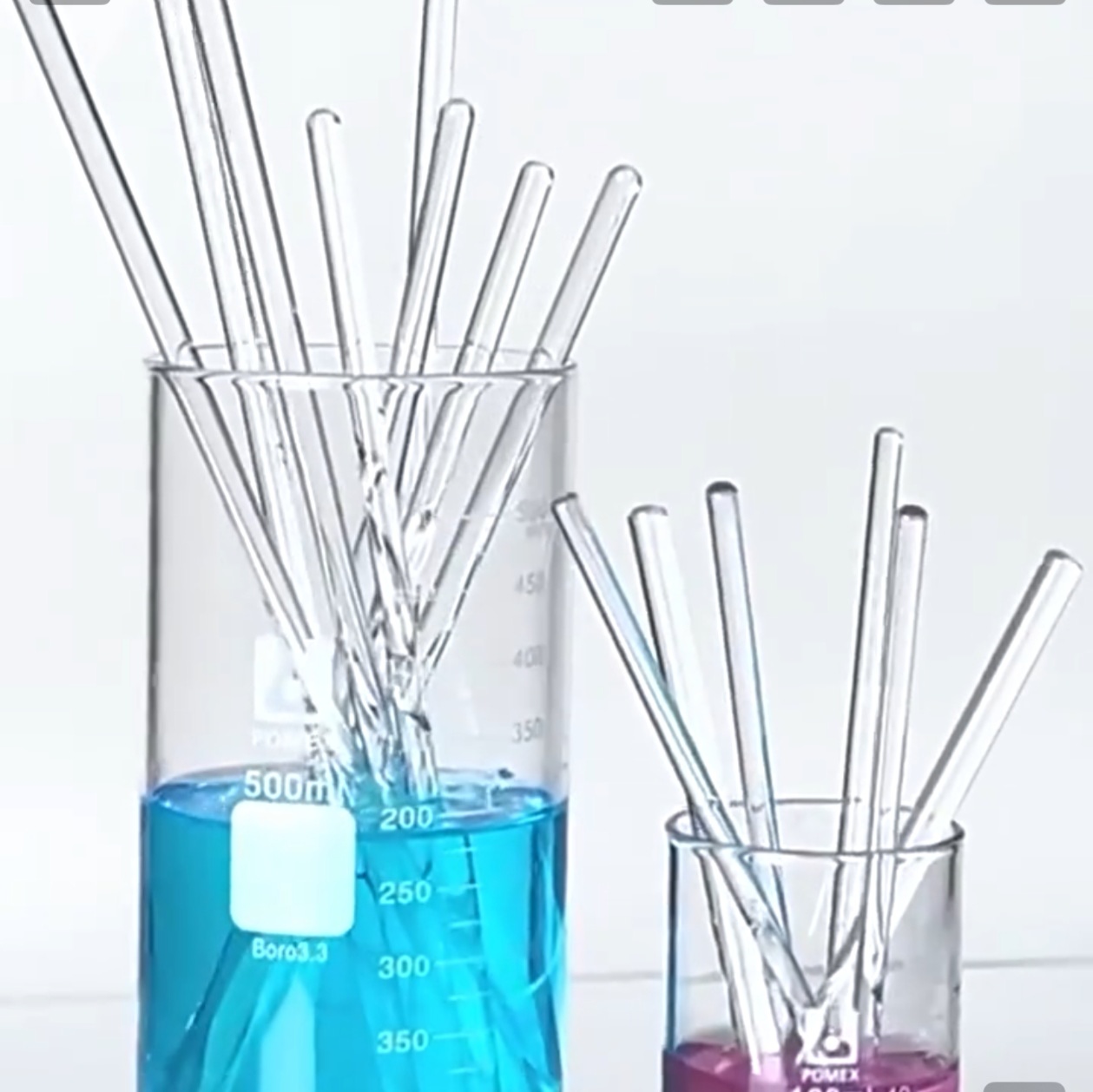
A glass stirring rod is the default manual mixer for a reason. It is chemically tolerant in ordinary lab use, easy to clean, and simple enough that the user can focus on the liquid rather than the device. But it only stays simple when the rod is prepared and handled correctly.
A good rod has smooth ends. That sounds minor, but it is basic bench safety. A rough cut end scratches glassware, chips vessel walls, and makes the rod less predictable to handle. Fire-polishing the ends removes those sharp edges and turns an unfinished cut piece of glass into an actual lab tool.
The rod should also make sense for the vessel. A very short rod in a tall beaker is awkward. A heavy rod in a small vessel makes the movement rougher than it needs to be. Most manual stirring problems are not dramatic technique failures. They are small mismatches in scale and control.
What good hand stirring actually looks like
Good hand stirring is driven mostly by the wrist, not the whole arm. The motion should be controlled and repeatable, usually along the inner wall of the vessel, so the liquid begins to circulate rather than simply being jabbed around. You are trying to create organized movement in the liquid, not beat it into submission.
That matters especially in small volumes. A beginner often stirs too fast and too deep, which drives liquid upward, splashes material out, or builds foam that makes the vessel harder to read. The better rule is to stir only as hard as the liquid actually needs.
Manual stirring is a good fit when
- the volume is small and the task is brief
- the vessel is open and easy to access
- the goal is dissolution, blending, or controlled mixing by hand
- you want immediate visual feedback from the liquid
- setting up powered stirring would add more complexity than value
Manual stirring is a poor fit when
- the mixture needs long, continuous agitation
- the system must stay sealed
- the liquid is too viscous to move cleanly by hand
- the solids load is large enough that simple circulation is not enough
- the setup is already assembled and access from above is limited
The rule that matters most: never stir with a thermometer
A thermometer is not a substitute stirring rod. It is thinner, more fragile, and built around measurement, not contact. Once it is used as a stirrer, the risk is no longer theoretical. The tip can strike the vessel wall or base, the bulb can break, and the measurement tool becomes a contamination and cleanup problem.
This is one of those lab rules that beginners sometimes hear but do not fully respect until they understand the mechanics. The problem is not just that the thermometer is “delicate.” The problem is that stirring introduces repeated impact and side-loading into a tool that was never designed for that kind of force.
Do not use a thermometer as a stirrer
If you need mixing and temperature monitoring at the same time, solve that as a setup problem. Do not turn the thermometer into a mixing tool. A broken thermometer is not a minor inconvenience; it can become a contamination, exposure, and waste-handling problem very quickly.
When you need stirring and temperature monitoring at the same time
Some operations need both. Cooling-sensitive additions, crystallization work, and reactions that must stay inside a narrow temperature window are common examples. In those cases, the better habit is to keep the mixing tool and the temperature probe distinct, even if they are temporarily held together in a controlled way.
A simple parallel arrangement can work: the stirring rod and thermometer can be lightly fixed together so the rod extends slightly below the thermometer bulb. That way the rod does the mechanical work and the thermometer stays clear of the vessel bottom. The exact geometry matters. If the bulb touches the glass wall or base, the reading becomes less trustworthy even before breakage is considered.
This is the same basic measurement logic taught in Stage 1 — Starting Organic Lab Work: a temperature reading is only meaningful when the sensing part of the instrument is sitting in the part of the system you actually mean to measure.
Swirling and agitation when a rod is no longer practical
Once a flask is already fitted with a condenser or another vertical component, a glass rod may no longer be the sensible way to mix. That does not mean the only next step is magnetic stirring. Sometimes the correct answer is simple agitation by hand.
Swirling works best when the liquid is still fairly mobile and the setup is not top-heavy enough to become awkward. The motion should stay small and controlled. The goal is to roll the liquid and refresh the interface inside the flask, not to swing the apparatus around dramatically. When the setup is clamped, that decision becomes partly about load and balance, not just about liquid behavior.
In other words, swirling is a vessel-and-support judgment as much as a mixing choice. If the apparatus already feels tall, off-center, or under-supported, the better question may be whether the whole assembly is stable enough in the first place. That wider setup logic sits inside Mixing & Reaction Setup, not just inside “mixing technique.”
Grinding and solid mixing are different jobs
A mortar and pestle are not just “another way to stir.” They are for a different physical task. Their real value is breaking down solids and forcing intimate contact between powders. That is why they are useful for sample preparation, mixed melting-point work, and situations where simple side-to-side blending with a spatula is not enough.
This matters in a teaching lab because beginners sometimes treat all mixing as if it were liquid mixing. It is not. Solid mixing is usually about contact area, not circulation. If the job is to combine powders evenly or crush a solid to a usable texture, a glass rod is the wrong tool from the start.
That is one reason the topic naturally overlaps with Stage 1 and with Downloadables: the right tool depends on what kind of material you are trying to move, not just on whether you are “mixing something.”
Spatulas, scoops, and other small metal tools
Metal tools are often used for small-scale solid blending, scraping, and transfer. They are practical because they are rigid and easy to control in shallow dishes, weighing paper, and small containers. But they are not chemically neutral in every situation.
If the medium is strongly corrosive, or if the chemistry is unusually sensitive to metal contact, the convenience of a metal spatula may no longer be worth the risk. This is not a reason to panic about every stainless steel lab tool. It is a reminder that tool material belongs in the same judgment chain as reagent compatibility and vessel choice.
The manual tool many people forget about: the stir bar retriever
A stir bar retriever is easy to think of as an accessory to magnetic stirring, but in practice it is also a manual handling tool. Its job is not glamorous. Its job is to keep you from tipping a vessel too far, reaching into dirty liquid, or losing a stir bar into waste because cleanup was treated as an afterthought.
That is exactly the kind of bench logic ChemNorth cares about. A tool that seems minor becomes important the moment waste handling, corrosive solutions, or small-scale vessel geometry make direct retrieval awkward or unsafe.
Material compatibility is part of the judgment
Glass rods are highly useful in ordinary lab work because glass is chemically resistant across a wide range of common solvents and reagents. But “chemically resistant” is not the same thing as “safe in everything.” Hydrofluoric acid is the obvious glass exception, and strong hot alkali also deserves more respect than beginners often give it.
For that reason, it helps to know what kind of glass the lab tool or vessel is likely to be. In teaching and research lab work, the standard expectation is usually borosilicate glass. ISO 3585 defines the properties of borosilicate glass 3.3, and many laboratory glass products are also described under ASTM E438 Type I, Class A. Those standards do not magically make every rod or beaker safe in every reagent, but they do explain why proper laboratory glassware is more thermally and chemically suitable than ordinary household glass.
When glass is the wrong choice, PTFE is often the next place people look. That is usually reasonable, but even PTFE should not be described as universally inert under extreme conditions. If the chemistry is genuinely unusual, tool material should be checked deliberately rather than assumed.
How to choose between manual mixing and powered stirring
| Method | Best fit | Main strength | Main limit |
|---|---|---|---|
| Glass rod / PTFE rod | Open vessels, short tasks, low-viscosity liquid mixing | Direct control, simple, cheap, immediate feedback | Not sealed, not continuous, tiring for longer work |
| Swirling / hand agitation | Simple flasks, brief resuspension, assembled but accessible setups | No extra tool inside the vessel, quick to do | Limited force, poor for thick or heavily heterogeneous systems |
| Mortar and pestle | Powder grinding and solid mixing | Excellent solid-to-solid contact | Not a liquid mixing tool |
| Magnetic stirring | Small to moderate liquid systems that benefit from continuous mixing | Continuous, simple, good for sealed or condenser-topped setups | Limited by viscosity, solids, and stir-bar coupling |
The practical rule is to start with the simplest tool that still gives real control. If a rod does the job cleanly, there is no need to force the task into a powered setup. But once the system needs long, sealed, or higher-torque agitation, insisting on hand mixing usually stops being a virtue and starts becoming a limitation.
A good first judgment
Use manual mixing when the task is short, visible, and easy to control directly. Upgrade to magnetic or mechanical stirring when the chemistry, vessel, or setup stops cooperating with hand work.
Related pages
Use the surrounding setup pages when manual mixing is only one part of a larger bench decision.
FAQ
Why should you never use a thermometer as a stirring rod?
Because a thermometer is designed to measure temperature, not to absorb repeated side impact. Using it for stirring raises the risk of breakage, contamination, and false readings if the bulb contacts the vessel wall or bottom.
When is a glass stirring rod better than a magnetic stirrer?
A glass rod is often better when the task is brief, the vessel is open, and you want direct control rather than continuous unattended agitation. It is especially useful for dissolution, blending small volumes, and other quick bench operations.
What is the best way to mix a flask that already has a condenser attached?
If a rod no longer makes sense, controlled swirling is often the next practical option, provided the setup is stable and the liquid is still mobile enough to respond. If the apparatus feels top-heavy or awkward, the stability problem should be solved before mixing is forced.
When should a mortar and pestle be used instead of a stirring rod?
Use a mortar and pestle when the job is grinding or intimately mixing solids. A stirring rod moves liquids well enough, but it does not create the same solid-to-solid contact or particle breakdown that a proper grinding tool does.
Is borosilicate glass always chemically safe for manual mixing?
No. Borosilicate glass is the normal laboratory standard because it performs well in ordinary lab conditions, but it is still a poor choice for hydrofluoric acid and deserves caution in hot strong alkali. “Laboratory glass” is not the same thing as “safe in every chemical system.”