Overhead stirring is what you move to when a stir bar is no longer really controlling the mixture. The vessel may be larger, the liquid may be thickening, solids may keep settling, or the batch may need a flow pattern that magnetic stirring cannot produce reliably.
That does not make overhead stirring the automatic “better” choice. For small, low-viscosity, routine solution work, magnetic stirring is usually simpler and cleaner. Overhead stirring earns its extra hardware when the chemistry stops behaving like a quiet solution and starts behaving like a slurry, a viscous reaction mass, or a system that needs deliberate mechanical control.
Fast answer: choose overhead stirring when the real problem is no longer just rotation, but circulation, suspension, shear, torque capacity, or seal integrity. If the stir bar is still spinning but the batch is no longer truly moving, you are already at that decision point.
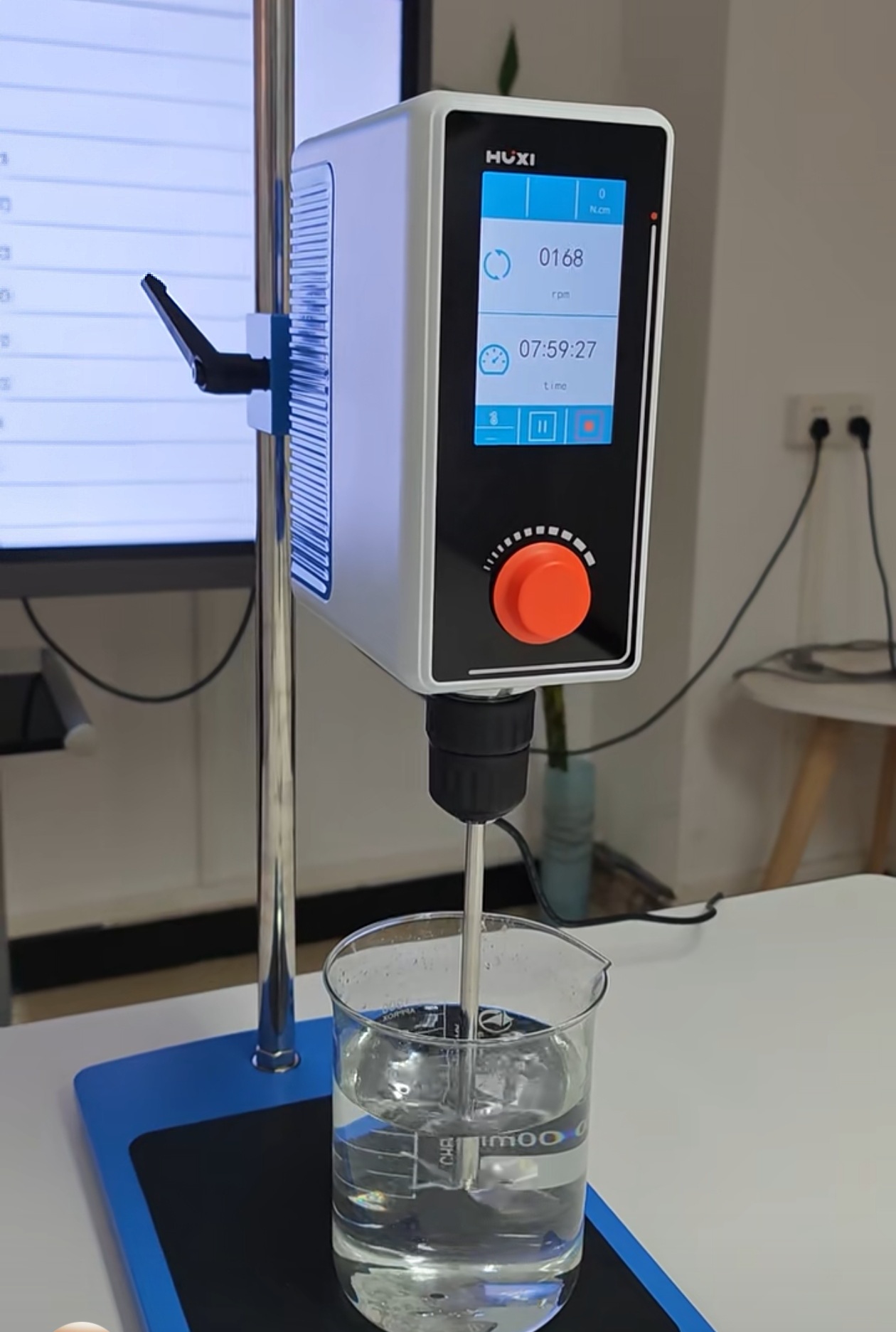
When overhead stirring is actually the right tool
Use it when viscosity rises during the run, solids are heavy or fast-settling, the vessel is large enough that a stir bar only affects a local region, or the process needs a defined mixing pattern rather than simple spinning.
Stay with magnetic stirring for small-scale, low-viscosity work when the stir bar is stable, the liquid is circulating well, and the main job is simply keeping the system mixed during dissolution or heating.
If the run also needs good inert handling, vacuum integrity, or a very stable top entry, the shaft seal and mechanical layout matter as much as the motor itself. At that point, this is no longer just a stirring choice.
On ChemNorth, this sits naturally inside Mixing & Reaction Setup. It also connects directly to Stage 1 when the real issue is setup judgment, and to Troubleshooting when the shaft wobbles, the seal leaks, or the assembly looks mechanically wrong.
Impeller geometry decides what kind of mixing you actually get
Once you switch to overhead stirring, the impeller often matters more than the rpm number on the front panel. Different impeller shapes create different flow patterns, and that is what determines whether the mixture circulates, shears, suspends solids, or merely spins near the shaft.
| Impeller type | Main mixing character | Best fit | What people often misjudge |
|---|---|---|---|
| Anchor | Wall-following sweep with strong contact near the vessel boundary. | Very viscous systems, wall buildup, and situations where heat transfer at the wall matters. | It is excellent for sweeping thick material off the wall, but it is not the first choice when you need aggressive bulk turnover in a tall vessel. |
| Propeller | Strong axial circulation with clear top-to-bottom movement. | Low- to medium-viscosity liquids, rapid homogenization, lighter suspensions, and heat-transfer support. | It can look energetic while still doing a poor job on dense solids that settle hard. |
| Turbine / radial blade | Stronger radial discharge and higher local shear. | Gas-liquid dispersion, liquid-liquid emulsification, or keeping heavier particles suspended. | More shear is not always better. It can entrain air, foam the surface, or make the system mechanically harsher than needed. |
| Paddle | A practical middle ground: useful circulation without being too specialized. | Routine organic reaction slurries, medium viscosity, heterogeneous runs, and sustained addition work. | People sometimes treat it as a “basic” option, but in many three-neck flask setups, basic is exactly what makes it reliable. |
A workable starting rule is simple: for ordinary synthesis, a paddle is often enough; for faster bulk turnover, move toward a propeller; for harder suspension or dispersion problems, move toward turbine-style blades; for very viscous wall-dragging systems, think anchor.
Torque matters more than rpm once the batch starts thickening
One of the real advantages of overhead stirring is that it makes mechanical load visible. In a thin solution, speed is often the number people watch. In a thickening system, torque becomes the more meaningful signal.
In practice, this is especially useful in polymerization, crystallization, heavy precipitation, or any run where the mixture changes character during the reaction. A smooth rise in torque often tracks gradual thickening. A sudden jump can mark rapid solids formation or a phase change. Repeated overload or stalling usually means the motor–impeller combination is no longer matched to the batch.
Important boundary: torque trend is a very useful process signal, but it is not a universal viscosity number. Change the impeller, fill level, vessel geometry, or temperature, and the torque reading changes too.
If you need viscosity values that can be compared in a defined way across runs or across labs, treat that as a measurement problem rather than a mixer-display problem. Methods such as ASTM D2196 and ISO 3219-based rotational viscometry exist for that reason: they define the measurement conditions instead of treating the overhead stirrer as a viscometer.
Seal choice becomes part of the apparatus logic
For an air-tolerant atmospheric reaction, top-entry stirring can be mechanically straightforward. Once vapor containment, inert gas, or vacuum starts to matter, the shaft entry stops being a minor accessory choice and becomes part of the actual setup design.
A dedicated stirrer bearing is usually the first serious step up from improvised top-entry arrangements. This is the level to think about when the reaction needs better containment or moderate vacuum performance, but the rotating shaft itself is still acceptable as part of the design.
Magnetically coupled drives solve a different problem: they remove the rotating seal as a leak point. That is why they matter for stricter vacuum work or more demanding air- and moisture-sensitive operations, even though they add complexity and cost.
A good practical chain is: ordinary atmospheric work → simple bearing arrangement; better containment or moderate vacuum → dedicated stirrer bearing; high-integrity vacuum or very demanding inert handling → magnetic drive or a more serious reactor-style solution.
When this part of the setup starts giving trouble, it is usually not just a stirring problem anymore. It overlaps with joint condition, grease practice, and top-entry sealing logic, which is why pages like ground-glass joint maintenance become directly relevant.
Small installation details that prevent broken glass
Use a flexible coupling, not a rigid one
The motor shaft and the glass stirring shaft are rarely perfectly aligned. A flexible coupling absorbs small alignment errors and vibration before they are transmitted into the glass shaft or the center neck. Without that mechanical forgiveness, the setup may run, but it runs while storing stress in exactly the wrong place.
Centering matters more than people expect
If the motor axis is off-center, the shaft is bent, or the blade is too close to the wall, wobble becomes a structural warning rather than a cosmetic issue. Visible orbiting, knocking, or side loading at the neck should be treated as a stop-and-fix problem.
There are a few habits worth making routine every time:
- set the motor and shaft vertically before increasing speed
- run slowly first and watch the shaft path before ramping up
- confirm the impeller is not clipping the flask wall, thermometer, baffle, or addition hardware
- do not treat the center neck like a load-bearing handle
- lubricate or set up the bearing correctly so drag at the seal is not mistaken for reaction resistance
A useful rule of thumb for impeller–vessel matching is that water-like systems usually want the vessel diameter around twice the impeller diameter, while very viscous systems often need the impeller closer to the wall. It is not a law, but it is a good reminder that vessel geometry and impeller choice have to be judged together.
Quick troubleshooting index
| What you notice | What it usually points to | Check first |
|---|---|---|
| Large vibration, knocking, or visible wobble | Misalignment, bent shaft, poor coupling, weak fixing, or blade contact with glassware. | Lower the speed, re-center the shaft, inspect the coupling, and check for contact with the wall, bottom, thermometer, or other inserted parts. |
| Motor heating, overload alarm, or repeated stalling | The batch has outrun the available torque, or the bearing / seal drag is too high. | Ask whether the viscosity, solids load, impeller size, or seal friction is still realistic for that motor before simply increasing rpm. |
| Good shaft motion but poor real mixing | The impeller pattern is wrong for the fluid, or the blade height is wrong. | Watch circulation in the vessel, not just rotation at the chuck. If only a local zone is moving, the problem is not solved. |
| Leak, odor, or poor inert performance around the shaft entry | The seal strategy is below the demands of the run. | Inspect the bearing, compression parts, O-rings, grease practice, and whether the setup needs a better feedthrough entirely. |
| Foaming or obvious air entrainment | Too much surface draw, too much rpm, or the wrong impeller geometry for the job. | Lower the blade, reduce speed, or change to a geometry that is less aggressive at the surface. |
If the real failure is not the overhead stirrer itself but the fact that magnetic stirring has already stopped being mechanically credible, the more useful next page may be Why Your Stir Bar Keeps Decoupling rather than trying to force a stir bar past its limits.
FAQ
When should I switch from magnetic stirring to overhead stirring?
Switch when the stir bar is no longer controlling the whole batch: rising viscosity, settling solids, larger vessel size, unstable magnetic coupling, or a need for a different mixing pattern are the usual triggers. The key sign is that the bar may still spin, but the mixture is no longer really circulating.
Which impeller is the safest starting point for an ordinary reaction slurry?
A paddle is often the best first choice for a normal organic reaction slurry because it is mechanically simple, broadly useful, and less specialized than a propeller, turbine, or anchor. Change geometry only when the real problem becomes clear.
Why is my overhead stirrer wobbling or making noise?
The usual causes are misalignment, a bent shaft, a poor or rigid coupling, weak support, or an impeller touching the vessel or another inserted part. Visible wobble is a warning sign that the setup is mechanically unhappy and should be corrected before continuing.
Can I run overhead stirring under nitrogen or vacuum?
Yes, but only if the shaft entry is designed for that level of sealing. A dedicated bearing may be enough for better containment or moderate vacuum work, while more demanding inert or vacuum service may require a magnetic drive or a more serious reactor-style top entry.
Does the torque display tell me the actual viscosity?
Not by itself. Torque trends are useful for following changes within one setup, but they are not a universal viscosity measurement across different vessels, impellers, fill levels, and temperatures. For defined viscosity measurement, use an appropriate viscometry or rheology method.