A reflux setup with an addition funnel is one of the most useful upgrades from a basic reflux assembly. It comes into play when the reaction is better run by controlling how fast one reagent enters the flask, not just by controlling how hard the flask is heated.
That is why this setup shows up so often in exothermic additions, moisture-sensitive reactions, and multi-component syntheses where concentration, timing, and heat release all matter at once. The apparatus is not complicated because the chemistry is advanced. It is complicated because the reaction needs a steadier hand.
What this setup is actually for
The most common reason to use an addition funnel under reflux is that dumping everything into the flask at once would make the reaction harder to control. Sometimes the problem is heat. A strongly exothermic addition can surge, boil too hard, or throw material upward if the reagent enters too quickly. Sometimes the problem is concentration. A reagent that behaves well at low local concentration may give more side reaction when it hits the flask in one large slug. Sometimes the issue is simply sequence: one component needs to be present in the flask first, and another needs to arrive gradually while the reaction is already underway.
That is the underlying logic of this setup. The stopcock on the funnel is not just a valve. It is a way to manage kinetics, heat release, and local concentration together. At the bench, that usually translates into a simple habit: let the drop rate set the pace, and let the behavior of the reflux tell you whether that pace is right.
How the standard setup is arranged
The usual working vessel is a three-neck round-bottom flask. One neck takes the condenser, one takes the addition funnel, and the center neck is usually reserved for the most mechanically demanding or alignment-sensitive part of the apparatus: often an overhead stirrer, but sometimes a thermometer or another vertical element depending on the reaction design. The point is not that there is one sacred arrangement. The point is to keep the vertical load stable, the stirring effective, and the side connections uncrowded.
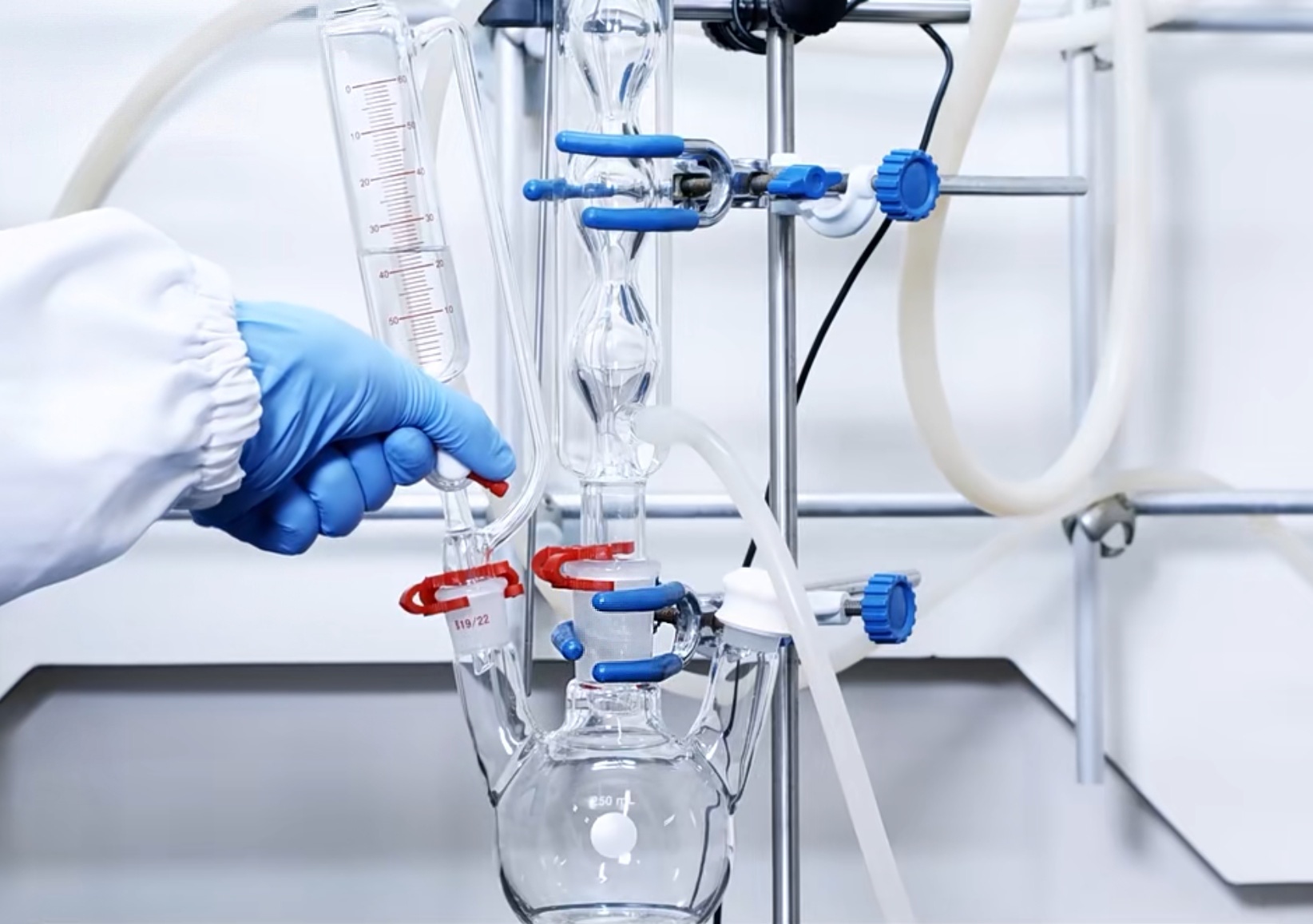
Reaction flask
A three-neck round-bottom flask is the most natural choice because it lets reflux, addition, and stirring happen at the same time without turning the setup into a stack of improvised adapters.
Condenser
The condenser belongs on a stable vertical path. Under reflux, it is there to return solvent and keep the working volume in the flask rather than letting the solvent inventory walk away over time.
Addition funnel
The funnel holds the reagent that must be fed in gradually. For many ordinary atmospheric reactions, a standard dropping funnel can work. For drier or more pressure-sensitive systems, a pressure-equalizing funnel is usually the better tool.
Stirring
Good stirring is not optional here. If the incoming reagent is not dispersed quickly, local concentration spikes and local exotherms can appear even when the overall flask temperature looks reasonable.
If the real question is how these parts fit into the wider apparatus, the best companion page is Mixing & Reaction Setup. If the main vessel itself still feels abstract, it is worth reviewing Round-Bottom Flasks first.
Why pressure-equalizing funnels are so useful here
A pressure-equalizing addition funnel is not automatically required for every reflux-with-addition setup, but it is often the cleaner choice. Its side arm allows the gas space above the liquid in the funnel to communicate with the gas space of the reaction apparatus. In practice, that means the liquid can drain more smoothly when the rest of the setup is relatively closed or when the reaction atmosphere is being protected.
This matters most in setups fitted with drying tubes, inert-gas protection, or any arrangement where a plain funnel would otherwise hesitate, glug, pause, or stop because the pressure above and below the liquid no longer matches. One of the simplest teaching-lab rules is that if your addition funnel does not have a pressure-equalizing arm, you may need to vent it periodically to keep the liquid moving. That is precisely the nuisance a pressure-equalizing funnel is meant to avoid.
How to run the addition
The most useful habit is to start by making the flask behave well before the main addition begins. That usually means the initial charge is already in the flask, stirring is steady, condenser water is running correctly, and the apparatus is warm enough that the system has settled into a manageable reflux rather than a cold, unpredictable startup phase.
Once addition starts, the drop rate becomes the main control knob. The correct rate is not a universal number of drops per second. It is the rate that keeps the flask under control. In a good run, the addition may briefly strengthen the reflux, but the system should not leap from calm return to violent solvent flooding. If the condenser is suddenly carrying a continuous stream downward, the reflux zone is climbing too high, or the flask behavior changes abruptly after each opening of the stopcock, the addition is too fast, the heating is too aggressive, or both.
For many exothermic additions, the goal is for the reaction itself to help sustain the reflux once the chemistry is underway. That does not mean you remove judgment from the process. It means you watch whether the added reagent is now driving the boil harder than the setup can comfortably absorb.
What to watch while the funnel is running
- Whether stirring stays centered and effective after each increment of reagent enters
- Whether the condenser is returning liquid calmly or carrying an obviously overloaded downward flow
- Whether the reflux zone remains in a sensible part of the condenser instead of surging upward
- Whether color change, gas evolution, or sudden thickening suggests the flask is no longer responding smoothly
What usually goes wrong
The most common failure is not a broken part. It is a mismatch between addition speed and what the flask can absorb. Beginners often think of the funnel as a delivery device. In practice, it is a throttling device. If the incoming liquid arrives faster than the stirring can disperse it or faster than the apparatus can dissipate the heat it generates, the problem shows up immediately as an unstable reflux, a sharp change in flask behavior, or both.
The second common failure is assuming that a funnel solves atmosphere control by itself. It does not. If the reaction is water-sensitive or air-sensitive, the solvent in the funnel, the reagent in the funnel, the joints around the funnel, and the way the funnel communicates with the rest of the apparatus all matter. A drying tube only helps if the rest of the assembly is being treated like a system rather than like a collection of separate parts.
The third common failure is poor stirring. This is easy to underestimate because the condenser and funnel are visually obvious while the mixing pattern in the flask is not. But if stirring stops, decouples, or leaves dead zones, the incoming reagent no longer meets the whole flask. It meets one local patch of solution. That is exactly how “the flask was fine and then suddenly it wasn’t” happens.
What to do if you only have a single-neck flask
If you only have a single-neck round-bottom flask, a Claisen adapter can convert that one joint into a workable two-path top. One branch can carry the condenser and the other can carry the addition funnel. This is a legitimate workaround and is a standard part of organic glassware logic, not a strange improvisation.
But it is still a workaround. Extra adapters raise the center of gravity, add more joints, and make the whole assembly easier to crowd or destabilize. That is why a true multi-neck flask is often the better long-term choice when the reaction needs reflux, addition, and protected atmosphere or temperature monitoring all at once. ChemNorth’s own guide on three-neck flasks, four-neck flasks, and Claisen adapters is worth reading if the question is no longer just “can this be made to work?” but “what gives the cleaner, steadier setup?”
Troubleshooting quick table
| What you see | Likely reason | What to check first |
|---|---|---|
| Liquid in the funnel will not drip or stops intermittently | Pressure imbalance, blocked tip, or poor venting behavior in a non-equalizing funnel | Check whether the funnel is pressure-equalizing, whether the setup is effectively sealed, and whether the outlet tip is actually clear |
| The reflux suddenly becomes much more intense after opening the stopcock | Addition is too fast, external heating is too high, or both | Stop the addition, then reduce heat if needed and re-start more slowly once the flask settles |
| The flask behaves unevenly even at a modest drop rate | Stirring is weak, decoupled, or leaving local dead zones | Check the stir bar behavior or mechanical stirrer alignment before blaming the funnel |
| Moisture-sensitive reaction keeps failing even though a drying tube is present | The system is not actually dry or sealed where it matters | Check reagent dryness, solvent dryness, joint condition, and whether the funnel itself is introducing air or moisture |
| Stopcock area leaks or wets the outside of the funnel | Worn stopcock, poor seating, or unsuitable sealing for that style of tap | Inspect the tap condition and sealing approach before continuing; do not ignore a funnel leak above a hot flask |
If the broader problem is not limited to this one setup, the next stop should be Troubleshooting Organic Lab Work. If the issue is really about joint sealing rather than reaction design, ground-glass joint handling and sealing is often more relevant than changing the whole apparatus.
When this setup is the right answer — and when it is not
A reflux-with-addition setup is the right answer when the reaction needs heat and controlled dosing at the same time. That usually means exothermic additions, reactions that need one reagent held at lower effective concentration, staged additions into a hot reaction mixture, or protected-atmosphere work where feeding the flask gradually matters more than raw speed.
It is not the right answer just because a reaction has more than one reagent. If nothing about the chemistry requires staged addition, pressure behavior, or real-time control of the heat released during dosing, then a simpler reflux setup is often better. Adding apparatus that the chemistry does not need usually costs you more in crowding, support problems, and leak points than it gives back in control.
FAQ
Why use an addition funnel under reflux instead of adding everything at the start?
Because some reactions are easier to control when one reagent enters gradually. Slow addition can limit local concentration spikes, moderate exotherms, and keep the flask in a steadier operating range than a one-shot charge would allow.
Do I need a pressure-equalizing addition funnel for reflux?
Not always, but it is often the better choice when the setup is relatively closed, protected from moisture, or sensitive to pressure imbalance. A pressure-equalizing funnel keeps the liquid feeding more smoothly without repeated manual venting.
How fast should I add reagent through the funnel?
As slow as the flask needs, not as fast as the funnel allows. The right rate is the one that keeps reflux controlled, stirring effective, and the reaction from surging after each adjustment of the stopcock.
Why does the liquid stop dripping from my addition funnel?
The most common reasons are pressure imbalance, a blocked outlet, or poor venting behavior in a standard funnel. Check whether the funnel is pressure-equalizing and whether the outlet tip and stopcock path are actually clear.
Can I build this setup on a single-neck flask with a Claisen adapter?
Yes. A Claisen adapter can make a single-neck flask workable by splitting one joint into two paths. It is a legitimate solution, but it adds height, joints, and balance problems, so a real multi-neck flask is often cleaner if the setup will be used often.