Erlenmeyer Flasks
Erlenmeyer flasks are some of the most useful general-purpose vessels on the organic lab bench. They are especially good for mixing by swirling, holding solutions temporarily, collecting liquids, and handling work that benefits from a narrow neck and a stable base.
What they are not is a default substitute for a round-bottom flask. An Erlenmeyer flask is usually at its best when the job is bench handling, not when the job is building a heated, closed, or vacuum-capable setup.
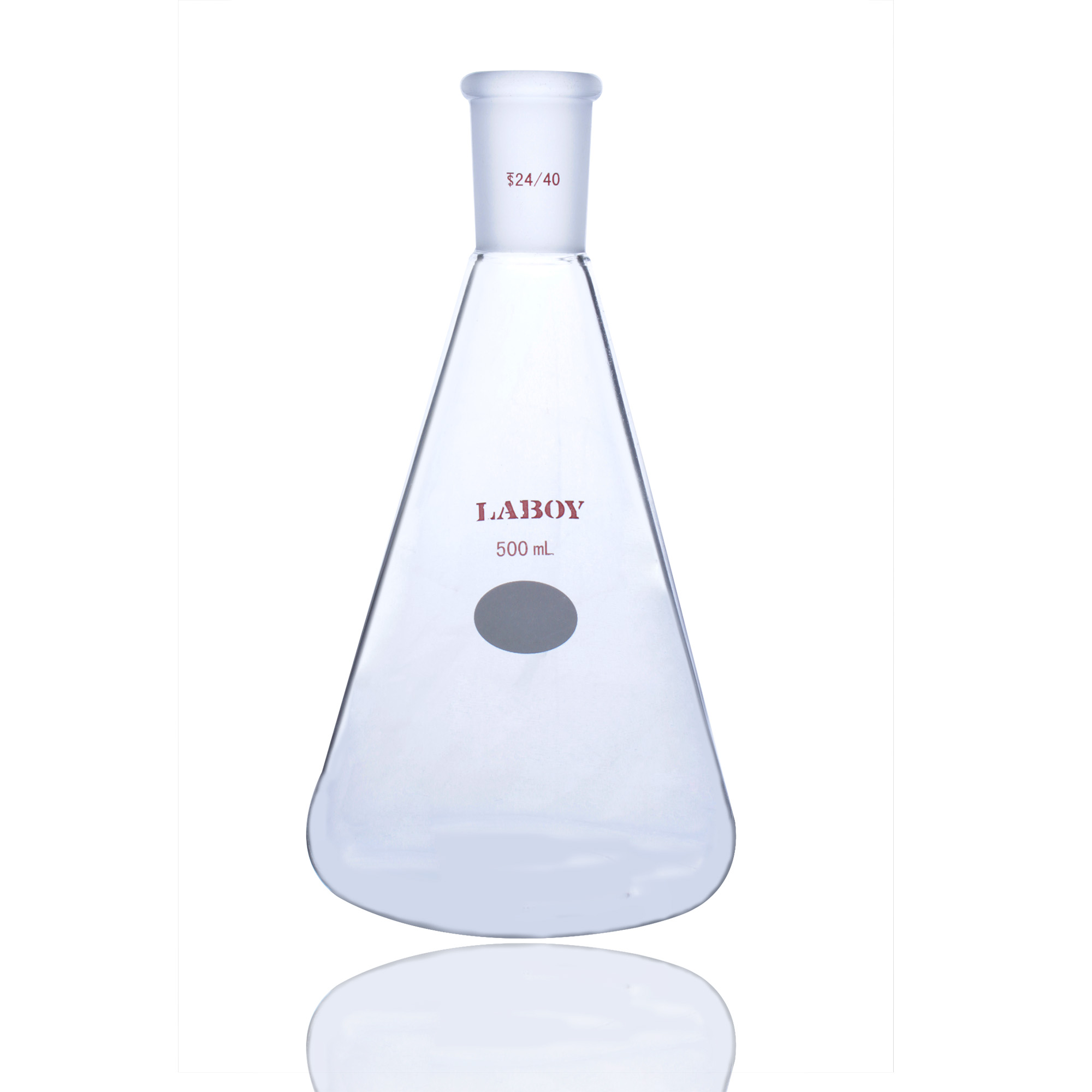
Fast answer: Choose an Erlenmeyer flask when you want a vessel that stands on its own, is easy to swirl, and handles routine bench work well. Do not choose it automatically when the job really calls for a reflux vessel, a distillation flask, or a container that must tolerate vacuum.
How to Recognize It
An Erlenmeyer flask has a flat base, sloping sides, and a narrower neck than a beaker. That shape matters. It lets you swirl liquids more safely than in a wide-open vessel, and it makes the flask much easier to set down and handle during ordinary bench work.
What It Does at the Bench
At the bench, an Erlenmeyer flask is usually doing one of these jobs:
- holding a solution during mixing or swirling
- serving as a temporary working vessel during transfer or collection
- collecting liquid from a gravity filtration or similar routine step
- holding material during crystallization, precipitation, or other bench-scale handling
- giving you a more controlled narrow-neck vessel without the instability of a round-bottom flask
Its value is practical. It stands on its own. It is easy to move around the bench. The conical body helps contain liquid during swirling. The narrower neck reduces splashing and makes casual evaporation or contamination a little easier to control than in a beaker.
That combination makes the Erlenmeyer flask one of the most common “working vessels” in an organic lab, even though it is not the main answer to every heated setup problem.
When You Would Choose It, and When Not
Erlenmeyer flasks are most useful when the task is bench handling rather than apparatus building. They are especially useful when you want a vessel that is easy to set down, easy to swirl, and more controlled than an open beaker.
Situations where an Erlenmeyer flask is often the right choice
| Situation | Typical use case | Why an Erlenmeyer flask fits well |
|---|---|---|
| Routine mixing and swirling | Dissolving solids, combining solutions, washing, temporary reaction mixture handling | The conical body and narrow neck make swirling safer and cleaner than in a beaker. |
| Temporary holding or transfer | Holding a solution during a workup or between setup steps | It stands on its own and is easy to move around the bench. |
| Gravity filtration receiving | Collecting filtrate in a stable vessel | The narrow neck and flat base make it a comfortable receiving vessel for routine bench use. |
| Crystallization or precipitation handling | Cooling, standing, and gently swirling solutions | It supports standing, swirling, and observation without needing a clamp or support ring. |
| Work that benefits from a jointed bench vessel | Using a jointed Erlenmeyer flask in a more controlled glass-to-glass connection | A jointed version can be useful when you still want the basic Erlenmeyer body but need a standard taper connection. |
Situations where it may not be the best first choice
- Reflux as a standard heated setup: A round-bottom flask is usually the more natural reflux vessel.
- Distillation as the main boiling vessel: A round-bottom flask fits distillation logic and heating behavior much better.
- Vacuum or reduced-pressure work: Do not treat a plain Erlenmeyer flask as a general vacuum vessel.
- Setups that need several connected parts: A conical bench vessel is not the same thing as a purpose-built apparatus vessel.
- Long, strongly heated reactions: Standing convenience does not outweigh the setup advantages of a round-bottom flask in those cases.
Quick decision guide: If the task is mainly swirling, holding, collecting, or ordinary bench handling, an Erlenmeyer flask is often a good choice. If the task is mainly heating, reflux, distillation, vacuum, or building a connected apparatus, start by asking whether a round-bottom flask would make more sense.
Boundaries, Variants, and Similar Tools
Common Erlenmeyer Flask Variants
Plain Erlenmeyer Flask
This is the classic form: flat base, conical body, narrow neck, no ground-glass joint. It is the version most people mean when they say “Erlenmeyer flask.”
It is best for routine bench handling, swirling, standing, and temporary liquid work. It is not meant to replace a round-bottom flask in fully developed heating setups.
Erlenmeyer Flask with Standard Taper Joint
A jointed Erlenmeyer flask keeps the same overall body shape, but adds a standard taper connection at the neck. That makes it more controlled in situations where you want a fitted connection rather than a simple stopper or open neck.
The important boundary is this: a jointed Erlenmeyer flask is still an Erlenmeyer flask. The joint adds connection options, but it does not automatically turn the vessel into the best choice for reflux, vacuum, or distillation.
Heavy-Wall Erlenmeyer Flask
A heavier-wall version is built for greater robustness than a very thin, lightweight flask. That can matter in everyday handling, especially when the vessel is being used repeatedly for demanding bench work.
Still, “heavy-wall” should not be read as “suitable for anything.” The job still matters more than the marketing adjective. Vessel shape, support needs, pressure conditions, and apparatus role still decide whether it is the right flask.
Erlenmeyer Flask Variants at a Glance
| Variant | Best for | Main advantage | Main limitation | Common beginner mistake |
|---|---|---|---|---|
| Plain Erlenmeyer flask | Swirling, standing, routine bench handling | Simple, stable, convenient | Not a strong substitute for many setup-driven roles | Treating it as a general-purpose reaction flask for everything |
| Erlenmeyer flask with standard taper joint | Bench work that benefits from a fitted connection | More controlled glass-to-glass connection | Still not automatically the best reflux or distillation vessel | Assuming the joint alone makes it equivalent to a round-bottom flask |
| Heavy-wall Erlenmeyer flask | More durable day-to-day handling | More robust feel in use | Wall thickness does not change the vessel’s role at the bench | Thinking thicker glass removes all other vessel-choice limits |
Similar Tools and Key Boundaries
Erlenmeyer Flask vs Beaker
A beaker is more open and more direct. It is easy to pour from and easy to access. An Erlenmeyer flask gives you more control during swirling and a narrower opening.
That makes the Erlenmeyer flask a better choice when splashing, casual evaporation, or cleaner mixing matter more than easy top access.
Erlenmeyer Flask vs Round-Bottom Flask
This is one of the most important boundaries for beginners. An Erlenmeyer flask is usually a bench vessel. A round-bottom flask is usually a setup vessel.
Erlenmeyer flasks are easier to stand, move, swirl, and handle casually. Round-bottom flasks are better suited to heating mantles, reflux, distillation, vacuum, and multi-part apparatus work.
Erlenmeyer Flask vs Flat-Bottom Flask
Both stand on their own, but the body shape leads to different behavior. An Erlenmeyer flask is better for swirling and narrowing the opening. A flat-bottom flask keeps a more flask-like body without the same conical mixing logic.
Erlenmeyer Flask vs Filter Flask
These are easy to confuse because both may sit flat on the bench. The important difference is function. A filter flask is built around vacuum filtration logic. An Erlenmeyer flask is not just a filter flask with no side arm, and a plain Erlenmeyer should not be casually used where the real job is vacuum filtration.
Erlenmeyer Flask vs Other Common Bench Vessels
| Vessel | Better for | Advantage over an Erlenmeyer flask | Limitation compared with an Erlenmeyer flask | When an Erlenmeyer flask is the better choice |
|---|---|---|---|---|
| Beaker | Wide access, easy pouring, rough temporary holding | More open and easy to access from the top | Worse for swirling and splash control | When you want a standing vessel that handles swirling and narrow-neck control better |
| Round-bottom flask | Heating, reflux, distillation, vacuum, connected apparatus | Far better as a true setup vessel | Cannot stand on its own and is less convenient for ordinary bench handling | When the job is really bench handling rather than apparatus building |
| Flat-bottom flask | Standing while keeping a more conventional flask form | Useful where a self-supporting flask body is wanted | Less naturally suited to swirling behavior than an Erlenmeyer flask | When conical shape and narrower neck improve handling |
| Filter flask | Vacuum filtration receiving | Purpose-built for vacuum filtration | Less of a general bench vessel | When the task is ordinary mixing, holding, or collecting rather than vacuum filtration |
Common Beginner Mistakes
1. Treating an Erlenmeyer flask as a default reaction vessel
Mistake: Reaching for it automatically whenever a reaction mixture needs a flask.
Why it causes trouble: A vessel that is convenient on the bench is not automatically the best vessel for reflux, distillation, or connected heated apparatus.
A better approach: Ask first whether the job is bench handling or setup building.
2. Assuming the flat base makes every use safer
Mistake: Thinking that because it stands on its own, it is automatically the safer or better flask in all cases.
Why it causes trouble: Stability on the bench is useful, but it does not replace the advantages of a purpose-built heating or vacuum vessel.
A better approach: Separate “easy to stand” from “best for the job.”
3. Using a plain Erlenmeyer flask where vacuum logic really matters
Mistake: Treating it casually as a substitute for a filter flask or other vacuum-suitable vessel.
Why it causes trouble: The fact that it is a flask does not mean it is designed for every pressure condition or apparatus role.
A better approach: Match the vessel to the pressure and apparatus demands, not just the general flask category.
4. Overfilling during swirling or mixing
Mistake: Filling it so high that there is little room for motion.
Why it causes trouble: The conical shape helps with swirling only when there is room for liquid to move safely.
A better approach: Leave enough headspace for the liquid to move without climbing too far into the neck.
5. Assuming a jointed Erlenmeyer flask is now equivalent to a round-bottom flask
Mistake: Seeing a standard taper joint and assuming the vessel now fills the same role as a setup-driven round-bottom flask.
Why it causes trouble: The joint changes connection options, but it does not change the underlying vessel logic.
A better approach: Treat the joint as an added feature, not a total change of vessel category.
6. Ignoring chips, cracks, or damaged necks
Mistake: Continuing to use a flask that looks “mostly fine.”
Why it causes trouble: Bench vessels still need basic inspection. Damage can lead to leaks, breakage, or poor handling at exactly the wrong time.
A better approach: Check the body, rim, base, and any joint before using it as a working vessel.
What to Check in Use
Before you start
- Check for chips, cracks, and scratches
- Make sure the base stands cleanly and stably
- Ask whether the task really calls for an Erlenmeyer flask
- Check any jointed version for a clean, intact taper
During use
- Leave enough room for swirling
- Watch for splashing into the neck
- Make sure the flask is not being used beyond its actual role
- Use a stopper, cover, or fitted connection only where that makes sense for the task
When rethinking the vessel choice
- The task is becoming a true heated setup
- You now need reflux, vacuum, or several connected parts
- The vessel is being chosen for convenience rather than role
- You are starting to treat a bench vessel like an apparatus vessel
Related Pages
Learn the setup
- Understanding Core Setups
- Basic Setup Principles
- Reflux Apparatus Basics
Compare related tools
- Round-Bottom Flasks
- Flat-Bottom Flasks
- Filter Flasks
- Pear-Shaped Flasks
Fix a related problem
- Common Beginner Setup Mistakes
- Why Your Setup Feels Unstable
- Why Your Vessel Choice Is Making the Setup Harder
Use a quick reference
- Flask Shape Comparison Sheet
- Basic Glassware Inspection Checklist
- Bench Vessel Selection Quick Guide