Flat-Bottom Flasks
Flat-bottom flasks sit in an awkward but useful middle position in the organic lab. They keep some of the “flask” feel of a round-bottom vessel, but add one practical advantage that changes how they behave at the bench: they stand on their own.
That sounds simple, but it matters. A flat-bottom flask is easier to set down, easier to handle during ordinary bench work, and often more convenient than a round-bottom flask when the job is not a full reflux or distillation setup. At the same time, that convenience does not automatically make it the best choice for strongly heated, vacuum, or apparatus-heavy work.
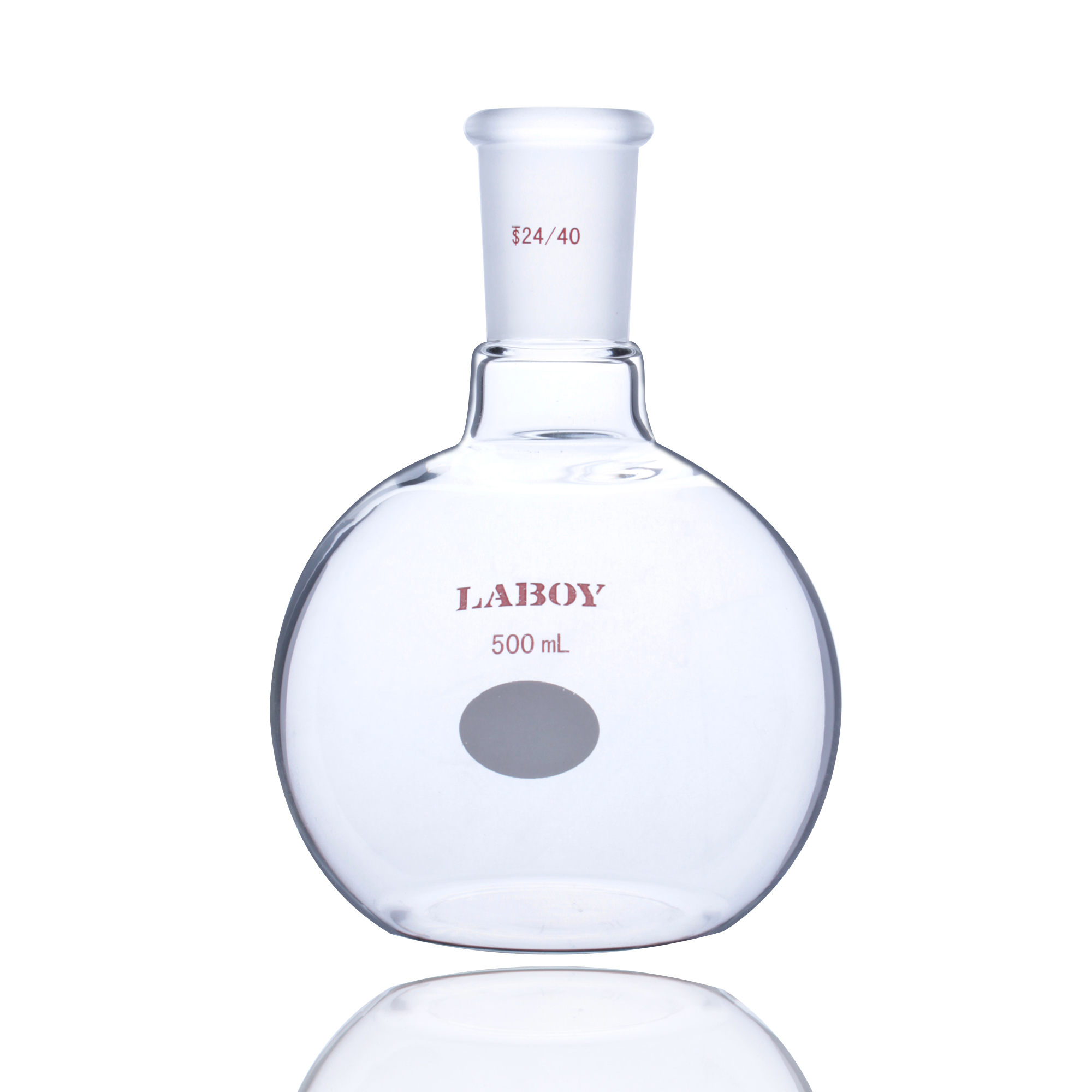
Fast answer: Choose a flat-bottom flask when you want a flask-shaped vessel that can stand on its own and handle ordinary bench work or simpler heated tasks. Do not assume that standing convenience makes it the best choice for reflux, distillation, vacuum, or more demanding connected setups.
How to Recognize It
A flat-bottom flask looks like a flask body set on a stable base rather than a spherical bottom. It may have one or more necks, and many versions use standard taper joints. The key point is not just that the bottom is flat. The key point is that the vessel is meant to stand on the bench without needing a support ring or clamp just to stay upright.
What It Does at the Bench
At the bench, a flat-bottom flask is usually doing one of these jobs:
- holding liquids in a flask-shaped vessel that can stand on its own
- supporting simple heating where the setup does not need the full advantages of a round-bottom flask
- serving as a convenient intermediate vessel for transfer, mixing, or temporary handling
- supporting some routine connected work when a jointed standing vessel is useful
- giving you more stability on the bench than a round-bottom flask, while still feeling more like a flask than a beaker
The main reason to choose a flat-bottom flask is convenience without giving up the basic flask form. It stands on its own, which makes setup pauses, transfers, and ordinary handling simpler. That can be genuinely useful in real lab work.
What it does not automatically do is replace the round-bottom flask in every heated or apparatus-driven role. Flat-bottom flasks can be useful, but they do not erase the usual reasons round-bottom flasks are preferred for reflux, distillation, and many vacuum situations.
When You Would Choose It, and When Not
Flat-bottom flasks make the most sense when standing stability is part of the job. If the task benefits from a flask body but does not clearly demand the stronger setup logic of a round-bottom flask, a flat-bottom flask may be the easier and more practical choice.
Situations where a flat-bottom flask is often the right choice
| Situation | Typical use case | Why a flat-bottom flask fits well |
|---|---|---|
| Standing bench work | Temporary holding, transfer, routine liquid handling | The flask stands on its own, which makes ordinary bench handling easier than with a round-bottom flask. |
| Simpler heated work | Heating that does not require a full reflux or distillation-driven vessel choice | You still get a flask body and jointed options, but with easier standing stability. |
| Intermediate vessel choice | Work that feels more controlled than a beaker but does not need a round-bottom flask | It keeps the familiar flask format without forcing the support demands of a round-bottom flask. |
| Routine jointed bench work | Using a flask with a standard taper connection but without a round bottom | A jointed flat-bottom flask can be convenient when a fitted connection matters more than classic round-bottom setup logic. |
Situations where it may not be the best first choice
- Standard reflux setups: A round-bottom flask is usually the more natural choice.
- Distillation as a main boiling vessel: Round-bottom flasks fit distillation work more naturally.
- Vacuum or reduced-pressure work: Do not assume every flat-bottom flask should be treated like a general vacuum vessel.
- Work where even heating and apparatus geometry matter a lot: Flat standing convenience is not always the deciding factor.
- Setups that are becoming more crowded or more vertical: A standing vessel is not automatically the most stable vessel once several connected parts are involved.
Quick decision guide: If the main benefit you want is that the flask stands on its own, a flat-bottom flask may be the right choice. If the job is mainly reflux, distillation, vacuum, or building a strongly setup-driven apparatus, ask first whether a round-bottom flask is the better vessel.
Boundaries, Variants, and Similar Tools
Common Flat-Bottom Flask Variants
Single-Neck Flat-Bottom Flask
This is the simplest version. It gives you one main neck and a stable base. It is the easiest way to understand why someone would choose a flat-bottom flask at all: it behaves more like a standing bench vessel, but still keeps a flask form and often a standard taper joint.
Two-Neck Flat-Bottom Flask
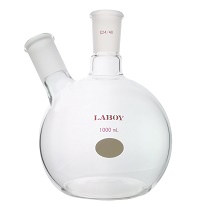
A two-neck flat-bottom flask gives you more than one working path while still keeping the convenience of a standing base. That can be useful in simpler multi-part work where the vessel still needs to stand without a support ring.
Jointed Flat-Bottom Flask
A jointed flat-bottom flask adds fitted glass-to-glass connection logic to a self-supporting flask. That can be helpful in work where you want a standing vessel but still need a controlled joint connection.
Flat-Bottom Boiling Flask
The name can tempt beginners to assume this is simply interchangeable with a round-bottom boiling flask. In practice, the name points to a possible use, not a guarantee that it is the best choice for every boiling setup.
Flat-Bottom Flask Variants at a Glance
| Variant | Best for | Main advantage | Main limitation | Common beginner mistake |
|---|---|---|---|---|
| Single-neck flat-bottom flask | Simple standing flask work | Stable on the bench, easy to handle | Less naturally suited to classic reflux/distillation roles than round-bottom | Assuming the flat base makes it a better choice for every heated setup |
| Two-neck flat-bottom flask | Simpler two-path work with a standing vessel | Extra connection flexibility while remaining self-supporting | Still not a blanket substitute for more setup-driven vessel choices | Focusing on neck count while ignoring apparatus role |
| Jointed flat-bottom flask | Standing flask work that benefits from a taper connection | Controlled glass connection with bench stability | A joint does not automatically make it the best vessel for every apparatus | Thinking the joint alone makes it equivalent to a round-bottom flask |
| Flat-bottom boiling flask | Situations where boiling and standing convenience both matter | More convenient to set down than a round-bottom vessel | Boiling convenience does not erase setup limits | Reading the name as a universal recommendation |
Similar Tools and Key Boundaries
Flat-Bottom Flask vs Round-Bottom Flask
This is the most important comparison. A flat-bottom flask stands on its own. A round-bottom flask usually behaves better in many setup-heavy heated roles. So the question is not which one is better in general. It is whether the task needs standing convenience or setup performance.
Flat-Bottom Flask vs Erlenmeyer Flask
Both stand on the bench, but they feel different in use. An Erlenmeyer flask is better for swirling and narrowing the opening. A flat-bottom flask feels more like a flask body with a stable base. If swirling is central, Erlenmeyer often makes more sense. If you want a more conventional flask shape that still stands, flat-bottom may be the better fit.
Flat-Bottom Flask vs Beaker
A beaker is more open, simpler, and easier to access from the top. A flat-bottom flask gives you a more flask-like shape, often with a narrower neck and a more contained vessel format.
Flat-Bottom Flask vs Filter Flask
These are not interchangeable just because both can stand on the bench. A filter flask is built around vacuum filtration logic. A flat-bottom flask is not automatically a vacuum filtration vessel just because it has a stable base.
Flat-Bottom Flask vs Other Common Vessels
| Vessel | Better for | Advantage over a flat-bottom flask | Limitation compared with a flat-bottom flask | When a flat-bottom flask is the better choice |
|---|---|---|---|---|
| Round-bottom flask | Reflux, distillation, vacuum, setup-driven heating | Better apparatus vessel logic | Cannot stand on its own | When self-supporting stability matters more than classic round-bottom setup behavior |
| Erlenmeyer flask | Swirling, narrow-neck bench handling | Better for swirling and splash control | Less flask-like in some heating-related roles | When you want a standing vessel but not necessarily a conical one |
| Beaker | Open access, rough temporary holding, quick pouring | Simpler and easier to access | Less controlled neck and less flask-like handling | When you want more containment and a narrower opening than a beaker gives |
| Filter flask | Vacuum filtration receiving | Purpose-built for vacuum filtration | Less general-purpose for routine bench handling | When the task is ordinary standing flask use rather than vacuum filtration |
Common Beginner Mistakes
1. Treating a flat-bottom flask as a round-bottom flask that just happens to stand up
Mistake: Assuming the flat base is only a convenience upgrade.
Why it causes trouble: It changes how and where the vessel is most useful. A self-supporting flask is not automatically the better reflux or distillation vessel.
A better approach: Decide whether the job needs standing convenience or classic setup performance.
2. Choosing it because it feels safer on the bench, even when the setup is becoming more complex
Mistake: Letting the flat base decide the vessel choice even when several connected parts are involved.
Why it causes trouble: Once the setup becomes crowded, connected, or strongly heated, the base shape is only one part of the decision.
A better approach: Re-check the full apparatus role, not just whether the vessel can stand on its own.
3. Assuming a jointed flat-bottom flask is now equivalent to any jointed setup vessel
Mistake: Treating the standard taper joint as if it erases all the usual vessel-choice boundaries.
Why it causes trouble: The joint adds connection options, but the body shape and bench role still matter.
A better approach: Treat the joint as one feature, not a complete change of vessel category.
4. Using the flat base as a reason to ignore support and layout
Mistake: Thinking that because the vessel stands, support issues are gone.
Why it causes trouble: In connected work, apparatus balance and stress can still matter a lot, even with a flat base.
A better approach: Treat standing convenience as helpful, not as the whole stability story.
5. Overfilling during heating or mixing
Mistake: Filling the flask so high that headspace disappears.
Why it causes trouble: Even a standing flask still needs space for boiling, movement, and safe handling.
A better approach: Leave room for liquid motion and for the behavior of the task, not just for the liquid volume itself.
6. Ignoring chips, cracks, or base damage
Mistake: Continuing to use a flask that “still stands fine.”
Why it causes trouble: The base may stand, but damage still affects safety, sealing, and overall reliability.
A better approach: Check the body, base, neck, and any joint before using it as a working vessel.
What to Check in Use
Before you start
- Check for chips, cracks, and scratches
- Make sure the base sits cleanly and stably
- Ask whether the task really calls for a flat-bottom flask
- Check any jointed version for a clean, intact taper
During use
- Leave enough headspace for the actual task
- Watch whether the flask is being used within its real role
- Check whether connected parts are making the setup awkward or unstable
- Do not let standing convenience hide a poor apparatus choice
When rethinking the vessel choice
- The work is becoming a true reflux or distillation setup
- Vacuum is becoming part of the operation
- Several connected parts are starting to crowd the vessel
- The flat base is now the main reason you are still using it
Related Pages
Learn the setup
- Understanding Core Setups
- Basic Setup Principles
- Heating-Vessel Matching Logic
Compare related tools
- Round-Bottom Flasks
- Erlenmeyer Flasks
- Pear-Shaped Flasks
- Filter Flasks
Fix a related problem
- Common Beginner Setup Mistakes
- Why Your Vessel Choice Is Making the Setup Harder
- Why Your Setup Feels Unstable
Use a quick reference
- Flask Shape Comparison Sheet
- Basic Glassware Inspection Checklist
- Bench Vessel Selection Quick Guide