When PTFE or PFA Flat-Bottom Flasks Make More Sense Than Glass
Most routine organic lab work still uses glass. This page becomes useful when glass is chemically attacked, when contamination from glass starts to matter, or when a non-glass vessel changes the practical outcome of the work.
Fast answer
For most teaching-lab and routine synthesis work, borosilicate glass remains the better default because it is easy to inspect, easy to monitor during a run, and already fits the jointed apparatus used across organic lab work.
PTFE and PFA become useful when the medium is hard on glass, when trace contamination matters, or when a non-glass vessel is required for bench compatibility reasons. The important point is that switching away from glass is not just a material substitution. It changes how the vessel heats, what you can see, how you inspect damage, and which mistakes become more likely.
Students often learn “glassware choice” as if it were only about shape. In practice, material choice can be just as important. A flat-bottom PTFE or PFA flask may look like a simple swap for a glass flat-bottom flask, but at the bench the behavior changes immediately: heating is slower, the contact with the hotplate matters more, visibility may be worse, and the damage signs are different.
That is why it helps to separate two questions. First: is glass still the right default for this job? Second: if not, what new handling logic comes with PTFE or PFA?
| Material | What it does well | What changes at the bench | When not to choose it | Typical use |
|---|---|---|---|---|
| PTFE | Very broad chemical resistance and strong compatibility with aggressive media. | Usually opaque or hard to read through; heats more slowly than glass; base contact becomes more important. | When you need clear visual monitoring, easy meniscus reading, or a familiar glass setup with standard joints throughout. | Corrosive media, protected handling, situations where glass compatibility is the limiting factor. |
| PFA | Very broad chemical resistance with lower contamination risk and better visibility than PTFE. | Still does not behave like glass under heat; often needs slower ramping and better base support. | When ordinary borosilicate already works and there is no contamination-control reason to switch. | Trace work, corrosive media, cleaner transfer and storage situations. |
| Borosilicate glass | Clear visibility, familiar apparatus logic, easy inspection, broad usefulness in routine organic synthesis. | Integrates naturally with ground-glass systems and standard organic lab setups. | When the medium attacks glass or when contamination from glass becomes unacceptable. | Most routine organic reactions, setup training, general bench work. |
When glass is still the better default
It is worth saying this plainly: for most beginner and intermediate organic lab work, glass is still the easier and more teachable choice. It lets you see phase behavior, monitor solids, judge boiling and stirring, and connect cleanly into modular apparatus built around standard taper joints.
If your solvent, reagent system, and temperature range do not create a strong reason to leave glass behind, staying with glass usually gives you a more transparent and easier-to-troubleshoot setup. That is especially true when the work depends on watching the contents closely rather than simply containing them.
When PTFE or PFA starts to make more sense
PTFE and PFA become more attractive when glass is no longer a comfortable fit for the chemistry. That usually happens for one of three reasons: the medium attacks glass, contamination from glass starts to matter, or a non-glass container better matches the real handling demands of the work.
In that sense, the switch is usually driven by a limitation of glass, not by a vague idea that fluoropolymers are “better.” That framing helps readers make a cleaner decision and keeps the page grounded in bench logic.
Why heating changes first
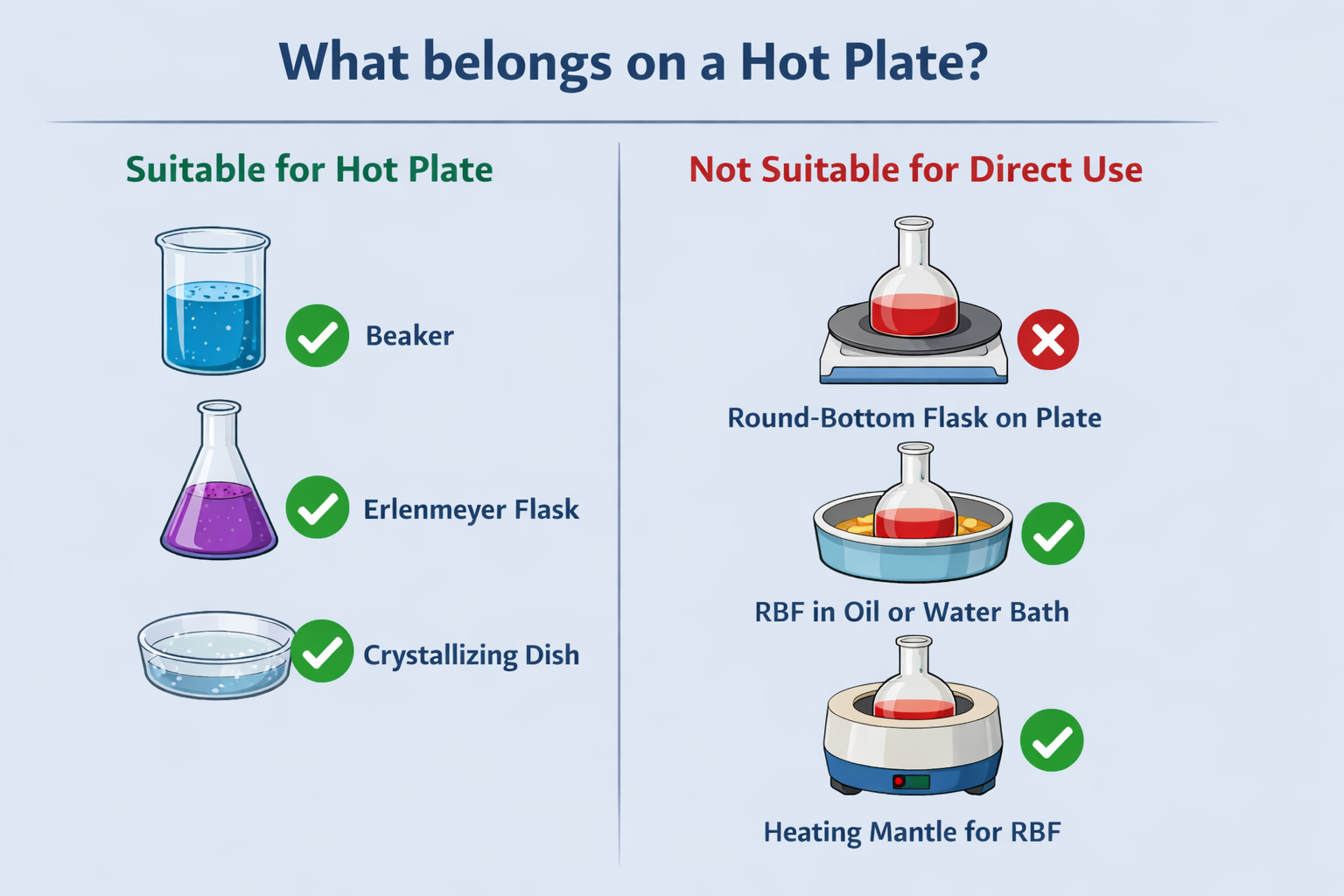
The first thing most users notice after switching away from glass is not chemical compatibility. It is thermal behavior. PTFE and PFA do not respond to the hotplate the way glass does. The contents often warm more slowly, the heating feels less intuitive, and poor base contact becomes a more serious problem.
This is one reason beginners misread non-glass setups. They expect the vessel to respond like borosilicate, see a delayed temperature response, then turn the heat up too quickly or assume “nothing is happening.” In practice, slower response is part of the new handling logic.
Non-glass heating checks
- Use slower heat ramps than you would use for a comparable glass vessel.
- Pay attention to full base contact rather than a few small hot spots.
- Do not assume the vessel interior is cold just because the response is delayed.
- Check the manufacturer’s service-temperature guidance before pushing the setup hard.
PTFE vs PFA at the bench
PTFE and PFA often get grouped together, but they do not feel identical in use. PTFE is often the less visually friendly option. PFA is usually easier to monitor and is often chosen when cleaner handling and lower contamination risk matter. If the experiment depends on seeing phase boundaries, solid buildup, or subtle color change, that difference becomes practical very quickly.
This is also where readers benefit from thinking beyond material names. The better question is not “which fluoropolymer is best in general?” but “which one creates fewer new problems for this specific task?”
When contamination from glass starts to matter
In some work, glass is not just a neutral container. It becomes part of the contamination story. That is where PFA, in particular, can become more attractive. If the experiment or analysis is sensitive enough that contact with glass changes what you can measure or trust, then the material choice has moved from convenience into experimental design.
That is a very different situation from ordinary synthetic bench work. For that reason, this page should not leave readers with the impression that PFA is a universal upgrade. It is more accurate to say that it becomes useful when the cleanliness requirement is higher than what routine glass use comfortably supports.
Common mistakes when switching away from glass
- Treating chemical resistance as total suitability. Compatibility with a reagent does not automatically solve heating, visibility, or pressure questions.
- Using the vessel like ordinary glassware. The thermal response is different, so the heating style usually has to change as well.
- Ignoring visibility limits. A vessel that is harder to see through can make phase reading, precipitation, and stirring problems easier to miss.
- Forgetting secondary contamination sources. A damaged PTFE-coated stir bar or poorly chosen transfer accessory can undo the cleanliness benefit of the vessel itself.
If stirring becomes unstable while you are working in flat-bottomed vessels, it is also worth reading our guide to flat-bottom flask stirring problems, because heat transfer and stir-bar behavior often interact in ways beginners do not expect.
Inspection and retirement look different here
With glass, many readers know to look for cracks, chips, star fractures, or worn joints. With fluoropolymer vessels, the warning signs are different. You may be looking more for surface damage, deformation, discoloration, clouding, or other changes that suggest the surface is no longer in the condition you need for clean work.
The basic habit is the same, though: inspect before use, not after failure. If you need a practical comparison for general inspection habits, see how to check and retire damaged glassware safely. The specific damage modes differ, but the discipline of routine inspection carries over directly.
What about hydrofluoric acid?
HF is exactly the kind of case that forces material choice to the front. Glass is not the right vessel material there. But the important teaching point is not just “use a different flask.” It is that a change in vessel material does not reduce the need for training, local SOPs, compatible PPE, and tightly controlled handling.
In other words, a compatible vessel solves one problem. It does not solve the whole safety system.
Practical decision rule
Ask these questions in order:
- Does glass already work chemically for this job?
- Does the work depend on easy visual monitoring during the run?
- Does contamination from glass matter at the level of the task?
- Will switching away from glass create new heating or handling problems that matter more than the chemical benefit?
If glass is still chemically acceptable and easier to interpret during use, it is usually still the better default. If glass is the limiting factor, PTFE or PFA can make sense, but only when you also accept the different heating and inspection logic that comes with the switch.
FAQ
Is PFA always better than glass?
No. PFA is not a universal upgrade. Glass is still the better default for most routine organic lab work because it is easier to inspect, easier to monitor during the run, and already fits the modular jointed systems used across the bench.
What is the biggest practical change when moving from glass to PTFE or PFA?
The biggest day-to-day change is usually heating behavior. The vessel often responds more slowly, and poor base contact becomes more important. Readers who treat the vessel like ordinary glass often overcorrect too early.
Why would someone choose PFA instead of PTFE?
A common reason is bench usability. PFA is often easier to monitor and is often chosen when cleaner handling and lower contamination risk matter more than the lower visibility that often comes with PTFE.
Can fluoropolymer flat-bottom flasks be treated like ordinary hotplate glassware?
Not safely by default. They need a more deliberate heating style, better attention to base contact, and slower expectation of response. The mistake is not always overheating first; it is often misreading the lag and then forcing the setup too hard.
Does changing the vessel material solve the whole safety problem for highly corrosive work?
No. It only solves one part of the problem. High-risk chemical handling still depends on compatible procedures, trained users, PPE, local rules, and a setup designed for the actual hazard rather than just the container.