Why Your Vigreux Column Failed: A Glassblower’s Guide | ChemNorth

Article Body

(Intro) A Vigreux column adds surface area, not controllable theoretical plates—and without proper thermal management, it rarely performs the way people expect.

Common Misconceptions: Is Your Vigreux Column Defective?

I’ve been blowing scientific glass for nearly twenty years, and over that time I’ve seen almost every kind of request imaginable. Last week, a long-time client from a local research institute came to my workshop with a Vigreux column I had made.

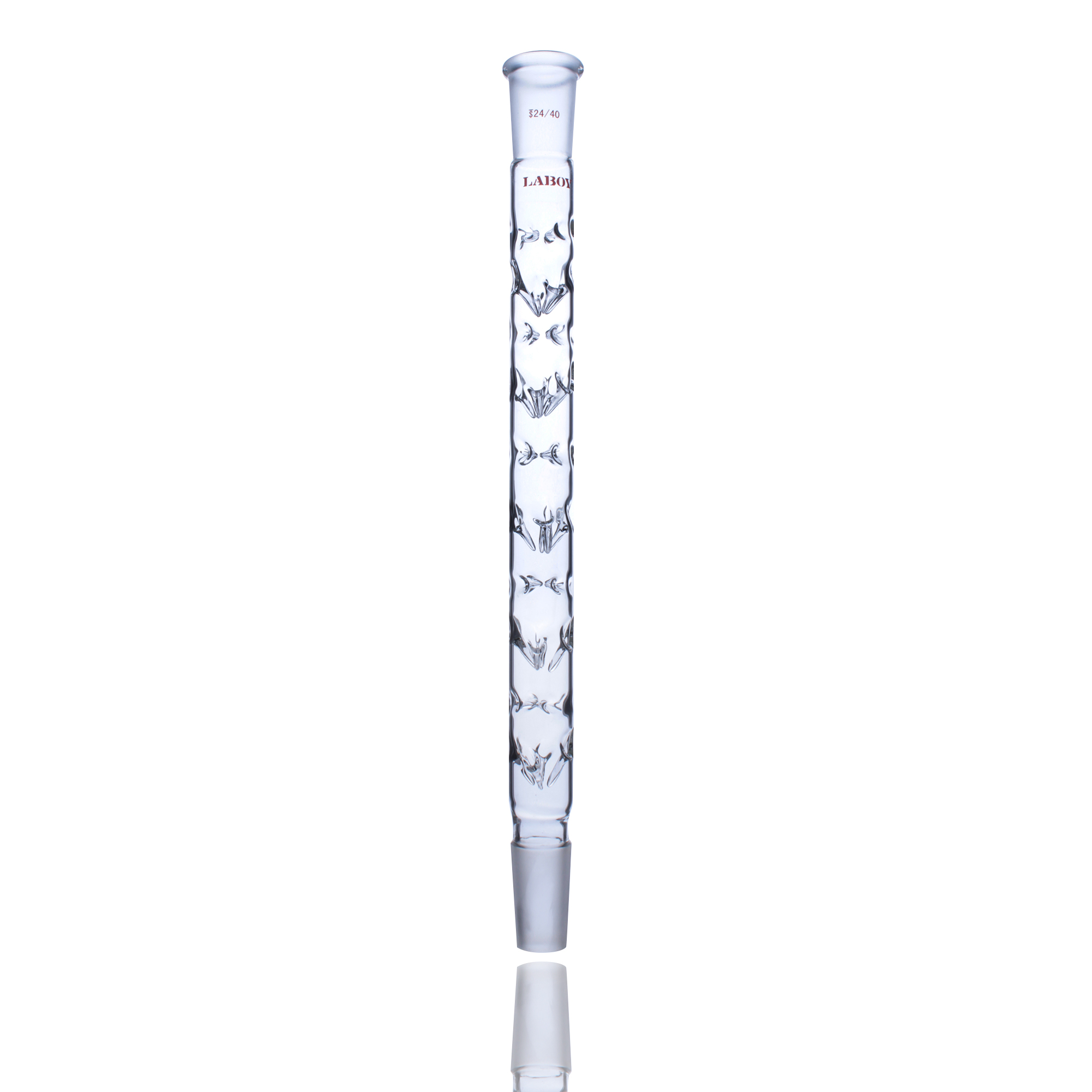
He pointed at the indentations and asked, “Is there a defect in this column? I’ve seen other brands where the spikes are much denser. Yours seem too sparse. My distillation purity was poor yesterday, and I suspect this column doesn’t provide enough theoretical plates.”

I held the column up to the light. It was a standard Vigreux structure—uniform wall thickness, consistent indentation depth and angle, no visible stress or flaws. There was nothing wrong with the glass itself.

I told him, calmly, “The column isn’t defective. Even if I rebuilt this to look like a hedgehog, your separation probably wouldn’t improve. The effectiveness of a Vigreux column has never depended on how many ‘teeth’ it has.”

That conversation reminded me how often even experienced chemists misunderstand the limitations of the glassware they use every day. From a glassblower’s perspective, here’s why a Vigreux column so often feels like it “isn’t working.”

Recommended Reading: For a clear visual comparison of how Vigreux, packed, and other fractional distillation columns are constructed internally, see our guide: 👉 Inside Fractional Distillation Columns: What’s Really Inside?

The Glassblower’s Perspective on Design

When customizing laboratory glassware, many people assume:

  • More complex structure → More surface area → Better separation.

That intuition isn’t wrong—but it’s incomplete.

Surface Area vs. Turbulence

The inward-facing indentations of a Vigreux column serve only two real functions:

  1. Increase Contact Area: They increase gas–liquid contact area.
  2. Create Turbulence: They disrupt straight vapor flow and introduce turbulence.

What they do not do is magically generate a large number of theoretical plates. By design, a Vigreux column is a low-efficiency fractionating column. If your target separation demands high plate counts, asking for more indentations misses the point. At that stage, you should be using a Packed Column, not trying to force extra performance out of a Vigreux.

Why More Indentations Reduce Efficiency

The next question I’m usually asked is: “If you add more rows of indentations, wouldn’t that help?”

In practice, it often does the opposite. From a glassblowing standpoint, indentation density is limited by the need to maintain uniform wall thickness and manage thermal stress. However, overcrowding the internal structure introduces a more serious operational issue.

The Risk of Column Flooding

When vapor flow is partially obstructed by overly dense spikes, refluxing liquid can no longer drain smoothly downward. Instead, liquid becomes trapped and pushed upward by rising vapor. This phenomenon is known as Flooding.

When flooding occurs:

  • Gas–liquid contact turns chaotic.
  • Pressure drop increases significantly.
  • Effective fractionation collapses.

In extreme cases, the distillation stalls entirely. At that point, separation efficiency isn’t just poor—it’s fundamentally compromised.

The Real Culprit: Lack of Insulation & Thermal Management

If the column itself wasn’t the problem, what went wrong with my client’s experiment? I asked one simple question:

“When you ran the column, did you insulate it?”

There was a pause. “You mean dressing it? No—I wanted to see the liquid level.”

That answer explains most disappointing Vigreux results I encounter.

Understanding Internal Reflux

In my experience, the majority of “inefficient” Vigreux columns aren’t failing because of poor glass design. They fail because of poor insulation.

Vigreux columns are thin-walled by necessity. Without insulation, ambient air strips heat from the rising vapor long before it reaches the still head. This creates excessive, uncontrolled internal reflux. While some reflux is essential, reflux driven by room temperature rather than operator control rarely improves separation.

I advised him to try again: wrap the column with glass wool or cotton, or use a vacuum-jacketed alternative. Let vapor travel smoothly to the top, where the reflux ratio can be managed intentionally rather than dictated by heat loss to the lab.

Glass Vigreux distillation column wrapped in white cotton insulation to prevent heat loss, connected to a round bottom flask in a heating mantle.
The Solution in Action: A Vigreux fractional distillation column fully wrapped in insulation material (lagging). This setup illustrates the practical solution for maintaining adiabatic conditions, preventing premature condensation, and ensuring vapor reaches the condenser—crucial for high-boiling point distillations.

3 Expert Tips for Better Distillation Results

Two days later, I received a message: the desired purity had been reached. After decades at the torch, I’d offer three practical recommendations to anyone working with fractional distillation columns:

1. Communicate with Your Glassblower

Before assuming an instrument is defective, discuss the problem. Often the solution isn’t a new column—it’s an extra layer of insulation or a slight adjustment in technique.

2. Choose the Right Tool

Vigreux columns are meant for simple separations. If your components boil within about 10 °C of each other, stop struggling with a Vigreux and switch to a higher-efficiency design, such as a Packed Column.

3. Respect the Physics

Glass geometry is static. Heat input, insulation, and reflux control are not. Focus on the system as a whole, not just the shape of the glass.

Remember: Glass doesn’t decide how well your distillation runs. You do.


FAQ: Common Questions About Vigreux Columns

Q: What is the main disadvantage of a Vigreux column? A: The main disadvantage is its relatively low number of theoretical plates compared to packed columns. It is not suitable for separating compounds with very close boiling points.

Q: Why is my Vigreux column flooding? A: Flooding usually occurs when the vapor velocity is too high or the indentations are too dense, preventing the liquid from draining back down. It can also happen if the heat input is too aggressive.

Q: Do I need to insulate my Vigreux column? A: Yes, absolutely. Without insulation (like glass wool or a vacuum jacket), ambient air cools the vapor too quickly, causing uncontrolled internal reflux and reducing separation efficiency.

About the Author: Zoe.W

With over 20 years of experience in hand-blown glass manufacturing, Zoe.W is dedicated to bridging the gap between craftsmanship and laboratory application. Combining frontline lab feedback with deep industry knowledge, she specializes in solving complex equipment challenges for organic chemistry experiments.

Connect with Zoe: Email |