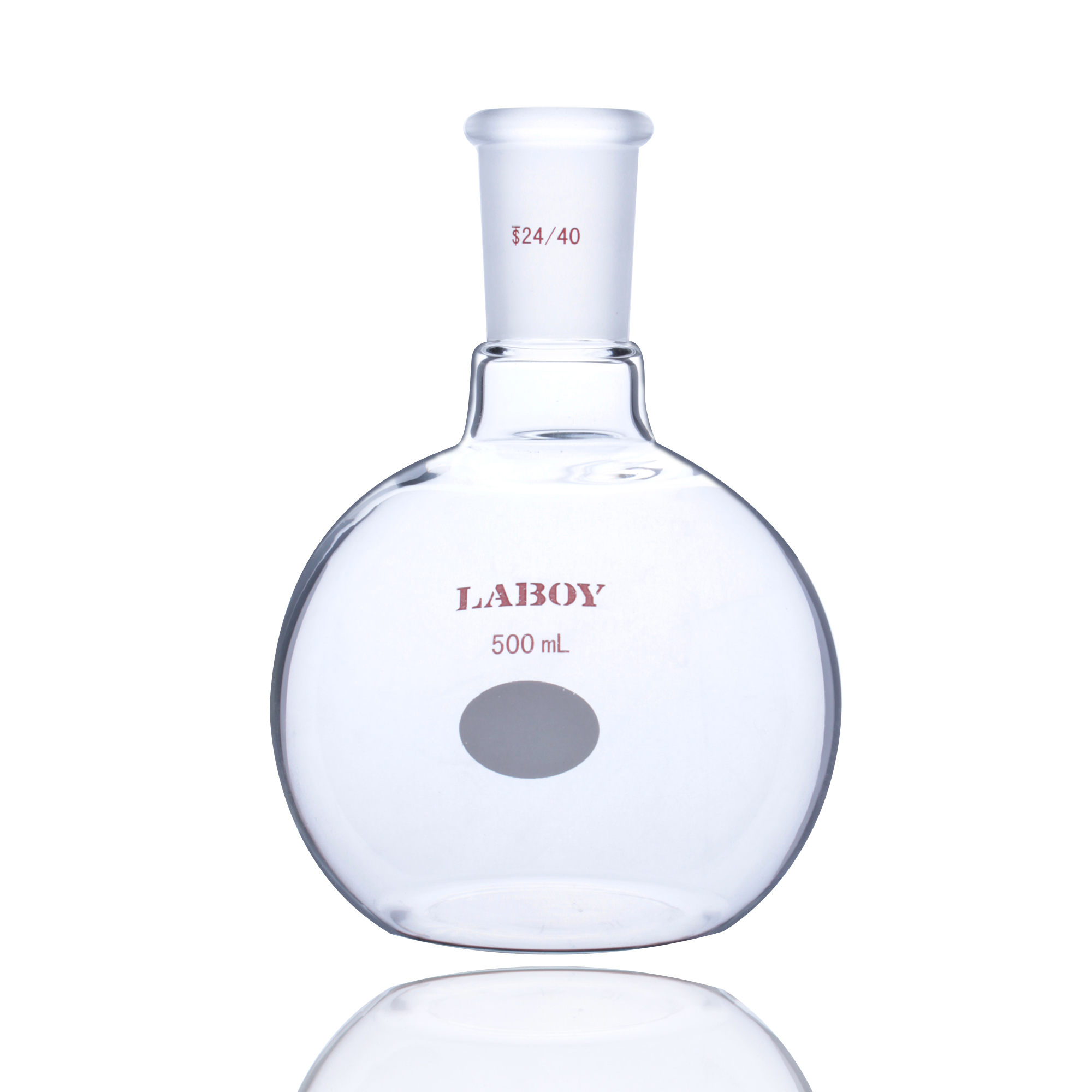
It usually happens during cleanup or a rushed solvent swap. You move a hot flask to the bench, or you push heat too quickly during a distillation, and then you hear the sound everyone dreads: a sharp tink. Moments later, the base of the flask has cracked or separated.
This is not just a broken piece of glassware. If the flask contains hot solvent, corrosive reagent, or air-sensitive material, it can turn into a real lab safety incident.
One common failure mode is a crack that forms near the junction where the side wall meets the bottom of the flask. Glassblowers often refer to this region as the heel. In practical lab terms, this is one of the most vulnerable parts of a flat-bottom flask because it sits at the boundary between two parts of the vessel that do not heat and cool in quite the same way.
For beginners, the key point is simple: a flat-bottom flask is often damaged not by one dramatic mistake, but by uneven heating or uneven cooling concentrated at the base.
Quick Answer
A flat-bottom flask usually cracks at the base because the bottom and the side walls do not change temperature at the same rate.
The most common causes are:
- placing a hot flask on a cold bench surface
- heating too aggressively or unevenly
- getting cold liquid or water on a hot base
- reusing scratched or previously stressed glassware
The risk is higher in flat-bottom flasks than in round-bottom flasks because the base region typically has a different geometry and often a different effective thickness than the body of the flask. That makes the wall-to-base junction a common location for thermal stress to build.
Why the Base Is a Vulnerable Area
To understand this failure, it helps to look at the shape of the flask.
A round-bottom flask has a continuous curved body, which helps distribute thermal expansion more evenly. A flat-bottom flask, by contrast, has to transition from a curved wall into a stable flat base. That transition creates a more mechanically demanding region near the bottom edge.
When the flask is heated or cooled too quickly, the side wall and the base may not respond at the same speed. The result is thermal stress. If that stress becomes large enough, a crack can begin at the wall-to-base junction and propagate around the heel of the flask.
This is why a flask may look completely fine one moment and then suddenly fail during heating, transfer, or cooling. The glass is not reacting to only its current temperature. It is reacting to the temperature difference across the vessel.
Why Flat-Bottom Flasks Are More Vulnerable Than Round-Bottom Flasks
This does not mean flat-bottom flasks are bad glassware. They are useful in many routine situations, especially when bench stability matters. But they do have a limitation: they are generally less forgiving under thermal stress than round-bottom flasks.
A round-bottom flask is usually the better choice when the setup involves:
- sustained heating
- reflux
- distillation
- heating mantles
- vigorous stirring at elevated temperature
- repeated heating and cooling cycles
A flat-bottom flask is more appropriate when:
- bench stability matters more than uniform heating
- the thermal demands are modest
- the vessel is being used for temporary holding, mixing, or lower-stress operations
For beginners, a good rule is this: if heat distribution matters, round-bottom glassware is usually safer and more predictable.
The Three Most Common Causes of Base Cracks
1. Setting a Hot Flask on a Cold Surface
This is one of the most common ways to destroy a flask.
If you remove hot glassware from a heating source and place it directly on a cold metal, stone, or sealed lab bench, the base cools first and fastest. The bottom contracts while the rest of the flask is still expanded. That mismatch creates stress right where the wall meets the base.
This is why a flask can survive heating, survive handling, and then fail only after it touches the bench.
2. Heating Too Fast or Too Unevenly
Glass tolerates heat better when the temperature changes gradually and evenly.
Problems start when one part of the flask gets much hotter than another. That can happen when:
- the hotplate is turned up too quickly
- the flame is concentrated in one area
- the vessel sits poorly on the heat source
- the flask is partially dry-heated while another region stays cool
The faster the temperature gradient develops, the greater the internal stress.
3. Water or Cold Solvent on a Hot Flask
A single drop of cool liquid on hot glass can create a local contraction zone. If that happens near the base, especially on already stressed glass, it can start a crack.
This is why hot glassware should never be treated casually during cleanup. A flask does not need to be red-hot to suffer thermal shock. It only needs a strong enough local temperature difference.
What to Do Right After Removing a Hot Flask from Heat
This is the point where many failures happen.
After heating, do not place the flask directly onto a cold benchtop. Instead, set it on a surface that slows the cooling rate and reduces local stress, such as:
- a cork ring
- a wood pad
- a heat-safe insulating mat
- another appropriate lab support surface that does not act like a heat sink
Also make sure the outside of the flask stays dry. If the base or lower wall is wet, a hot flask becomes much more vulnerable.
If the flask has been heated strongly, give it time to cool gradually before moving it into a colder environment or exposing it to wash water.
How to Reduce Thermal Shock in Daily Lab Work
Heat Gradually
Do not jump from low heat to maximum heat unless the setup truly calls for it and the apparatus is designed for it. Give the flask time to warm more evenly.
Match the Flask to the Job
Use round-bottom flasks for reflux, distillation, and other heat-intensive workflows. Use flat-bottom flasks more cautiously when significant heating is involved.
Keep the Exterior Dry
Before heating, make sure the outside of the flask is dry. Before setting a hot flask down, make sure the receiving surface is not wet.
Avoid Dragging Glassware
Dragging a flask across the bench can create scratches at the base. Those scratches act as stress concentrators and make later failure more likely.
Inspect Before Reuse
Do not focus only on dramatic cracks. Also check for:
- scratches on the bottom
- star-like impact marks
- chips near the base
- whitening or damaged-looking stress regions
- signs of previous bumping or mechanical shock
Treat Violently Bumped Flasks with Caution
If a flask has bumped hard during boiling, do not assume it is fine just because it did not break immediately. Mechanical shock plus thermal stress is a bad combination.
When a Flat-Bottom Flask Is the Wrong Choice
A flat-bottom flask is not the best default vessel for every heated operation.
You should strongly consider a round-bottom flask instead when the operation involves:
- high-temperature heating
- prolonged reflux
- distillation
- oil bath or mantle heating
- frequent thermal cycling
- any setup where uniform heat transfer matters
For more demanding work, the question is not just “Will this vessel hold the liquid?” The better question is “Will this vessel stay mechanically stable while being heated, cooled, stirred, and handled?”
That is why round-bottom flasks remain the standard choice for so many organic lab heating setups.
A Few Important “Never” Rules
- Never place a hot flask directly onto a cold metal or stone bench.
- Never cool a very hot flask abruptly unless the procedure explicitly requires it and the apparatus and quench method are designed for that transition.
- Never ignore visible scratches or impact marks on the base of a flask that will be heated again.
- Never assume that because borosilicate glass is heat-resistant, it is immune to thermal shock.
Heat-resistant glass is still glass. It performs well when temperature changes are controlled. It fails when temperature differences become too large and too localized.
Common Beginner Mistakes
One common mistake is treating a flat-bottom flask as if it were just a more convenient round-bottom flask. It is not. The shape changes how stress is distributed.
Another is thinking that the danger comes only from heating. In reality, many failures happen during cooling, especially when hot glass meets a cold surface.
A third is reusing glassware that has already been scratched, knocked, or stressed. Glass often gives very little warning before it fails. The damage that matters most may be small and easy to miss.
Final Takeaway
A cracked base is not random bad luck. In most cases, it is the result of uneven temperature change acting on one of the weakest parts of the vessel.
If you remember only one thing, remember this:
Flat-bottom flasks are more vulnerable when the base heats or cools differently from the rest of the flask.
That means safer handling starts with a few simple habits:
- choose the right flask for the job
- heat gradually
- keep the exterior dry
- avoid cold benchtop contact
- inspect the base before reheating
Good lab technique is not only about getting the reaction to work. It is also about keeping the vessel stable long enough to do the job safely.
Suggested Related Links
Frequently Asked Questions
Why do flat-bottom flasks crack at the base?
Flat-bottom flasks often crack at the base because the bottom and side walls do not heat or cool at the same rate. This creates thermal stress near the wall-to-base junction, which is one of the most vulnerable parts of the vessel.
Are flat-bottom flasks more likely to crack than round-bottom flasks?
In heat-intensive work, flat-bottom flasks are generally less forgiving than round-bottom flasks. A round-bottom flask distributes thermal expansion more evenly, while a flat-bottom flask has a more mechanically stressed base region.
Can a hot flask crack just from being placed on the bench?
Yes. A hot flask can crack when it is placed on a cold metal, stone, or sealed bench surface. The base cools faster than the rest of the flask, which can create enough stress to start a crack.
What is the safest way to set down a hot flask?
Set a hot flask on a cork ring, wood pad, heat-safe insulating mat, or another surface that does not pull heat out of the base too quickly. Avoid cold, wet, or highly conductive surfaces.
Should I keep using a flask if the bottom is scratched?
You should be cautious. Scratches at the base can act as stress concentrators, especially during reheating. Deep scratches, star cracks, chips, or visible damage near the base are strong reasons to stop using that flask for heated work.
When should I choose a round-bottom flask instead of a flat-bottom flask?
A round-bottom flask is usually the better choice for reflux, distillation, prolonged heating, oil bath work, mantle heating, and other workflows where even heat distribution matters.