In laboratory practice, vacuum distillation is often treated as the preferred solution for heat-sensitive compounds. The reasoning is straightforward: reduce the pressure, lower the boiling point, and remove solvent under gentler thermal conditions. In practice, however, many chemists discover that strong vacuum alone does not guarantee efficient evaporation. A system may appear to be operating under deep vacuum while the receiver remains nearly empty and the distillation proceeds far more slowly than expected.
The reason is simple but frequently overlooked. Lowering the pressure changes the temperature at which boiling becomes possible, but it does not remove the energy required for vaporization. In other words, vacuum helps molecules leave the liquid phase more easily, but the system must still supply enough heat to sustain that phase change at a useful rate.
| Distillation Symptom | Underlying Cause | Practical Correction |
|---|---|---|
| Very slow or “dead” distillation | The pressure is low enough for boiling, but the temperature differential is too small to deliver heat at an efficient rate. | Increase the bath temperature using a sensible working margin rather than matching it too closely to the adjusted boiling point. |
| Vapor bypass and poor recovery | At high vacuum, vapor volume expands and may pass through the condenser before full condensation occurs. | Lower the coolant temperature, improve condenser performance, and add a cold trap where appropriate. |
| Unexpected product degradation | Inefficient evaporation prolongs residence time and may increase exposure to heat, air leaks, or reactive conditions. | Improve evaporation efficiency so the material spends less time in the system. |
The Thermodynamic Reason Vacuum Alone Is Not Enough
To understand why strong vacuum can still produce disappointing results, it helps to separate two related but different ideas: the boiling threshold and the rate of vapor generation.
First, pressure determines when boiling can begin. When the external pressure is reduced, the liquid can boil at a lower temperature. This is the main reason vacuum distillation is so useful for thermally sensitive compounds.
Second, heat input determines how quickly boiling can continue. Even under vacuum, a liquid still requires a substantial amount of energy to pass from the liquid phase into the vapor phase. That energy demand does not disappear simply because the boiling point is lower. If the heating bath is set only slightly above the adjusted boiling temperature, the thermal driving force may be too small to sustain efficient evaporation.
This is often the point at which a vacuum distillation seems puzzling. The pressure reading suggests that boiling should occur, yet the actual rate of solvent removal remains slow. In most cases, the problem is not the absence of vacuum, but insufficient heat transfer across a very narrow temperature gradient.
A Practical Starting Point for Bath and Coolant Settings
Why Condensation Becomes More Difficult at High Vacuum
Once the liquid has vaporized, the next challenge is recovery. Under deep vacuum, the vapor occupies a much larger volume than many users expect. If the condenser is not cold enough, or if vapor flow is too rapid for the available surface area, a portion of the solvent may pass through the condenser instead of condensing into the receiving flask.
This is one reason why low yield during vacuum distillation is not always a boiling problem. In some systems, evaporation is occurring, but condensation is incomplete. The result is vapor loss downstream, reduced recovery, and unnecessary load on the vacuum pump.
For demanding applications, a cold trap placed between the receiver and the pump can provide an additional safeguard. It does not replace proper condenser performance, but it does act as a secondary low-temperature capture point for vapors that escape the primary condenser. This helps protect the vacuum pump, reduces solvent emissions into the pump line, and can improve overall material recovery in high-vacuum work.
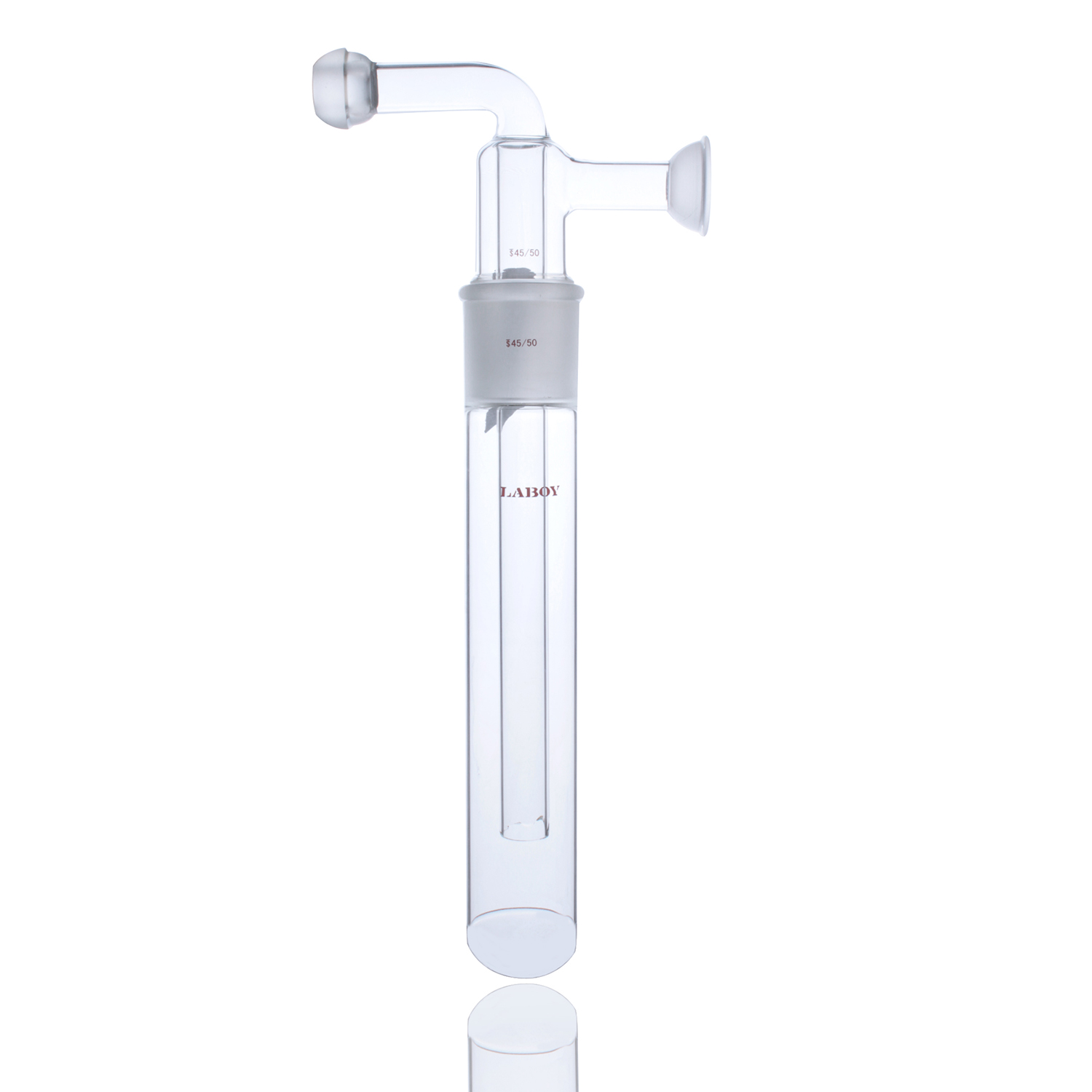
Practical Ways to Improve Vacuum Distillation Efficiency
Once the thermodynamic picture is clear, troubleshooting becomes more systematic. In most cases, improving vacuum distillation efficiency comes down to reducing resistance in one of three areas: heat transfer into the liquid, mass transfer from the liquid surface, or condensation of the resulting vapor.
1. Increase Surface Renewal During Evaporation
In rotary evaporation, rotation does more than prevent bumping. It continuously renews the liquid film, improves heat transfer, and increases the effective surface area available for evaporation. If the flask rotates too slowly, the liquid film may be thicker and less responsive, which can reduce evaporation efficiency.
2. Do Not Pull More Vacuum Than the Process Requires
Deep vacuum is not always the fastest setting. In many routine solvent-removal tasks, a slightly higher operating pressure combined with a better temperature differential will outperform a deeper vacuum with an under-heated bath. Stronger vacuum lowers the boiling point, but it may also increase vapor volume and make condensation more difficult. The most efficient setting is often the one that balances stable boiling with reliable condensation.
3. Check for Non-Condensable Gas Leaks
If distillation remains slow even after improving the bath and coolant settings, the system may have a small leak. Non-condensable gases interfere with heat exchange and reduce the effective performance of the condenser. A simple static vacuum hold test is often worthwhile before assuming the problem is purely thermodynamic.
4. Match the Apparatus to the Vapor Load
Condenser area, coolant flow, flask size, charge volume, and trap capacity all affect performance. A system that works well for a small solvent load may become inefficient when scaled up. When recovery is poor, it is worth evaluating the apparatus as a whole rather than focusing on bath temperature alone.
A More Useful Way to Think About Vacuum Distillation
Vacuum distillation is not simply a matter of lowering pressure as far as possible. It is a balance between pressure, heat input, mass transfer, and condensation capacity. When any one of these is out of proportion, the process becomes slow, wasteful, or unnecessarily harsh on the product.
Seen this way, the common “frozen distillation” problem is less mysterious. The system is not refusing to work; it is telling you that one part of the energy and recovery balance is missing. Once the bath temperature, condensation strategy, and apparatus are brought into alignment, vacuum distillation becomes both faster and gentler.
⚡ Quick Troubleshooting Checklist
Is your distillation crawling? Run through these four critical checks:
- 1. The Delta 20 Rule:
Is your heating bath 20°C above the adjusted boiling point? Is your chiller 20°C below it? - 2. The Vapor Path:
If the bath is hot but the receiver is empty, check the cold trap. Is solvent bypassing the primary condenser? - 3. Static Leak Test:
Close the valve to the pump. Does the vacuum gauge hold steady? If not, grease your joints. - 4. Surface Area:
Are you rotating at maximum safe speed? Efficiency starts with a thin liquid film.