Why a Reflux Condenser Is Not a Gas Scrubber
A reflux condenser can cool vapor and return condensable material to the flask, but that does not mean it is handling everything that reaches the top of the setup. When a reaction evolves gas or highly irritating vapor, the top of the system needs its own logic. Condensation, venting, gas handling, and pressure safety are related, but they are not the same job.
Fast answer: A reflux condenser is designed to condense and return condensable vapor. It is not automatically a tail-gas treatment device. If the reaction is evolving gas, the top of the setup may need separate venting or gas-handling logic, and the design goal must still avoid turning the system into a pressure problem.
Overview
This page is about a setup boundary that beginners often miss. Once a condenser is placed on top of a reflux flask, it is easy to feel that the “top of the setup” has already been dealt with. That is often true only in a narrow sense. The condenser may be doing its own job correctly while the rest of the top-end logic is still unclear.
That confusion matters because different things can be happening at the top of a reflux system at the same time. Some vapor may be condensing and returning normally. Some non-condensable gas may still be moving upward. Some attachment above the condenser may be acting as a light atmospheric barrier. None of those automatically means the setup is safely handling an evolving gas stream.
Core idea: the top of a reflux setup is not one single function. You need to separate condensation, venting, gas handling, and pressure safety instead of treating them as one problem.
What the reflux condenser is actually doing
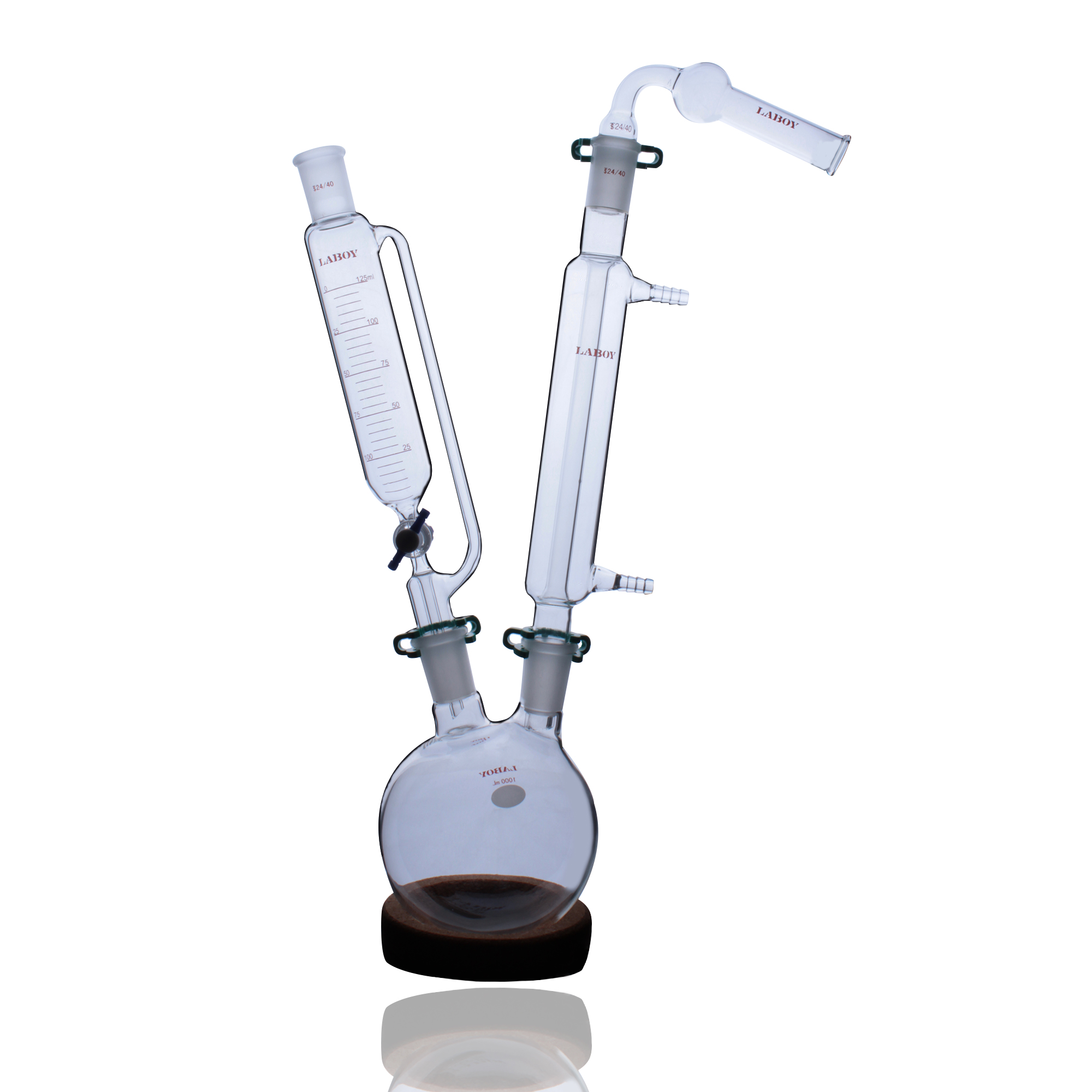
In reflux, the condenser sits above the heated flask so that condensable vapor can cool and return to the same vessel. That return loop is the whole point: boil, rise, condense, return, repeat. A good reflux condenser helps the system stay active without losing too much condensable material to the surroundings.
This is why condenser choice matters. The condenser needs to match the volatility of the system, the vapor load, and the way liquid returns. But even when those choices are good, the condenser is still solving a specific problem: condensation and return. It is not automatically solving every other problem that appears at the top of the setup.
Condensation
The condenser removes enough heat for condensable vapor to become liquid again.
Return
In reflux, the condensed liquid returns to the same flask in a stable, readable way.
Control
The setup stays active without looking like it is barely containing the vapor load.
What the condenser is not automatically doing
A reflux condenser is not automatically removing every gas or vapor that reaches the top of the apparatus. It is not automatically neutralizing corrosive gas. It is not automatically proving that the setup is safe to run closed. And it is not automatically telling you that whatever attachment sits above it is the right one for the atmosphere the reaction is actually producing.
This is where many beginner misreads start. They see “glass above the flask” and assume the whole upper region is now one unified control system. In practice, the condenser may be doing exactly what it should, while the real weak point is the top-end logic beyond it.
Useful check: ask two separate questions. Is the condenser returning condensable material? and Is the top of the setup handling any non-condensable or irritating gas appropriately? Those are not the same question.
Open reflux vs gas handling: what the top of the setup is and is not doing
Ordinary reflux logic assumes that the system should remain open rather than quietly turning into a pressure-building apparatus. That does not mean the top is doing nothing. It means the upper part of the setup must be designed so that the apparatus can operate without becoming sealed while still respecting the chemistry that is happening in the flask.
When a reaction evolves gas, the top-end logic becomes more demanding. You are no longer thinking only about whether condensable solvent is returning. You are also thinking about what continues upward, whether that stream needs deliberate handling, and whether any attachment above the condenser is solving the right problem rather than merely making the setup feel “more closed” or “more protected.”
This is why a setup can be good at reflux and still poor at gas handling. Those are linked decisions, but they are not identical decisions.
When a drying tube is the wrong answer
A drying tube can make sense when the main job is light atmospheric protection. It can help reduce moisture entry into a setup that otherwise still needs to remain open. That is a very different job from treating an evolving gas stream.
The mistake is to treat “something above the condenser” as if it automatically counts as gas treatment. It does not. A drying tube is not simply a universal top-end solution, and it should not be read as a general substitute for deliberate gas-handling design. Once the setup is actually producing a meaningful gas stream, the question is no longer just “what keeps air out?” It becomes “what is leaving the system, and is the top-end arrangement really designed for that?”
Better mental model: a drying tube belongs to the category of light top-end protection, not general tail-gas treatment.
Preventing vapor escape and preventing pressure buildup are not the same job
This is one of the most important setup distinctions on the page. Beginners often imagine a single scale: more open means more escaping vapor, more closed means more safety. Real setups do not work that way.
Sometimes the urge to “stop things from getting out” pushes the top of the setup toward becoming more closed than it should be. That can feel safer while actually creating a more serious risk. If the reaction is evolving gas, any top-end attachment that can block flow, degrade, or make the apparatus behave more like a sealed system may be solving the wrong problem.
Keep these two questions separate
Question 1: Are you reducing avoidable vapor loss?
Question 2: Are you keeping the setup from becoming an accidental pressure system?
You need both answers to be good. One does not guarantee the other.
What to notice at the bench
- Where is the visible condensation zone? This still tells you whether the condenser is keeping up with the reflux.
- Does the setup look like it is relying on improvised top-end attachments? That can signal that the real design problem has shifted above the condenser.
- Does the apparatus still behave like an open reflux? If the upper section begins to feel obstructed or more closed than intended, stop and reassess the logic.
- Are you mixing “keep air out,” “keep vapor in,” and “treat outgoing gas” into one vague goal? If yes, the setup probably needs to be mentally separated into clearer functions.
Quick logic table
| Question | What it is really asking | What beginners often confuse it with |
|---|---|---|
| Is the condenser working? | Is condensable vapor cooling and returning properly? | “Everything reaching the top is being handled.” |
| Does the setup need top-end protection? | Does the system need help staying appropriately open while limiting unwanted atmospheric exposure? | “Any tube on top counts as gas treatment.” |
| Is gas handling required? | Is something continuing upward that needs separate treatment logic? | “The condenser already solved that.” |
| Is the setup safe from pressure buildup? | Could the upper section become obstructive, degrading, or too closed for the reaction? | “Less escaping vapor automatically means safer.” |
Common beginner mistakes
- Thinking “condenser on top” means the top-end problem is already solved.
- Treating a drying tube as if it were a general gas-treatment device.
- Collapsing condensation, venting, and gas handling into one vague idea of “containing the setup.”
- Assuming that less vapor escape and lower pressure risk are automatically the same thing.
- Choosing upper attachments by habit instead of by what the reaction is actually producing.
Final takeaway
If you only remember one thing, remember this: a reflux condenser is designed to condense and return condensable vapor, not to serve as a general gas scrubber.
Once a reaction produces a meaningful gas stream, the top of the setup needs to be read more carefully. Condensation, venting, gas handling, and pressure safety are linked, but they are not the same job. Good setup design starts when you stop treating them as one thing.