Graham Condenser Overview
The Graham condenser is a high-efficiency water-cooled condenser defined by its spiral inner coil, which provides a larger cooling surface area than a straight-tube condenser. It is used mainly for distillation, especially downward distillation and vacuum evaporation, and can sometimes also be used for reflux, though its stricter installation requirements and potential flooding risk need to be kept in mind.
It is a high-efficiency but more specialized condenser, rather than the default general-purpose choice for routine teaching-lab work.
Basic Structure and Design Logic
Core Structure
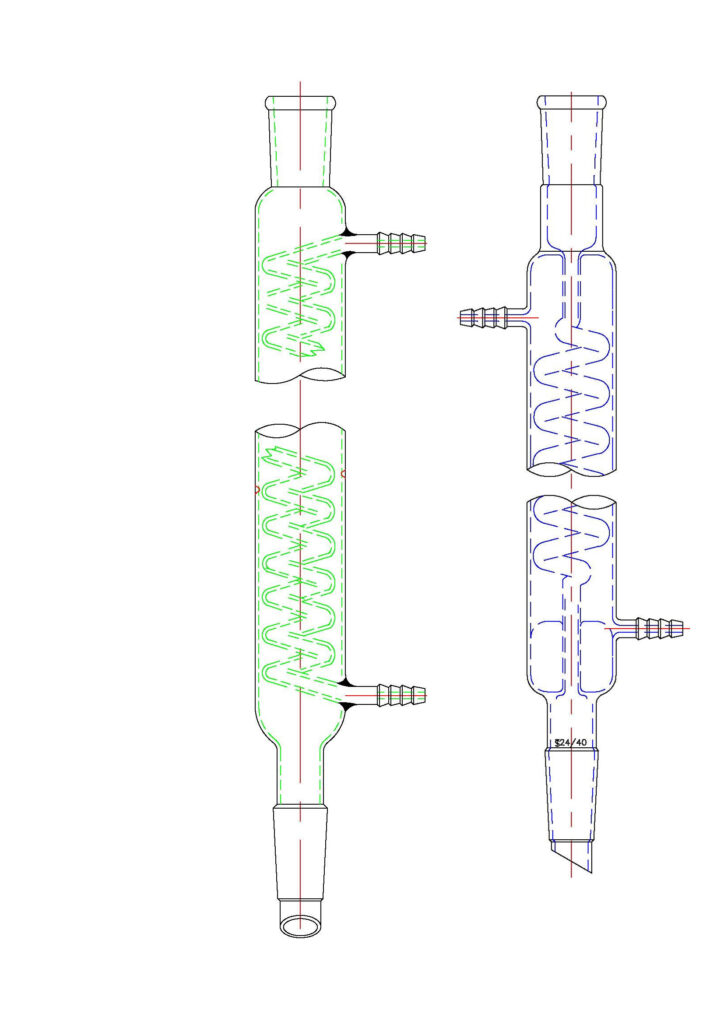
It consists of two concentric glass tubes, but the inner tube has a distinctive design.
Inner tube: a spiral glass coil running through the full length of the condenser. This coil serves as the path for vapor and condensate.
Outer jacket: a second glass tube surrounding the inner coil and forming an annular cooling space. Cooling water circulates through this outer jacket.
Key design feature: the Graham condenser and the coiled condenser are structurally similar, but their flow arrangements are reversed.
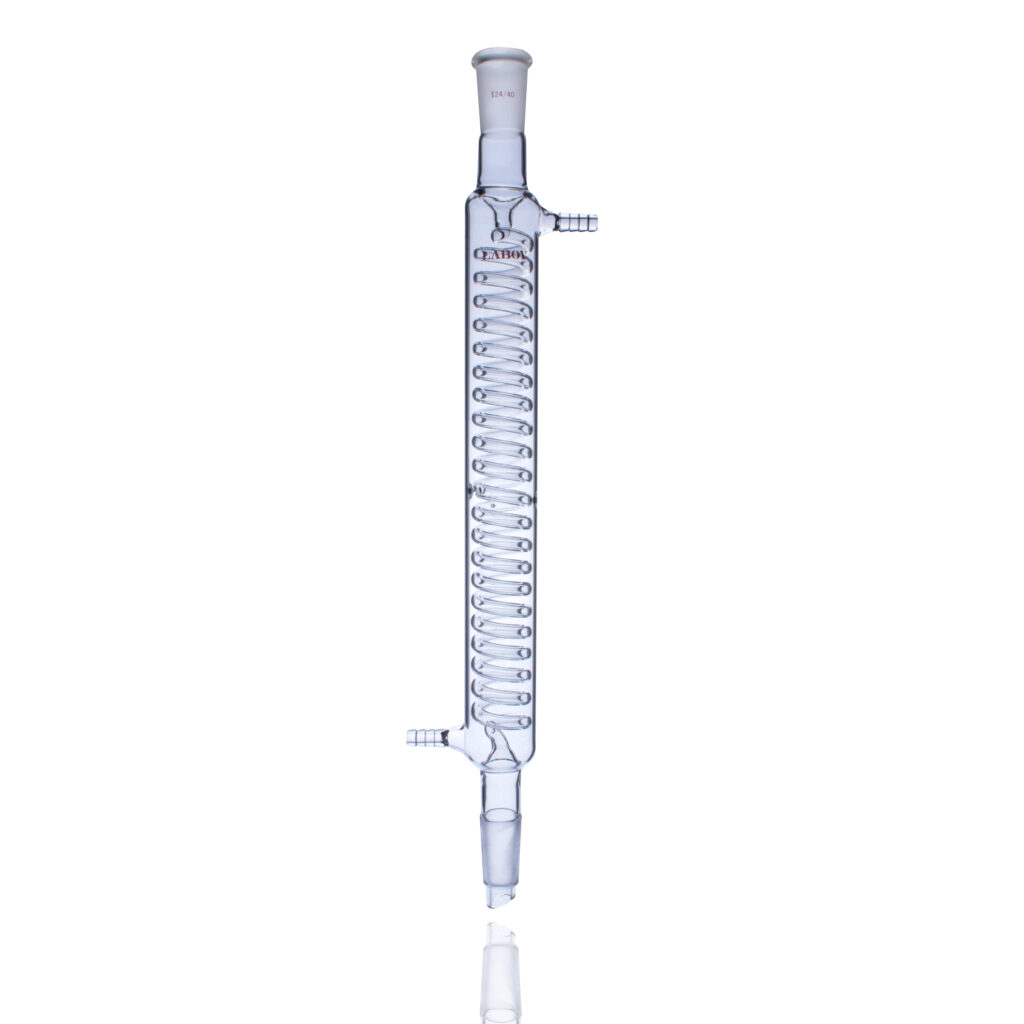
In a Graham condenser, cooling water flows through the outer jacket, while vapor condenses inside the inner spiral tube.
In a coiled condenser, the arrangement is reversed: cooling water flows through the inner spiral tube, while vapor condenses in the outer surrounding space.
This difference matters because it changes more than just the coolant path. It also changes how vapor moves, where condensation develops, and how easily liquid can return without creating flow problems. In practice, the reversed arrangement of a coiled condenser avoids some of the liquid-hold-up and flooding issues that can make a Graham condenser more sensitive in certain setups.
For a fuller comparison, see Graham Condenser vs Coiled Condenser.
Graham Condenser Flow Logic
This teaching animation shows the structural logic behind a Graham condenser: vapor travels through the inner spiral tube, cooling water removes heat through the outer jacket, and condensation develops along the same spiral path. The exact vapor direction is not fixed by the condenser alone. It depends on how the condenser is being used in the setup.
This is a schematic teaching animation rather than a literal fluid simulation. It is meant to show path logic and setup-dependent flow direction, not exact hydrodynamics.
Main Uses and Applications
The Graham condenser is not the most general-purpose condenser in the lab, but it performs especially well in certain applications. Its defining advantage is the spiral inner tube, which provides a longer cooling path and a much larger cooling surface area than a straight-tube condenser. When a setup genuinely needs stronger condensation, that design can be a real advantage.
Its most characteristic use is in downward distillation and vacuum evaporation. Teaching sources repeatedly note that Graham condensers are commonly used in these arrangements, especially when working with more volatile compounds and when it is important to minimize vapor loss. In these situations, the value of a Graham condenser is not simply that it “cools harder.” The longer spiral path gives vapor more contact time with the cooled glass surface, so condensation can occur more thoroughly before the vapor reaches the receiving end. For volatile materials, that added cooling path can make a meaningful difference.
A Graham condenser can also serve as a highly efficient condenser in ordinary distillation. Because the spiral inner tube provides more surface area for heat transfer, it usually offers stronger condensation than a straight-tube condenser such as a Liebig. When a distillation setup needs more cooling capacity or when the vapor is volatile enough that a larger condensation margin is desirable, a Graham condenser may be more effective than a simpler straight condenser.
The situation is different in reflux. A Graham condenser is not unusable for reflux, but it is more demanding and less forgiving in that role. Sources specifically note that it must be installed vertically to prevent liquid from collecting in the tube and acting as a trap. Higher condensation efficiency does not automatically make it a better reflux condenser. Reflux does not only require vapor to condense. It also requires the condensate to return smoothly without seriously obstructing the continuing upward vapor flow. In that respect, the same spiral path that makes a Graham condenser efficient can also make it more sensitive than a straight or bulb-style reflux condenser.
For that reason, even though the Graham condenser is highly efficient, it is not usually the default choice for vigorous reflux. In that kind of work, condensers such as the Allihn or Dimroth are often more reliable because they provide strong cooling while allowing condensate to return more smoothly. The Graham condenser is best understood as a condenser with strong advantages in high-efficiency distillation-related applications, rather than as a more advanced condenser that automatically improves every setup.
Flooding Risk in Reflux
One of the most important practical limits of a Graham condenser is its tendency to become problematic in reflux. This is not because the condenser is weak. In fact, the opposite is true: the spiral inner tube gives a Graham condenser strong cooling power. The problem is that in reflux, cooling efficiency by itself is not enough. The condensate also has to return smoothly while leaving a sufficiently open path for continuing upward vapor flow.
That is where the Graham condenser becomes more sensitive than a straight-tube or bulb-style reflux condenser. In a reflux setup, vapor rises through the spiral path while condensed liquid tries to return through that same confined route. If the liquid drains cleanly, the condenser may still function acceptably. But once liquid begins to collect instead of returning freely, the path becomes more restricted, the upward vapor is disturbed, and the reflux becomes less stable.
Flooding risk: In a Graham condenser used for reflux, condensate does not usually “go somewhere else.” It is still supposed to return to the flask. The problem is that it may begin to collect in the spiral, drain back only irregularly, and interfere with the upward vapor stream. That combination of liquid hold-up, disturbed vapor flow, and uneven return is what makes flooding a real practical concern.
That is why stronger cooling does not automatically make a Graham condenser a better reflux condenser. In reflux, the question is not only whether vapor condenses. It is also whether the condensate can return smoothly and continuously. Once liquid begins to accumulate in the spiral instead of draining cleanly, the condenser becomes more prone to unstable return, vapor disturbance, and, in some cases, re-evaporation or other unstable liquid behavior within the coil.
In practice, this is one reason Graham condensers are more restricted in reflux than their cooling power alone might suggest. They can work, but they are less forgiving than designs that give condensate a clearer return path. For vigorous reflux, condensers such as the Allihn or Dimroth are usually the more reliable choice.
Performance, Strengths, and Tradeoffs
One of the main reasons a Graham condenser stands out is its cooling efficiency. The spiral inner tube provides a much larger effective cooling surface than a straight-tube condenser, so vapor remains in contact with the cooled glass for longer and can be condensed more thoroughly. In practical terms, that usually makes a Graham condenser more efficient than a Liebig condenser when stronger condensation is needed.
That same geometry also helps explain why the Graham condenser can be especially effective in applications where maximum condensation and collection matter. Because the vapor is forced to travel through the full length of the inner spiral path, it has more sustained contact with the cooled surface before reaching the outlet. In the right setup, this can improve the capture of volatile vapors and reduce the chance of incomplete condensation.
Historically, the Graham condenser has also been referred to as an Inland Revenue condenser, reflecting its early association with alcohol distillation. That name is less important in practice than the structural point: this is a condenser designed around strong cooling performance rather than maximum simplicity.
The advantages of a Graham condenser follow directly from that design. It offers high cooling efficiency, it can be especially useful when working with more volatile compounds, and it is well suited to setups where a longer, more intensive condensation path is helpful. In addition, the condenser is typically made from borosilicate glass and is generally robust in routine laboratory use.
But those same design features also create the main tradeoffs. A Graham condenser is more prone to flooding, especially in reflux or when used in the wrong orientation, because condensate and vapor can end up competing within the same spiral path. It also has stricter orientation requirements than a simple straight condenser, which reduces flexibility in some assemblies. The spiral inner tube is harder to clean thoroughly and harder to inspect for residue, especially after working with crystallizing, sticky, or resin-forming systems. For the same reason, it is not usually the best default choice for reflux. Condensers such as the Allihn or Dimroth are often more reliable in reflux because they provide strong cooling while allowing condensate to return more smoothly.
How It Compares with Other Condensers
| Condenser | Main strength | Best suited for | Main limitation |
|---|---|---|---|
| Graham | Large cooling surface and strong condensation efficiency | Downward distillation, vacuum evaporation, volatile vapors, distillation setups needing stronger cooling | More prone to flooding in reflux, stricter orientation requirements, harder to clean |
| Liebig | Simple structure, direct vapor path, easy cleaning | Routine distillation, general-purpose use, teaching labs | Less cooling surface area and lower condensation efficiency |
| Allihn | Good cooling surface with smoother condensate return | Reflux | Less suited to setups where a long direct vapor path is preferred |
| Coiled condenser | High efficiency with fewer Graham-style flow conflicts | Strong cooling applications where the reversed flow arrangement is advantageous | More specialized, and not always the default teaching-lab choice |
This comparison is meant to clarify typical bench use, not to suggest that one condenser is always better in every setup.
Specifications, Selection, and Practical Use
Common sizes
Graham condensers are available in a range of sizes. Common jacket lengths include 120 mm, 200 mm, 250 mm, 300 mm, 400 mm, and 500 mm. Common joint sizes include 14/20, 19/22, and 24/40. Hose connections are typically fitted with glass or detachable hose nozzles, usually with an outer diameter of 8 mm or 10 mm.
Practical points that matter in use
The most important practical requirement is orientation. A Graham condenser should be installed vertically. This is essential for proper operation and is one of the main ways to reduce liquid hold-up and flooding risk.
Cooling water should enter from the lower port and leave from the upper port so that the jacket remains full during use.
In terms of application, a Graham condenser is best reserved for downward distillation, vacuum evaporation, or distillation setups that genuinely need stronger condensation. It can be used in reflux, but it should be done with caution, and only with a clear understanding of its stricter vertical-use requirement and its greater tendency toward flooding compared with more reflux-oriented condenser designs.
A useful selection question is not simply whether a Graham condenser is “better,” but whether the setup actually benefits from what it does best. If you need stronger condensation and the apparatus can accommodate strict vertical installation, a Graham condenser may be a good choice. If you need greater general-purpose flexibility, easier cleaning, and a more forgiving setup, a straight-tube condenser or a bulb-style condenser is often the better option.
Safety notes
Before use, inspect the glass carefully for cracks or damage. Make sure the condenser is securely clamped in a stable vertical position. When used in distillation, the boiling range of the system still matters. For very high-boiling systems, an air condenser may be the safer choice.
Final Take
The important point is not that one condenser is universally better. It is that the Graham condenser and the coiled condenser solve the cooling problem in different ways. Once you understand where the coolant goes, where the vapor goes, and how that affects liquid return, the comparison becomes much easier to judge at the bench.
In practice, a Graham condenser is often the better-known choice when strong condensation is needed, but its spiral vapor path also makes it more sensitive to flooding and liquid hold-up in some uses. A coiled condenser changes that internal flow arrangement, which is one reason the two should not be treated as interchangeable.
For the individual equipment pages, see Graham Condenser and Coiled Condenser. You can also return to the broader Mixing & Reaction Setup section to compare related condenser types in context.