A coiled condenser is not just a “more complicated condenser.” Its real value is that it combines strong cooling with a much easier vapor path than a Graham condenser. That makes it especially useful when vapor load is high, solvent loss matters, or an ordinary reflux setup no longer feels comfortably stable.
Fast Answer
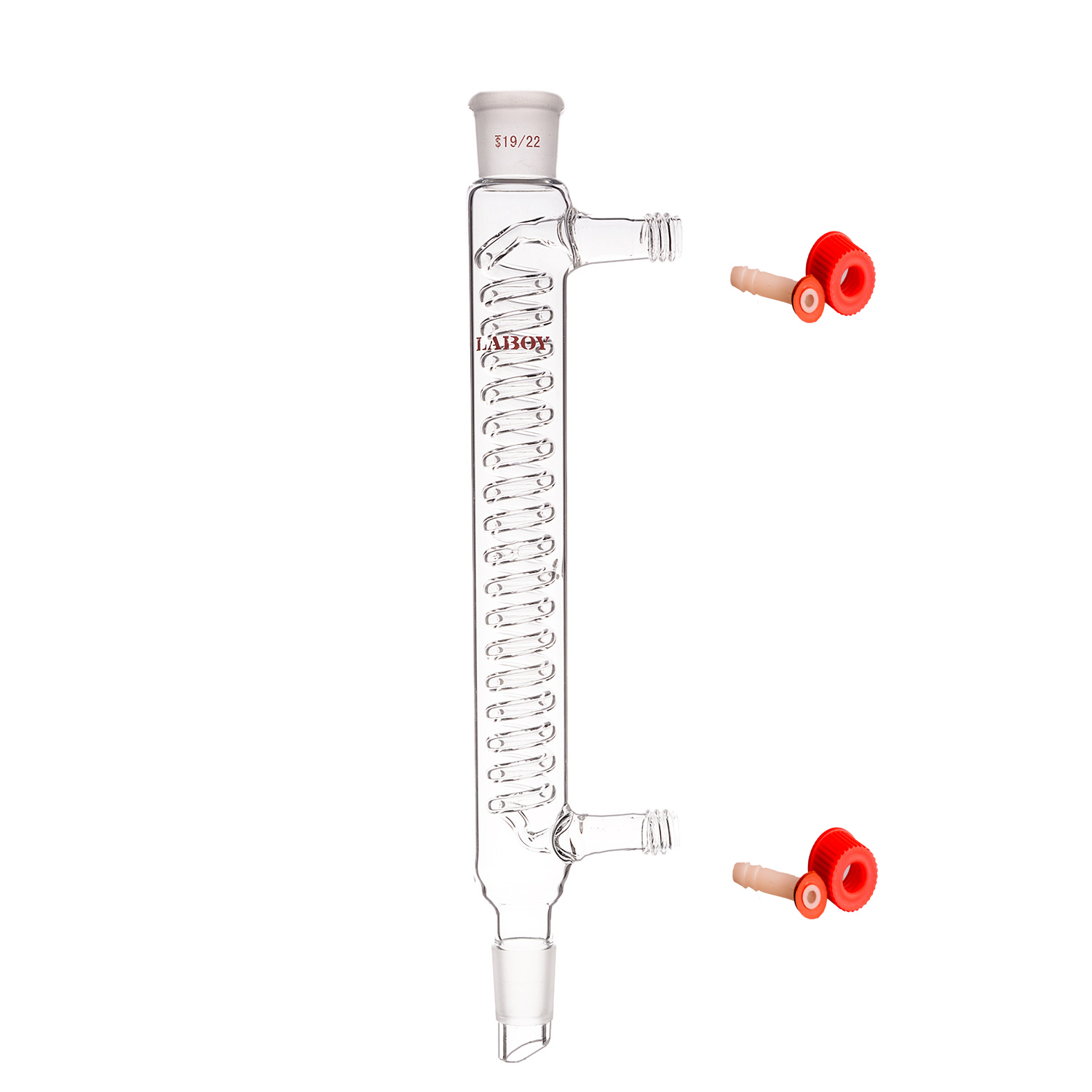
A coiled condenser is a high-efficiency water-cooled condenser in which coolant runs through the inner coil and vapor condenses in the outer jacket. That reverse arrangement matters. It gives you a large cold surface, but it also gives the vapor a wider and less congested path than a Graham condenser. In practice, that means strong cooling with less tendency to flood.
It becomes worth considering when you are dealing with volatile solvents, heavy vapor load, or long reflux runs where solvent loss or unstable return starts to matter. It is not automatically the best condenser for every setup, and it is still a water-cooled condenser, not the right answer for every high-temperature system.
What a Coiled Condenser Actually Is
The easiest mistake is to identify it by appearance alone. Beginners see a spiral inside the glass and assume it must be a Graham condenser. That is not enough. The real question is what is flowing through the spiral.
In a Graham condenser, vapor travels through the coiled inner tube and coolant surrounds it in the outer jacket. In a coiled condenser, that arrangement is reversed: the coolant flows through the inner coil, and the vapor rises through the larger outer space around that coil.
That is why this condenser is often defined in one short sentence: it is the reverse of the Graham condenser.
Quick distinction
If you want the full side-by-side comparison, see Graham Condenser vs Coiled Condenser .
Why This Design Matters
It is not just about surface area
Yes, a coiled condenser has a large cold surface. But that is only part of the story. What really matters is that the vapor does not have to climb through a narrow internal spiral while condensate tries to come back down the same route.
In a coiled condenser, vapor rises through the broader outer jacket, touches the cold coil surface, condenses there, and then drops back as liquid. That gives you two practical advantages at once:
- strong cooling from the large internal coil surface
- a more open vapor path than a Graham condenser
Why it is less prone to flooding
This is the point that matters most in real use. A Graham condenser can also offer a lot of cooling surface, but the vapor path is narrow and winding. Once condensate begins to accumulate in that inner coil, the upward-moving vapor and downward-moving liquid start competing for the same restricted space.
A coiled condenser reduces that problem because condensate forms on the outside of the coolant coil and drops back through a broader space instead of being trapped inside a tight internal spiral. That is why a coiled condenser is often the better choice when you want stronger cooling without creating a return-path bottleneck.
Why this matters at the bench
A coiled condenser is not just a colder Graham. It is a different flow design. That is why it often feels more stable when vapor load rises or when solvent return starts to look less controlled in an ordinary setup.
Where It Fits Among Common Condensers
Compared with a Liebig condenser
A Liebig is simpler, lighter, easier to inspect, and often perfectly adequate for straightforward distillation. But once vapor load rises or the solvent becomes more volatile, a Liebig can stop feeling comfortable very quickly.
Compared with an Allihn condenser
An Allihn is often the default student-lab reflux condenser because it supports repeated condensation and smooth vertical return without making the setup feel overbuilt. A coiled condenser generally offers stronger cooling, but it only becomes the better choice when the setup genuinely needs that extra capacity.
Compared with a Graham condenser
This is the most important comparison. Graham and coiled condensers are often confused because both contain a spiral. But in practical terms, the coiled condenser is usually the better answer when you want stronger cooling without forcing vapor and condensate through the same narrow internal path.
Compared with a Dimroth condenser
A Dimroth is often treated as the higher-performance member of the same broad design idea: coolant inside a coil, vapor outside it. In reflux work, especially with low-boiling solvents, a Dimroth can be even more effective than an ordinary coiled condenser.
| Condenser Type | Vapor Path | Cooling Strength | Flooding Risk | Typical Best Use |
|---|---|---|---|---|
| Liebig | Inner straight tube | Moderate | Low to moderate | Simple distillation, routine cooling |
| Allihn | Inner bulb section | Moderately high | Moderate | Ordinary reflux |
| Graham | Inner spiral tube | High, but flow-limited | Higher | Strong cooling, but more flooding-prone |
| Coiled condenser | Outer jacket around inner coolant coil | High | Lower | High-efficiency reflux, volatile solvents, heavier vapor load |
| Dimroth | Outer vapor space around internal coil | Very high | Low | Demanding reflux and stronger cooling duty |
When a Coiled Condenser Makes Sense
- Volatile-solvent reflux: when ordinary cooling starts to feel marginal and solvent loss matters.
- High vapor load: when the system is producing enough vapor that a simpler condenser no longer feels comfortably sized for the job.
- Long reflux runs: when you want stronger, steadier solvent return over time.
- Demanding condensation work: when efficient condensation matters more than keeping the glassware as simple as possible.
- Combined setups: when the condenser is part of a more demanding assembly and you want stronger cooling without relying on a flooding-prone internal vapor coil.
A useful bench question
Is the real problem “I need more cooling,” or is it “my current condenser is becoming a bottleneck”? A coiled condenser is most useful in the second situation.
When It Is Not the First Thing to Reach For
A coiled condenser is not automatically the right answer for every setup.
- Simple, low-demand distillation: a Liebig may already be enough.
- Ordinary teaching-lab reflux: an Allihn is often simpler and easier to read at a glance.
- Situations where cleaning simplicity matters a lot: a straight condenser is easier to inspect and brush through.
- Higher-boiling systems: stronger water cooling does not automatically make a water-cooled condenser the right choice.
Once you move into clearly higher-boiling systems, the question stops being “which water-cooled condenser is strongest?” and starts becoming “should this still be water-cooled at all?”
Practical Setup Notes
1. Water direction still matters
In ordinary use, water should still enter from the bottom and leave from the top, so the cooling path stays full. Some specialized coiled or Dimroth designs place both ports at the top, so always read the actual glassware in front of you rather than applying the rule mechanically.
2. Clamp it for its real weight, not its empty weight
Coiled condensers are heavier than they look, especially once the internal coil fills with coolant. Support should be placed so that the glass joint is not carrying the whole load.
3. More cooling does not justify reckless heating
A stronger condenser can handle more vapor, but it does not give you permission to drive the system blindly. If the condenser is barely keeping up, the first correction is still usually to reduce heat and read the setup again.
4. Watch the return path while it is running
Strong cooling is only useful if the condensate returns cleanly and the system still looks stable. The running setup should look controlled, not overloaded.
Common Beginner Mistakes
- Confusing “spiral inside” with “Graham.” The key question is what flows through the spiral.
- Choosing only by cooling strength. A condenser also needs a sensible return path and stable setup logic.
- Using a stronger condenser to compensate for overdriving the setup. The condenser is not there to rescue bad heating decisions.
- Ignoring weight and support. A water-filled coiled condenser puts more load on joints than many beginners expect.
- Treating all water-cooled condensers as interchangeable at higher temperatures. Once the boiling range climbs, the correct answer may be a different cooling strategy, not just a stronger water-cooled model.
Related Pages
Frequently Asked Questions
What is the difference between a coiled condenser and a Graham condenser?
They are often confused because both contain a spiral. In a Graham condenser, vapor travels through the inner coil and coolant surrounds it. In a coiled condenser, the arrangement is reversed: coolant runs through the inner coil and vapor condenses in the outer jacket. That difference is the main reason a coiled condenser is usually less prone to flooding.
Can a coiled condenser be used for reflux?
Yes. In fact, reflux is one of the situations where it can be especially useful, particularly when solvent volatility or vapor load starts to push an ordinary condenser toward its limits.
Why is a Graham condenser more likely to flood?
In a Graham condenser, rising vapor and returning condensate share a narrow internal spiral path. Once vapor flow becomes strong enough, the two interfere with each other more easily. A coiled condenser reduces that problem because condensate forms on the outside of the coolant coil and falls back through a broader space.
When should I choose a coiled condenser over an Allihn or Liebig?
Choose it when a simpler condenser no longer feels comfortably sized for the real vapor load. That often means volatile solvents, stronger reflux, longer runs, or cases where solvent loss matters. For calmer routine work, an Allihn or Liebig may still be the more practical first choice.
Does cooling water still need to run bottom-in and top-out on a coiled condenser?
In most ordinary designs, yes. Bottom-in and top-out keeps the cooling path full and avoids air pockets. However, some specialized coiled or Dimroth-type condensers place both ports at the top, so the actual glass design should always be checked before connection.
Final Takeaway
A coiled condenser earns its place when the setup needs more than basic cooling but you do not want the vapor path to become the weak point. Its advantage is not “more glass” for its own sake. Its advantage is that it combines high cooling capacity with a less congested flow path than a Graham condenser.
That is why this condenser matters most in situations where ordinary condensation starts to feel unreliable, not in situations where simpler glassware is already doing the job well.