A Dimroth condenser is a high-efficiency water-cooled condenser best known for its double internal spiral coil. Compared with more familiar condensers such as the Liebig, Allihn, and Graham, it usually provides a larger effective cooling surface and stronger vapor recovery. That is why it is often treated as a more specialized condenser for demanding reflux work rather than a default general-purpose choice.
Its most characteristic role is in reflux. When a system produces a large amount of vapor, uses a more volatile solvent, or needs especially strong vapor recovery to maintain a stable reflux composition, a Dimroth condenser is often more useful than a simpler condenser.
How a Dimroth Condenser Works
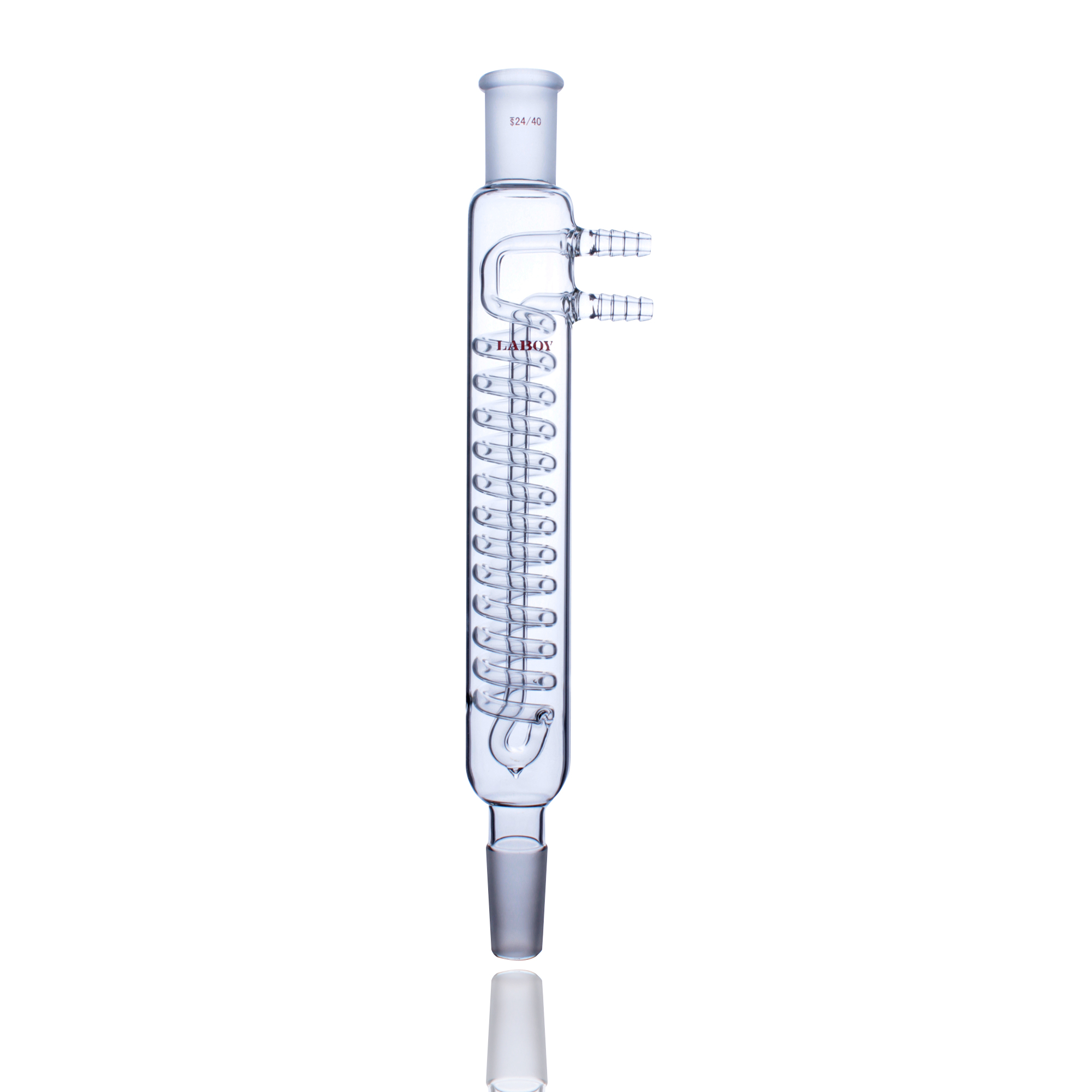
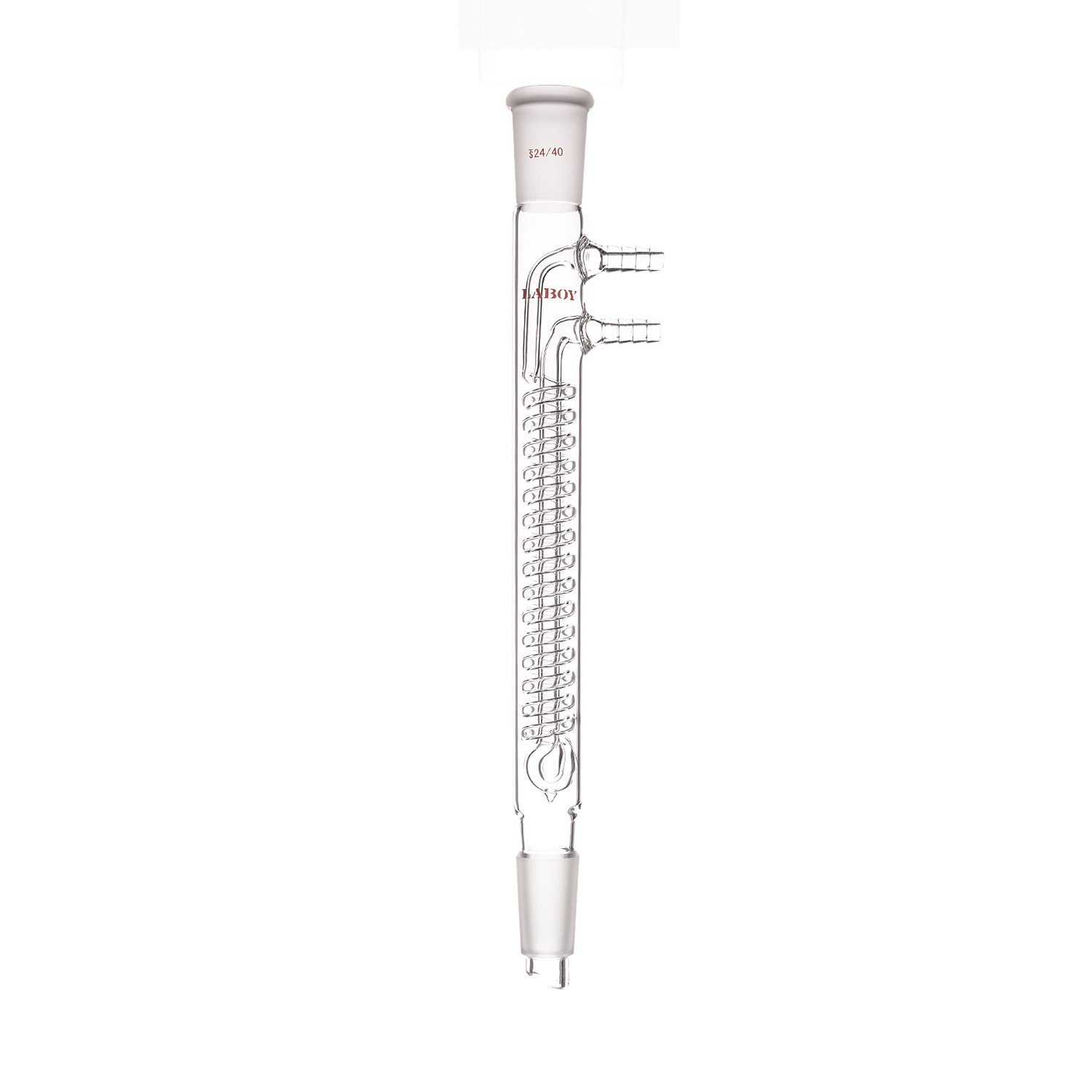
In a Dimroth condenser like the one shown here, the coolant circuit is built inside the condenser rather than in an external jacket. A typical visible layout is a central downward coolant path, a U-turn at the bottom, and a helical return coil rising back upward. The vapor does not move through that internal coil. Instead, it rises through the surrounding space around the coil and condenses on the cooled glass surface.
This corrected schematic matches the product photo more closely: coolant moves down the central internal path, turns at the bottom, and then returns upward through the visible helical coil. The vapor rises outside that coil, condenses on the cooled glass, and returns downward through the surrounding space.
Where It Helps Most — and Why It Is Not a Default Upgrade
Where It Helps Most
A Dimroth condenser is most useful when a setup genuinely needs stronger condensation. In reflux, its value is not just that it “cools harder,” but that it can return a large amount of vapor more effectively and help keep the reflux flask composition more stable.
This matters most when vapor production is heavy, when solvent loss would be especially undesirable, or when simpler reflux condensers are starting to feel marginal.
Why It Is Not a Default Upgrade
The Dimroth condenser is not just a “better condenser” that should replace simpler designs whenever available. It is more complex, heavier, and usually more expensive. Once cooling water is running, it becomes a heavier piece of glassware and must be clamped securely.
That is why it makes more sense to treat it as a purposeful choice for demanding setups, not as a universal upgrade.
The Warmer Outer Wall and the Low-Boiling-Solvent Question
What the Warmer Outer Wall Changes
Because the cooling water runs through the internal coil, the outer wall of a Dimroth condenser is often not as cold as the outside of a typical external water-jacket condenser.
That can be helpful: the outside surface is less likely to collect atmospheric moisture as obvious external condensation.
Some source material also notes that the structure is suitable for relatively high-boiling materials, in part because certain fused joints are not placed in especially severe temperature-gradient regions.
Why the Literature Does Not Fully Agree
This is one of the most important places to stay honest. The source material does not present a single completely unified view on whether the Dimroth condenser is especially suitable for very low-boiling solvents.
Some references strongly recommend it for volatile solvents. Other references warn that, because of the warmer outer-wall region, extremely low-boiling vapors such as ether may gradually escape along a warmer path if condensation is not fully secured.
Bench-level conclusion: a Dimroth condenser is clearly a strong-condensation option, but whether it is fully adequate for a very low-boiling system depends on the cooling-water temperature, flow rate, vapor load, sealing quality, and the exact geometry of the setup. The real question is not whether the name “Dimroth” automatically guarantees success, but whether this particular condenser under these particular conditions is actually keeping the vapor safely and reliably inside the system.
Practical Setup Points That Matter
Drying tube note: in moisture-sensitive reflux setups, a drying tube is also a common addition. Even though the outer wall is not especially prone to heavy external condensation, the open top region can still be a vulnerable place for atmospheric moisture to condense or enter, which is why many protective reflux assemblies place a drying tube above the condenser.
Frequently Asked Questions About the Dimroth Condenser
These questions focus on the issues readers are most likely to care about in real lab use: structure, reflux performance, hose layout, very low-boiling solvents, and moisture control.
What makes a Dimroth condenser different from a Liebig or Allihn condenser?
A Dimroth condenser uses an internal double spiral cooling coil rather than a simple outer water jacket. Cooling water flows through that internal coil, while the vapor rises through the surrounding space and condenses around the cooled glass. That is the key reason it is usually more efficient than a simpler straight-tube condenser and why it is often associated with stronger reflux performance.
Why is a Dimroth condenser so often used for reflux?
Its main advantage in reflux is not just that it cools well, but that it can recover a large amount of vapor efficiently and return condensate reliably when vapor production is heavy. That makes it especially useful when solvent loss matters, when the reflux is vigorous, or when a simpler condenser may be starting to feel marginal.
Why are both water connections usually at the top?
Because the coolant path is built inside the condenser. In a typical Dimroth design, cooling water enters through one top connection, travels through the internal spiral circuit, and exits through the other top connection. The vapor path is separate: it rises through the outer space around the coil. This top-connection layout is one of the easiest visual clues that the condenser is not working like a standard outer-jacket design.
Is a Dimroth condenser a good choice for very low-boiling solvents such as ether?
The honest answer is: not automatically. Some sources describe the Dimroth condenser as an excellent option for volatile solvents because of its strong cooling capacity. Other sources warn that for very low-boiling solvents such as ether, vapor may still escape under some conditions because the outer wall region is relatively warm. The practical lesson is that performance depends on cooling-water temperature, flow rate, vapor load, sealing quality, and the exact setup, not on the condenser name alone.
When should a drying tube be added above a Dimroth condenser?
A drying tube is a common addition in moisture-sensitive reflux setups. Even though the outer wall of a Dimroth condenser is not especially prone to heavy external condensation, the open top region can still be a vulnerable place for atmospheric moisture to condense or enter. That is why many protective reflux assemblies place a drying tube above the condenser when keeping moisture out of the system matters.
Final Take
A Dimroth condenser is a high-efficiency, more specialized condenser, not a general-purpose default. Its double internal spiral gives it strong cooling performance and makes it especially useful in demanding reflux work, in volatile systems, and in setups where vapor recovery matters enough to justify a more complex piece of glassware.
At the same time, its greater complexity, greater weight, higher cost, and the literature disagreement around very low-boiling systems mean it should be chosen deliberately, not automatically. For beginners especially, the real question is not whether the Dimroth condenser is “more advanced.” It is whether the apparatus task actually needs the kind of strong but more specialized condensation path that the Dimroth condenser provides.