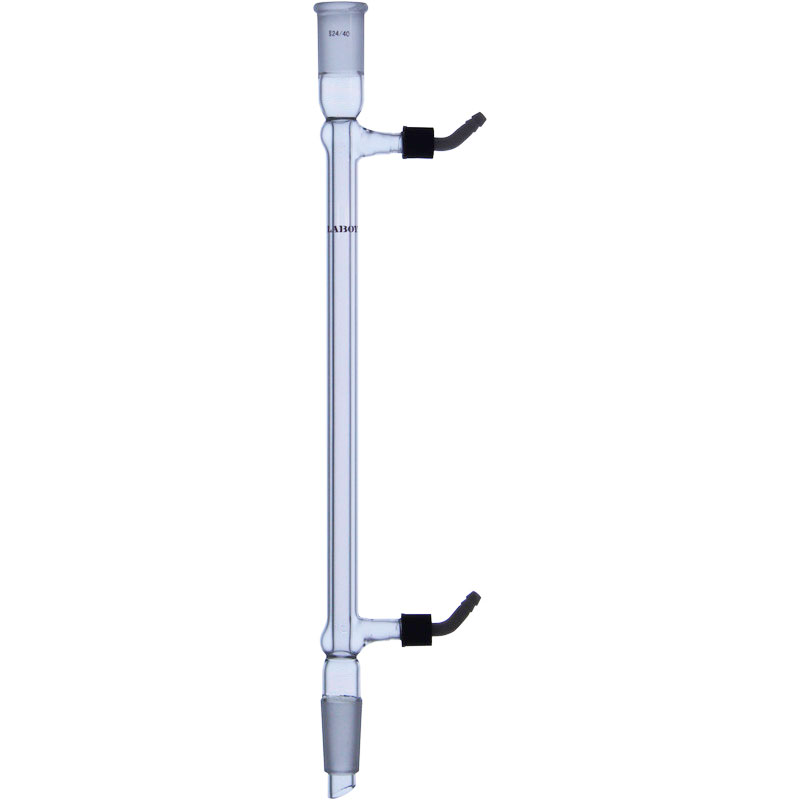
A West condenser is not the generic name for every straight water-cooled condenser. It is better understood as a narrower, more efficient Liebig-type condenser. That narrow jacket is the whole point: it keeps the structure simple, but pushes the cooling harder than a standard straight jacketed condenser.
Fast Answer
A West condenser is a straight water-cooled condenser with a narrower jacket than a standard Liebig. That narrower annular space improves heat exchange and usually gives stronger cooling for the same general straight-condenser logic. In practice, that makes it especially comfortable in routine distillation and often attractive in vacuum distillation, where strong, direct condensation matters.
It can be used for reflux, but reflux is not where its design makes the strongest case for itself. Once the job becomes demanding, repeated liquid return usually matters more than a straight, forward-flowing path, and that is where other condenser families begin to make more sense.
What a West Condenser Actually Is
The easiest way to misread a West condenser is to treat it as just another generic straight condenser. It is straighter and simpler-looking than bulb or coil designs, so it gets lumped together with “ordinary condensers” very quickly. But the useful comparison is not “straight versus not straight.” The useful comparison is West versus Liebig.
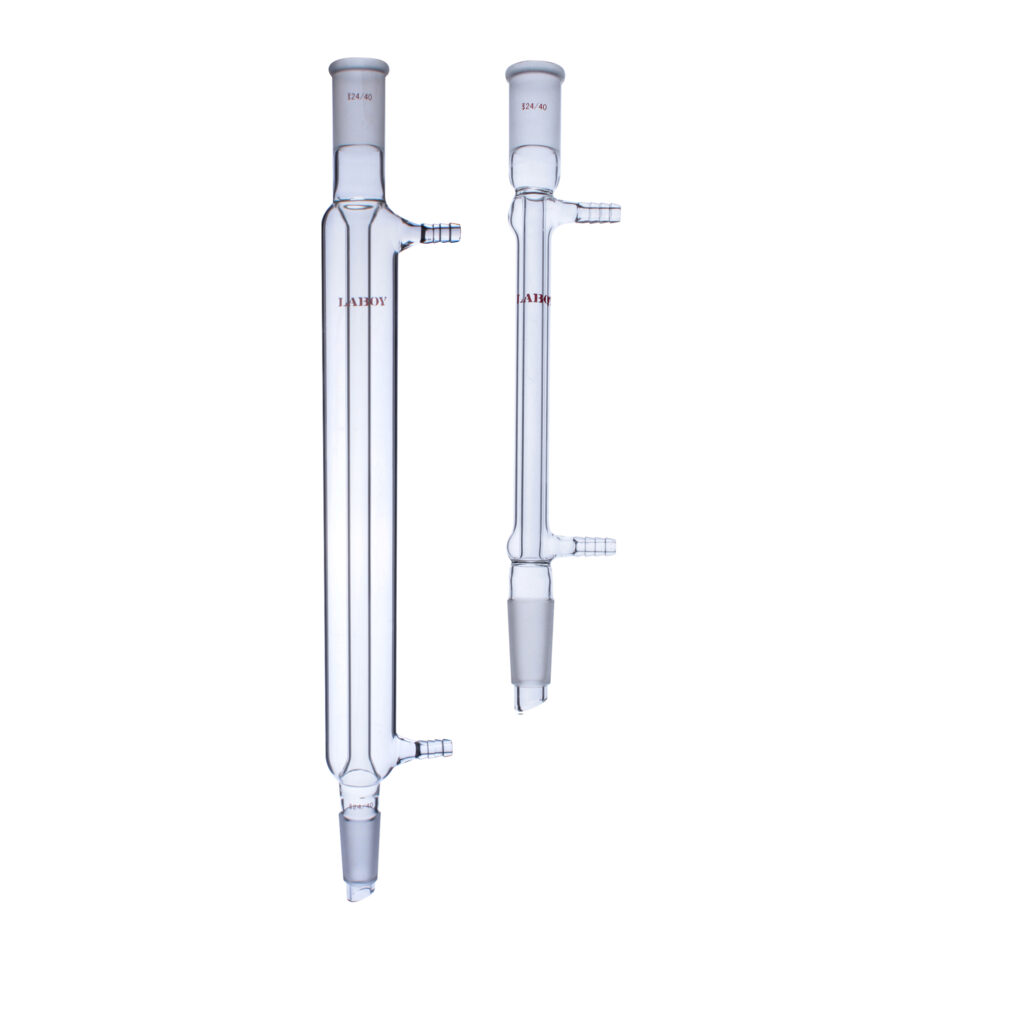
Both are straight water-cooled condensers. Both send vapor through a straight inner tube. Both rely on a water jacket around that tube to remove heat and turn vapor back into liquid. The difference is that a West condenser tightens the jacket. The cooling water sits in a narrower space around the inner tube, so the heat exchange becomes more concentrated.
That is why a West condenser is best thought of as a Liebig-style condenser with a narrower, more efficient jacket, not as a completely different condenser family.
Why the Narrow Jacket Matters
The West condenser is a good reminder that better glassware does not always mean more elaborate glassware. It does not add bulbs. It does not add coils. It does not turn the vapor path into something more complicated. Instead, it improves the part that already matters: how efficiently the cooling water can pull heat away from the vapor path.
Because the annular space is narrow, the coolant stays closer to the inner tube and the heat exchange stays tighter. That is why the West often feels like a more responsive straight condenser. It is still simple to read, still simple to clean, and still well suited to direct liquid transfer. It just cools harder than a bulkier straight jacket tends to.
Bench-level way to think about it
A West condenser is not a new condenser logic. It is a tighter version of an old one.
Why It Works So Well in Distillation
Distillation is where the West condenser usually makes the most immediate sense. In a distillation setup, vapor leaves the boiling flask, enters the condenser, cools, and then needs to move forward into the receiving side of the apparatus. That forward path matters just as much as raw cooling power.
A West condenser keeps that path very clean. The inner tube is straight. Condensed liquid does not have to work around bulb pockets or a coiled path. Once vapor cools, the liquid can move onward toward the receiver without the condenser geometry getting in the way.
That is the real reason it feels so natural in distillation. It combines two things that matter at the same time:
- a direct vapor-and-liquid path that suits transfer into a receiver
- stronger cooling than a standard Liebig-style jacket often provides
This is also why West condensers appear so often in vacuum-distillation discussions and assemblies. When the system benefits from faster, more concentrated condensation but still wants a straightforward transfer path, the West design fits neatly into that job.
It Can Be Used for Reflux, but Reflux Is Not Its Best Seat
A West condenser can absolutely be mounted vertically and used for reflux. If the vapor load is modest and the solvent is not especially demanding, it may work perfectly well. The question is not whether reflux is possible. The question is whether this is still the most natural condenser for the job.
Reflux does not only ask the condenser to cool vapor. It asks the condenser to cool vapor and return liquid back into the same flask smoothly, repeatedly, and for as long as the reaction needs. That is a different job from directed distillation into a receiver.
This is where the West condenser starts to show its priorities. It is excellent at direct condensation in a straight path. It is less obviously optimized for repeated liquid return than a condenser whose shape was built around reflux behavior from the beginning.
If the reflux is ordinary and calm, a West condenser may be completely acceptable. But once reflux becomes the central demand of the setup, it is usually smarter to think about a condenser that is more clearly built for return-flow behavior.
A more useful question than “Can I use it?”
Is this condenser still in the kind of job it is naturally good at, or am I asking it to cover a task that another design handles more comfortably?
The Temperature Boundary Still Matters
The West condenser may cool more aggressively than a standard Liebig, but it is still a water-cooled condenser. That means the familiar temperature boundary does not disappear just because the jacket is more efficient.
Once vapor temperature climbs into the range where strong water-cooling creates too much thermal stress across the glass, the question is no longer “Which water-cooled condenser is stronger?” The question becomes “Should this still be water-cooled at all?”
That is the point where an air condenser enters the discussion. The right change is often not “upgrade to stronger water-cooling,” but “switch to the condenser family that suits the hotter system.”
How It Compares with Other Common Condensers
| Condenser | Main Geometry | Where It Feels Most Natural | Main Strength | Main Limit |
|---|---|---|---|---|
| Liebig | Straight inner tube with a wider water jacket | Routine distillation and moderate general-purpose use | Simple, readable, easy to clean | Less aggressive cooling than a West or higher-surface-area design |
| West | Straight inner tube with a narrower water jacket | Routine distillation, strong straight-through condensation, frequent vacuum-distillation use | More efficient cooling in a still-simple straight design | Not the most naturally optimized choice for demanding reflux |
| Allihn | Bulb section inside a water jacket | Ordinary vertical reflux | Good repeated condensation and liquid return | Less direct liquid path for distillation transfer |
| Dimroth | Internal coolant coil, outer vapor space | High-efficiency reflux, especially with more volatile solvents | Very strong cooling and generous vapor path | More specialized and more than many ordinary setups need |
| Air Condenser | No water jacket | Higher-boiling systems where strong water-cooling is no longer the right answer | Avoids water-jacket thermal-stress problems | Far less cooling power than water-cooled condensers |
If the real choice is between a standard straight condenser and a stronger straight condenser, think Liebig versus West. If the real choice is between directed distillation and repeated return, start comparing West and Allihn.
Common Mistakes
- Treating “straight condenser” as one undifferentiated category. The narrower West jacket is not a cosmetic detail.
- Using reflux success as the main standard for judging every condenser. Distillation and reflux do not reward the same geometry.
- Assuming stronger water-cooling solves every hot-vapor problem. Sometimes the correct move is to stop using a water-cooled condenser at all.
- Forgetting water direction. Bottom-in, top-out still matters because the jacket must stay full.
- Blaming the condenser first. Overheating, poor support, weak coolant flow, and wrong setup geometry can all make a reasonable condenser look bad.
Related Pages
Frequently Asked Questions
Is a West condenser basically a Liebig condenser with a narrower jacket?
In practical bench terms, yes. A West condenser follows the same straight-through cooling logic as a Liebig condenser, but the water jacket is much narrower. That narrower annular space is the feature that makes the West feel more efficient rather than simply “different.”
When is a West condenser a better choice than a standard Liebig condenser?
It starts to make sense when the job still wants the simple forward path of a straight condenser, but you want stronger cooling than a standard Liebig comfortably gives. That is why the West often looks especially attractive in distillation and frequently comes up in vacuum-distillation discussions.
Can a West condenser be used for reflux?
Yes. For mild or ordinary reflux, it may work perfectly well. But reflux is not the job that most clearly shows the West condenser’s design advantage. Once repeated liquid return becomes the main demand of the setup, a more reflux-oriented condenser often becomes the better fit.
Why should cooling water enter at the bottom and leave at the top?
Because the jacket needs to stay full. Bottom-in, top-out pushes air out of the jacket and keeps the cooling space completely filled with water. If the water direction is reversed, the condenser can look connected while still cooling less effectively than it should.
When should I stop using a water-cooled condenser and switch to an air condenser?
The turning point is not simply “when I want stronger cooling.” It is when vapor temperature is high enough that continuing strong water-cooling creates a glass-stress problem rather than a sensible cooling solution. At that stage, the right answer is often an air condenser, not a more aggressive water-cooled one.
Final Takeaway
A West condenser earns its place because it improves a very basic condenser idea without making the apparatus harder to read. It keeps the straight, directed logic that works so well in distillation, but tightens the cooling jacket enough to make the condensation noticeably more efficient.
That is why it matters. Not because it tries to do everything, but because it does one familiar job more sharply than the baseline straight condenser.