Liebig Condenser
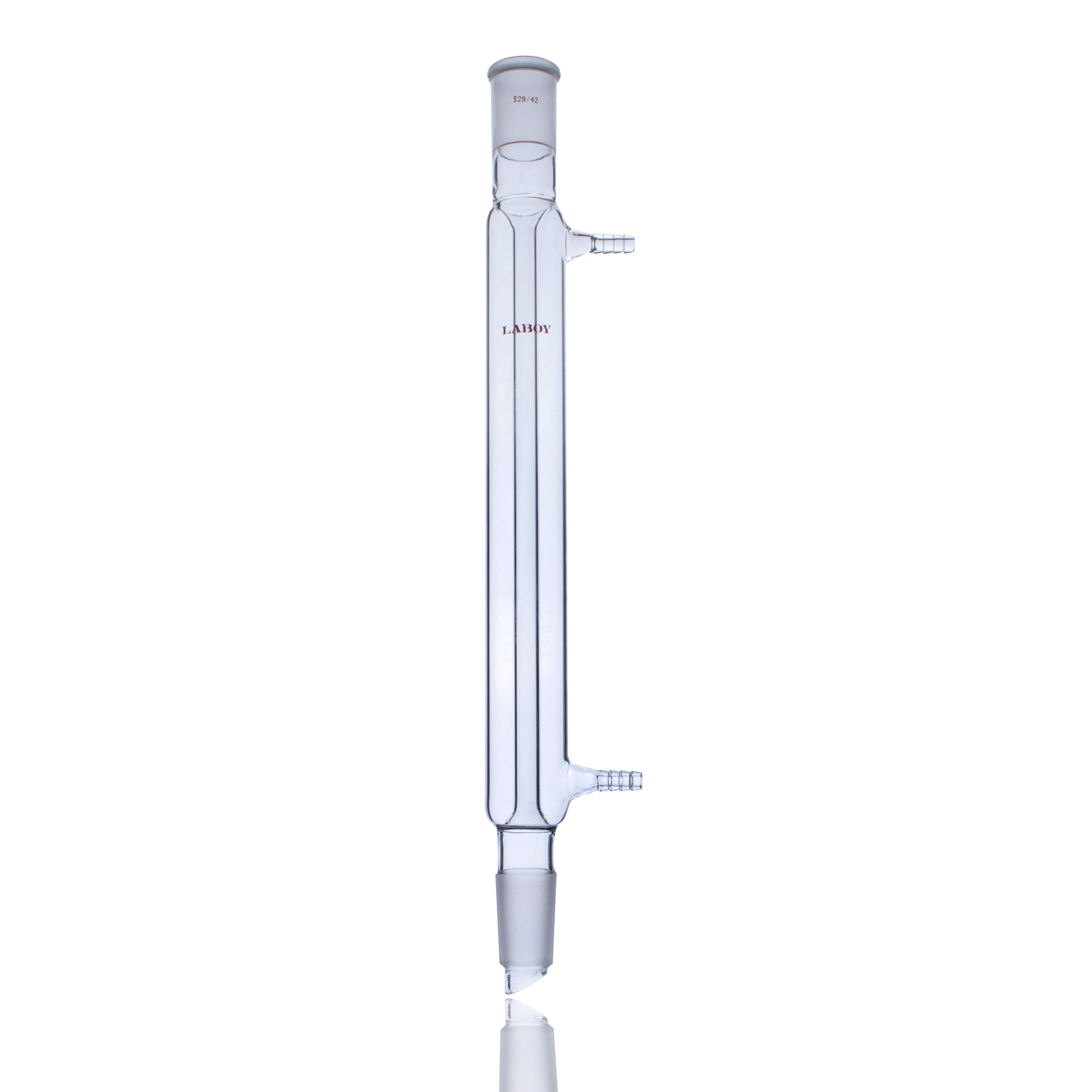
A Liebig condenser is one of the most common water-cooled condensers in the organic lab. It is especially important in routine distillation, can also be used for reflux, and helps beginners understand a basic but central idea: condenser choice depends on what the setup is actually trying to do.
Fast answer
A Liebig condenser is a straight water-jacketed condenser. It is especially common in simple distillation because the vapor path is direct, the assembly logic is easy to read, and the condenser is easy to clean. It can also be used for routine reflux, but once reflux becomes more demanding, a condenser with more surface area may be the better choice.
What a Liebig condenser is
A Liebig condenser is a straight water-jacketed condenser. Vapor travels through the inner tube. Cooling water flows through the outer jacket and removes heat through the glass wall, allowing vapor inside the tube to condense back into liquid.
The basic design explains most of its behavior at the bench:
- It has a straight, open vapor path, which is one reason it is so common in distillation.
- It has less cooling surface area than bulb or coil-style condensers, which is one reason it is not always the strongest reflux choice.
- It is easy to inspect and easy to clean, which matters in teaching labs and routine repeated use.
Bench-first way to think about it: a Liebig condenser is not just “a cold tube.” It is a simple condenser that works best when the job matches its design: a direct vapor path, routine cooling demand, and a setup where simplicity is an advantage rather than a limitation.
Main uses of a Liebig condenser
In organic lab work, a Liebig condenser is mainly used in two roles: as a distillation condenser and as a reflux condenser. These are the two uses that matter most for understanding why this condenser is so common.
1. As a distillation condenser
This is the most classic and usually the most important use. In a simple distillation or fractional distillation setup, the Liebig condenser is normally placed between the distillation head and the receiving side of the apparatus.
Vapor leaves the boiling flask, passes through the head, enters the condenser, and should condense fully before reaching the receiver.
Why it works well here
- a direct and unobstructed vapor path
- clear visual logic for how vapor moves
- reliable delivery of condensed liquid into a receiver
- simple cleaning after the run
The Liebig condenser is often the first condenser students meet in simple distillation, and it remains a very practical choice for routine distillation work.
2. As a reflux condenser
A Liebig condenser can also be used vertically as a reflux condenser. In this arrangement, vapor rises from the heated reaction flask into the condenser, cools, and returns directly to the same flask.
In ordinary heated reactions, a Liebig condenser can work well for reflux. But reflux places different demands on a condenser than distillation does.
Why choice starts to matter more
- the solvent may be more volatile
- the vapor load may be higher
- the reflux may be vigorous and continuous
- you may want more cooling margin over time
A Liebig condenser is not wrong for reflux. It is just not always the strongest reflux choice once the job becomes more demanding.
A Liebig condenser may also appear in other assemblies, including Soxhlet-related setups and steam distillation. Those are real uses, but for most beginners they are secondary. The two uses that matter most for learning apparatus logic are still distillation and reflux.
Why the same condenser can feel strong in distillation but only “good enough” in reflux
This is one of the most useful judgment points for beginners.
In distillation, the condenser is mainly being asked to cool moving vapor and send liquid to a receiver. A straight inner tube works well for that.
In reflux, the condenser is being asked to continuously condense rising vapor and return that liquid back into the same flask. That makes cooling surface area more important, and it also makes return-flow behavior more important.
A straight inner tube can do this, but not always as efficiently as designs that deliberately increase surface area or improve liquid return. That is why students may see Liebig condensers used in basic reflux, but later be taught to prefer Allihn or other higher-surface-area condensers for more demanding reflux jobs.
When a Liebig condenser is a good choice
- Routine simple distillation, where the main job is straightforward condensation and collection.
- Fractional distillation setups, where the condenser sits downstream of the fractionating section.
- Ordinary reflux, when the solvent is not extremely volatile and the reflux is not especially demanding.
- Teaching labs, where a simple, visible, easy-to-clean condenser helps students understand apparatus logic.
- General-purpose use, when you want a versatile condenser that can appear in more than one common setup type.
When a Liebig condenser is not the best choice
A Liebig condenser becomes less attractive when the setup needs more cooling power, more reflux efficiency, or a safer response to high vapor temperature.
- Very vigorous reflux: the available cooling surface may be smaller than you want.
- Low-boiling solvents: you may prefer a condenser with more surface area and more reflux margin.
- High-temperature vapor: once you move into roughly the 140–150°C range or above, water-cooling a Liebig condenser can create enough temperature difference across the glass to raise real thermal-stress concerns.
- Situations needing stronger condensation security: if vapor escape would become a practical problem, a more efficient condenser may be the better choice.
- Deep cooling needs: if ordinary circulating water is not enough, a standard Liebig condenser is not the right answer.
Important safety point: if the vapor temperature is around 140–150°C or higher, do not treat a water-cooled Liebig condenser as the default safe choice. At that point, the temperature difference between the hot inner tube and the cooled outer jacket can place significant thermal stress on the glass, especially near the sealed jacket ends. In that situation, an air condenser is usually the better and safer choice.
Main advantages
- Simple structure: easy to understand and easy to assemble correctly.
- Good versatility: useful in both distillation and routine reflux.
- Easy cleaning and maintenance: the straight inner path is much easier to inspect and wash than more complex designs.
- Clear apparatus logic: very good for teaching how vapor cooling actually works in a setup.
- Reliable routine performance: often more than adequate for standard teaching-lab use.
Main limitations
- Limited cooling surface area: less efficient for demanding reflux than bulb or coil-style condensers.
- Less forgiving return-flow behavior in reflux: condensed liquid can partially interfere with rising vapor in the straight inner tube.
- Thermal-stress concerns at high vapor temperature: a real limitation, not just a performance detail.
- Not ideal for very volatile or especially heavy vapor loads: another condenser style may provide more margin.
Common beginner mistakes
In distillation
- Driving the distillation too hard: if vapor moves too quickly, even a reasonable condenser may not fully condense it.
- Wrong cooling-water direction: water should enter from the lower port and leave from the upper port so the jacket stays full.
- Wrong thermometer position: if the bulb is too high or too low relative to the sidearm, the temperature reading may mislead you.
- Poor support: a condenser should not hang under strain from glass joints alone.
- Wrong slope: the condenser should tilt toward the receiver so condensate drains properly.
In reflux
- Assuming any condenser is equally good for reflux: condenser choice becomes more important as solvent volatility and heating intensity increase.
- Using a Liebig condenser too close to its cooling limit: if vapor is clearly escaping, the problem may be condenser choice, not just water flow.
- Forgetting that reflux is continuous: a setup that looks acceptable at the start may become less comfortable over time if cooling margin is small.
- Treating the condenser like a gas scrubber: solvent condensation and gas handling are not the same design problem.
If something looks wrong during operation, do not jump straight to “this condenser is bad.” First check water flow, heating rate, support, installation angle, and the overall task the condenser is being asked to perform.
Bench-use rules worth remembering
- Water in at the bottom, out at the top. This keeps the jacket filled and improves cooling reliability.
- Support the condenser properly. Do not let the assembly hang under joint strain.
- Start cooling before heating. Do not wait until vapor is already arriving.
- Stop heating before stopping cooling. Let the apparatus settle before shutting off the water.
- Inspect before use. Check for cracks and damaged hose connections.
- Clean promptly after use. Straight condensers are easy to clean, but only if residue is not allowed to harden inside.
How a Liebig condenser compares with other common condensers
| Condenser | Main strength | Typical best use | Main limit |
|---|---|---|---|
| Liebig | Straightforward, easy to clean, very common in distillation | Routine distillation, ordinary reflux | Less surface area for demanding reflux |
| Allihn | More cooling surface from bulb geometry | Reflux | Less simple and direct as a straight vapor path |
| Graham | High cooling area from coil design | Situations needing stronger cooling | More complex flow behavior and less beginner-transparent |
| Air condenser | No water jacket, avoids jacket-related thermal-stress concerns | Higher-boiling systems | Much less cooling power than water-cooled designs |
Practical summary: choose a Liebig condenser when you want a simple, visible, general-purpose condenser, especially for distillation and for moderate reflux. Move away from it when the system demands more reflux efficiency, more cooling margin, or a safer response to high vapor temperature.
Frequently Asked Questions
What is a Liebig condenser mainly used for?
A Liebig condenser is mainly used to condense vapor back into liquid during distillation and reflux. It is especially common in student laboratories because the straight water-jacketed design is simple, easy to read as part of a setup, and suitable for many routine jobs.
Can a Liebig condenser be used for reflux, or is it only for distillation?
It can be used for both. A Liebig condenser works well in many ordinary reflux setups, but it is often most at home in routine distillation. When reflux becomes more demanding, for example with very volatile solvents or heavier vapor loads, a condenser with more cooling surface area may be the better choice.
Why should cooling water enter at the bottom and leave at the top?
Cooling water should enter from the lower port and leave from the upper port so that the water jacket stays completely full. This gives more reliable cooling and helps avoid partially empty cooling space inside the jacket. In practice, only a slow, steady flow is usually needed.
When should I choose a different condenser instead of a Liebig condenser?
A different condenser may be a better choice when the setup needs more cooling efficiency than a straight Liebig condenser comfortably provides. In practice, that often means more demanding reflux, very low-boiling solvents, or situations where a larger cooling surface area gives you a better safety margin. A Liebig condenser remains a very practical choice for routine distillation and moderate reflux.
What should I check if vapor is escaping or not fully condensing?
First check the basics before blaming the condenser itself: make sure water is flowing in the correct direction, make sure the joints are secure, make sure the condenser is properly supported, and make sure you are not heating too hard. In distillation, the condenser should slope downward toward the receiver so condensate can drain properly. In reflux, the condenser should be cooling steadily rather than letting vapor push too high up the tube.